When Perception Becomes Reality: Is the AP Poll Giving the SEC a Benefit of the Doubt?
Sunday Commentary | October 11, 2026 • Revised October 13, 2026
By Coach Griff | Hoosier Football Tailgate
A Ranking Is an Opinion, Not a Fact
There is a problem with the way we discuss college football rankings, and it goes well beyond whether Indiana should be fourth or fifth in the country. The problem is the power of perception. Once a program is placed near the top of a poll, its ranking becomes part of the evidence used to judge everybody else. Beat that team, and suddenly you have a marquee victory. Lose to that team, and the defeat is explained away as understandable because of the opponent’s reputation. But what happens when that supposedly elite opponent spends the next two or three weeks proving it might not have been quite as good as everyone assumed?
That is the question I keep coming back to as I examine the latest Associated Press Top 25. The SEC has outstanding programs and some of the best coaches and players in college football. Nobody needs to dispute that to question whether the conference is being evaluated with the same scrutiny applied to the Big Ten. What bothers me is the tendency to treat the SEC’s reputation as a starting assumption and then interpret each week’s results in a way that preserves it.
I am not arguing that every AP voter is deliberately working against the Big Ten. That would be an accusation the available evidence does not establish. I am arguing that the poll can produce a self- reinforcing narrative: teams begin highly ranked, victories over those teams produce enormous rewards, and the value of those victories can linger even after subsequent results raise serious questions about the original evaluation. Meanwhile, a capable Big Ten team without a number beside its name can be treated as an ordinary opponent, no matter what the underlying football data says.
The Preseason Advantage: When an Early Ranking Becomes a Permanent Credential
Before we even reach the SEC results, consider where the problem starts: the preseason poll. Teams with established brands, favorable expectations and recent success can begin the year with a substantial ranking advantage before anyone has played a down. There are reasonable reasons for those expectations, including returning personnel and coaching continuity. But expectations are not accomplishments, and a preseason number should never become a permanent credential.
Once a team begins highly ranked, it often takes multiple losses to dislodge the perception that it belongs among the elite. Meanwhile, an undefeated program that began outside the Top 25 can struggle to break through. That is poll inertia, and it has consequences beyond one week’s order. A team that defeats an early Top-10 opponent may receive a significant ranking boost even if that opponent later loses again and reveals weaknesses that were not apparent in August.
We should give teams credit for the opponent they actually defeated, not indefinitely for the opponent everyone imagined that team would become. An upset remains an accomplishment. But a win over a team that was ranked fourth at kickoff is not necessarily equivalent to defeating the fourth-best team in the country. As the season develops, we learn more about the quality of both teams, and the evaluation should develop with it.
That is the standard I want applied across every conference. If a team starts the year unranked and produces strong performances, those results should count. If another begins in the Top 10 and keeps losing, voters should be willing to reconsider not only its current ranking but also how much credit other teams are receiving for beating it.
The SEC Ranking Elevator: Who Was Actually That Good?
Look at the sequence of results involving Ole Miss, LSU and Florida. Ole Miss defeated a highly ranked LSU team 32-24 and earned significant recognition. Florida then defeated a highly ranked Ole Miss team 52-28, producing another dramatic change in the national conversation. But Florida subsequently lost 45-17 to Missouri and 38-19 to South Carolina. LSU later lost to Kentucky, 35-34 in overtime, and dropped twelve places in the October 11 AP Poll, from No. 10 to No. 22.
Every one of those results counts. Ole Miss deserves credit for beating LSU. Florida deserves credit for beating Ole Miss. Kentucky deserves credit for beating LSU. The issue is not whether the games happened; it is whether the original rankings were accurate enough to justify the enormous conclusions drawn from them. If Team A earns a major boost for beating Team B, and Team B soon looks considerably less formidable than its ranking suggested, shouldn’t we revisit how impressive that first victory actually was?
The same question applies to the winner. If a team makes a massive jump because it defeats a highly ranked opponent, only to lay an egg against an opponent it was expected to beat, what did we really learn from that one headline victory? Perhaps the winning team played an outstanding game. Perhaps the supposedly elite team was overrated. Perhaps both things are true. What we cannot do is freeze the value of the victory at the moment the final whistle blew and refuse to incorporate the evidence that follows.
Kentucky is another useful example. The Wildcats entered the AP Top 25 at No. 15 after defeating LSU, while LSU fell twelve spots. Kentucky also climbed from No. 25 to No. 17 in the Coaches Poll, an eight- place rise. Kentucky also has a win over a Texas A&M team that later lost 27-6 to Missouri. Those are legitimate results, but they raise a larger question about the strength of the teams being beaten and the rankings they carried at the time. If those earlier rankings were inflated, then a victory over them may not be quite the credential the national discussion made it out to be.
This is not an argument that the SEC is weak. It is an argument that conference depth cannot be established by circular logic. You cannot simply point to a collection of highly ranked SEC teams, celebrate every conference victory as proof of extraordinary strength, and then ignore the possibility that some of the original rankings were too generous. The more those teams play, the more evidence we get. Evaluations should change accordingly. This is a criticism of the ranking process, not an allegation that individual voters or broadcasters are coordinating outcomes. The question is whether the published rankings hold up when we compare them with the results.
A fair evaluation must also recognize counterexamples. Texas dropped six places in the October 11 AP Poll after its loss to Oklahoma, and Florida fell out of the Top 25 following its loss to South Carolina. Those moves show that SEC teams are not uniformly insulated from consequences. The criticism here is about the consistency of the framework, not a claim that every SEC team is protected.
Texas Beat Ohio State. So How Much Does Head-to-Head Really Matter?
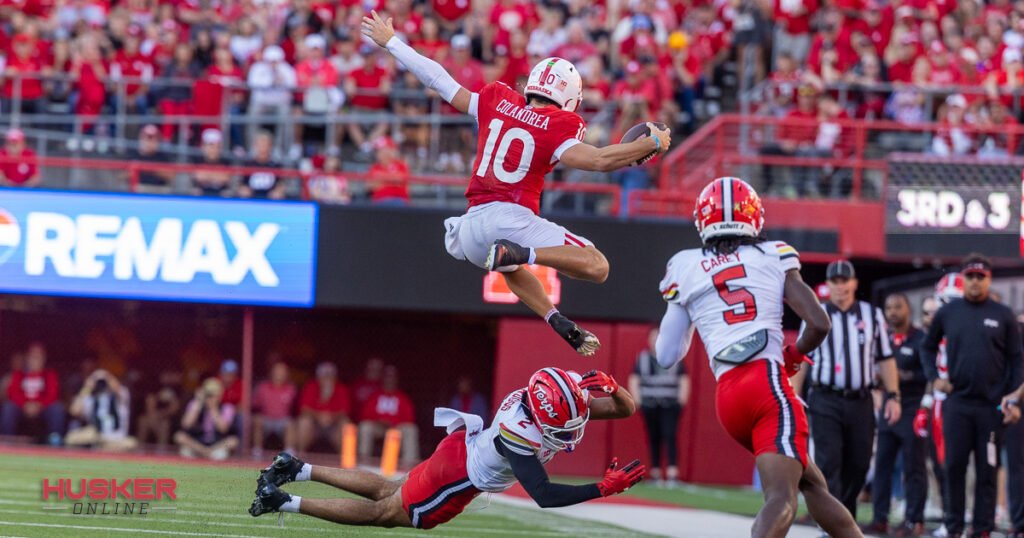
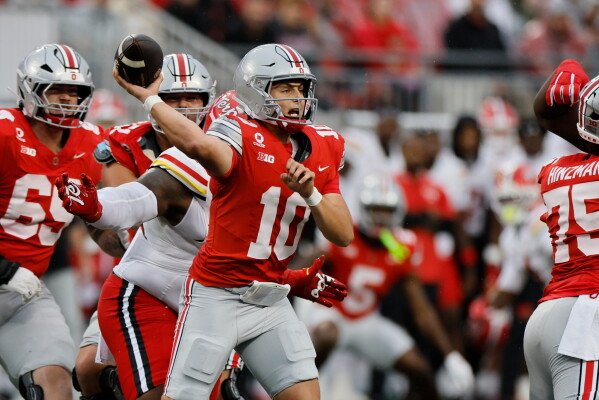
Now consider a completely different example that exposes another inconsistency in the way we talk about schedules and rankings. Texas defeated Ohio State 24-23 earlier this season. That was exactly the kind of nonconference game college football fans and commentators claim every Power Four program should schedule: two major brands, an excellent opponent and a result settled on the field. Texas won. It deserved credit for winning.
Then Texas lost 27-24 to rival Oklahoma on Saturday. That was a damaging loss, and there is no reason to pretend otherwise. Texas fell six places to No. 7 in the AP Poll. Ohio State, whose lone loss came against Texas, moved to No. 4. The October 11 AP snapshot shows Ohio State at 5-1 and Texas at 4-1, so their overall records are not identical, although both have one loss. That difference in games played belongs in the comparison. So does the head-to-head result.
Ohio State has a compelling case based on its broader body of work. I thought the Buckeyes were punished too severely when they fell from No. 1 to No. 6 following a one-point road loss at Texas. Ohio State also earned a meaningful road win against Iowa, and the advanced metrics continue to rate the Buckeyes among the very best teams in the country. I have no trouble saying Ohio State may be the stronger team today.
But Texas beat Ohio State. We cannot simply pretend that did not happen. When two programs are being compared, head-to-head competition should carry significant weight, particularly when their records and résumés are reasonably close. It is not an automatic rule for AP voters, and a full-season evaluation involves more than one game. Still, if we are going to celebrate a marquee September matchup as an essential test of quality, why does its outcome seem so easy to discount when the October rankings become inconvenient?
There is a difference between believing Ohio State would beat Texas if they played again and deciding which team deserves to be ranked higher based on games already played. One is a projection. The other is a résumé judgment. Too often, the national discussion slides between those two standards without acknowledging the change.
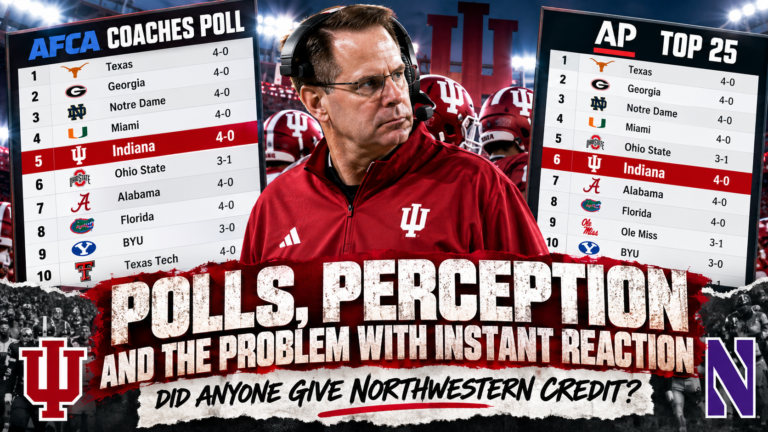
The two major polls also disagree on Indiana and Ohio State entering their October 17 meeting. The October 11 AP Poll places Ohio State fourth and Indiana fifth, while the US LBM Coaches Poll places Indiana fourth and Ohio State fifth. Indiana received one AP first-place vote and nine Coaches Poll first- place votes. That disagreement is not proof of bias, but it illustrates how the same results can produce different judgments—and why voters should explain the criteria they apply.
The Power Four Nonconference Argument Has Become a Weekly Crutch
That brings me to the criticism Indiana hears almost every week: the Hoosiers did not schedule a Power Four opponent outside the Big Ten. I understand why people want those games. They are great for college football, and they give us an early look at teams against high-level competition. I would like to see more of them, too.
But what exactly are we asking schools to accomplish? If Texas schedules Ohio State and wins, then the victory ought to remain meaningful when the full season is evaluated. If it can be substantially outweighed by later results, that is a reasonable conclusion—but then let’s stop pretending one marquee nonconference game is the definitive measure of a program’s worth. Conference play and the complete body of work will ultimately tell us far more. Nonconference results should not become meaningless in November or December; they should remain part of that complete body of work. But the significance of one September game should be evaluated consistently, rather than elevated when convenient and dismissed when inconvenient.
Indiana plays nine Big Ten conference games. Its nonconference schedule can be criticized without making that criticism the only lens through which every subsequent victory is viewed. The same standards should apply to Notre Dame, SEC programs and every other contender. If the argument is that quality of competition matters, then we need to evaluate the actual quality of the competition—not merely the conference label or a poll number attached to an opponent on game day.
Notre Dame, currently No. 2 in the AP Poll, presents an instructive contrast. Questions about the Irish schedule are fair, just as questions about Indiana’s schedule are fair. But the advanced ratings are extraordinarily favorable to Notre Dame, placing the Irish first in FPI and first in ESPN overall efficiency, and third in SP+. That is evidence we should acknowledge even while examining their opponents. We cannot demand data-driven evaluation for Indiana and then disregard it when the data supports somebody else.
Nebraska Is Unranked. The Numbers Say Something Else.
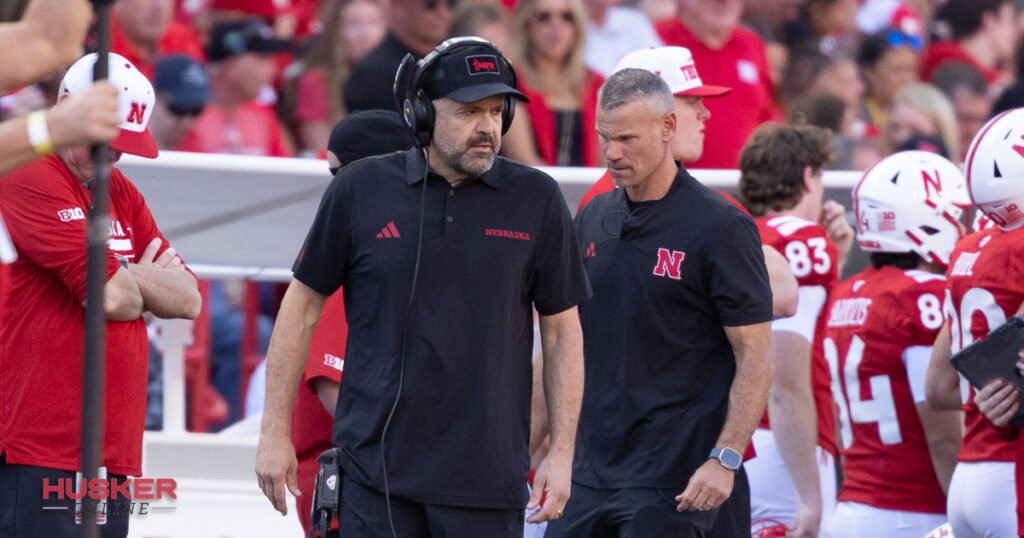
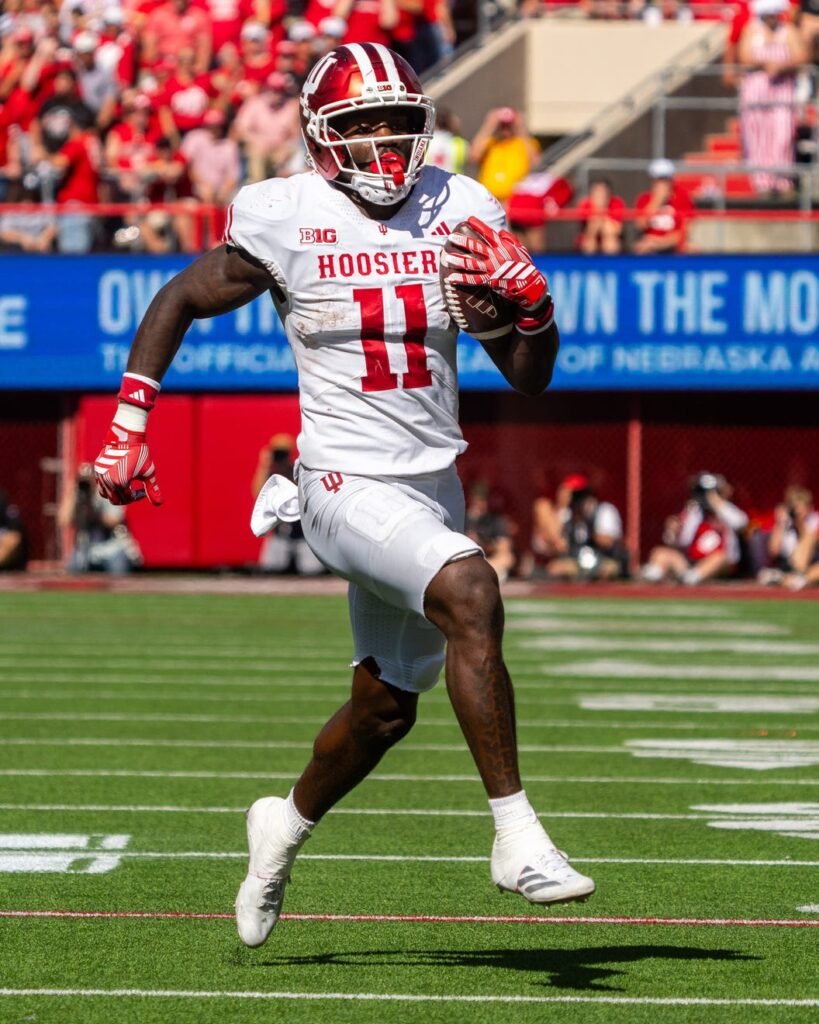
Here is where the discussion becomes particularly revealing. Indiana defeated Nebraska 20-17 on the road Saturday. The Cornhuskers entered the game undefeated, played well and lost a competitive game to the defending national champions. They remain outside the AP Top 25, receiving 65 votes in the latest poll.
Yet the October 11 ESPN Football Power Index snapshot ranks Nebraska 12th nationally. ESPN’s overall team efficiency rankings place the Cornhuskers 16th, and SP+ ranks them 14th. Those are not rankings invented by Indiana supporters. They are systematic evaluations of team performance and strength. None is infallible, and they measure somewhat different things, but all three see Nebraska as a top-16 team.
Now look at Iowa. The Hawkeyes are No. 17 in the AP Poll, which makes Ohio State’s victory over them a ranked win. But Iowa is No. 23 in FPI and No. 24 in SP+, although it stands No. 15 in overall efficiency. Nebraska ranks higher than Iowa in FPI and SP+. So why does Ohio State’s win over Iowa arrive with the automatic prestige of a ranked opponent, while Indiana’s win over Nebraska is so easily dismissed as beating another unranked team?
Iowa may have a stronger résumé in the eyes of AP voters. That is a defensible position. The issue is that the number beside Iowa’s name should not end the conversation, just as the absence of a number beside Nebraska’s name should not end the conversation. If we are truly concerned about strength of schedule, the quality of the football team must matter more than the convenience of a poll label.
Northwestern provides another example. Its competitive performance this season is relevant context. The Wildcats are No. 25 in the AP Poll, but No. 20 in FPI, No. 11 in ESPN overall efficiency and No. 17 in SP+. Indiana’s close victory over Northwestern drew plenty of criticism. The underlying numbers suggest the Wildcats may have been a substantially better opponent than the public narrative acknowledged at the time. I am not using these numbers to claim Indiana played perfectly against Nebraska or Northwestern. This is not a recap of either game. It is a challenge to the way we evaluate the opponents themselves. When a Big Ten team is unranked, that label can become a shortcut for dismissing a quality win. When an SEC team carries a lofty ranking, that label can become a shortcut for celebrating a quality win. Both shortcuts are dangerous.
What the Advanced Metrics Support—and What They Don’t
We need to be precise about the evidence. FPI and SP+ are predictive, opponent-adjusted team-strength systems. ESPN’s overall efficiency rankings are a separate performance-based measure. They are not interchangeable, and they are not official replacements for the AP Poll or the College Football Playoff committee’s résumé evaluation. They can also change as the season produces more data. In fact, they should change as new information becomes available.
The models support several of the concerns I have raised. Nebraska is rated far better than its AP standing. Northwestern’s performance profile is stronger than its No. 25 ranking. Kentucky is No. 15 in the AP Poll but only No. 30 in FPI and No. 21 in overall efficiency. Those are meaningful discrepancies worth questioning.
But the numbers do not tell a one-sided story. LSU is only No. 22 in the AP Poll yet stands No. 8 in FPI and No. 9 in both overall efficiency and SP+. Ohio State is No. 1 in SP+ and No. 3 in FPI. Notre Dame is No. 1 in FPI and overall efficiency. Those evaluations suggest some SEC and nationally prominent programs are stronger than their win-loss records or conventional rankings alone might indicate. If we are going to respect the data, we have to respect all of it.
The real lesson is that predictive strength and résumé accomplishment are different questions. One asks how strong a team is likely to be against future opponents; the other asks what it has earned through results. A responsible national discussion should distinguish those questions instead of selecting whichever one supports a preferred conclusion that week.
Strength of Schedule Is Not a Free Pass for Losses
There is a related debate that will become even more important when the College Football Playoff committee begins comparing teams from different conferences. SEC advocates have argued that a team with two losses against a demanding schedule may deserve consideration over a one-loss contender elsewhere—and that even a three-loss SEC team can have a stronger case than a two-loss team from another Power Four conference. The possibility is real. But the conference label cannot settle the question. The actual opponents, performances, wins and losses must.
We have seen the argument before. In 2024, Ole Miss finished 9-3 and missed the playoff despite an impressive victory over Georgia. Its losses to Kentucky, LSU and Florida mattered, particularly the defeat to a Kentucky team that finished 4-8. The Rebels had a legitimate strength-of-schedule argument, but a quality win cannot erase damaging losses. In 2025, Texas also finished 9-3 and missed the playoff. The Longhorns could point to a difficult schedule and high-level wins, but their defeat against Florida complicated the case. Neither example proves a three-loss SEC team should never qualify. Both show why schedule difficulty must be weighed alongside what happened on the field.
Consider the October 2026 data as another illustration of how different measurements answer different questions. In the strength-of-schedule comparison reviewed this week, Ohio State stands No. 29 nationally and Indiana No. 52. That supports the conclusion that Ohio State has faced the tougher schedule so far. But a separate ESPN Strength of Record snapshot lists Indiana No. 2 and Ohio State No. 15. The latter measure asks how difficult it would be for an average Top 25 team to match or exceed a team’s actual record against its schedule. These are distinct measures, and the snapshots should not be mistaken for identical-time updates. Indiana can have the stronger record relative to its competition even while Ohio State has faced the tougher schedule.
For predicting how teams might perform, I put substantial value on opponent-adjusted systems such as FPI and SP+. The October 11–12 snapshots place Ohio State third in FPI and first in SP+, with Indiana seventh and fifth, respectively. Those models favor the Buckeyes as a predictive team-strength assessment. That is information worth respecting, just as Indiana’s undefeated record and résumé-based measurements deserve respect. Predicting which team is stronger and selecting which team has earned a playoff berth are related, but they are not identical, exercises.
One caution is essential: the SEC’s concentration near the top of an SOS table does not by itself establish bias. Some SEC schedules may genuinely be more difficult. The question is whether opponent ratings, interconference results and actual game performance support the difference—and whether the same standard is applied to every conference. Otherwise, high preseason expectations can become a self-reinforcing credential: ranked opponents create strong schedules, and strong schedules are then used to excuse losses to those ranked opponents.
My standard is simple. Reward ambitious scheduling. Recognize the difficulty of playing quality opponents. But do not treat SOS as the king of all metrics or as a substitute for winning games. Evaluate strength of record, FPI, SP+, head-to-head results, quality wins, damaging losses and the complete body of work before deciding who belongs in the playoff.
The Big Ten Deserves the Same Scrutiny and the Same Credit
The Big Ten has produced three consecutive national champions from three different programs—Michigan (2023), Ohio State (2024) and Indiana (2025). That should matter when people speak as though conference superiority has already been settled before the games are played. Yet the conversation too often begins with the familiar assumption that the SEC is the deepest league, and results are then interpreted through that assumption. A ranked SEC team defeats another ranked SEC team and the victory becomes proof of conference strength. A Big Ten contender survives a difficult road game against an unranked but statistically strong opponent, and the conversation returns to its schedule.
That pattern is why I want more evidence-based pushback from everyone who covers college football. Not cheerleading. Not an argument that the Big Ten deserves preferential treatment. Actual scrutiny. Show the opponent-adjusted numbers. Examine what happens to highly ranked teams in the weeks after they lose. Reevaluate the quality of earlier wins. Ask why one result produces a dramatic poll jump while another produces little recognition.
Most people do not have the time to watch every game, study the film and compare statistical models. They want the end result: who is No. 1, who is No. 5 and who belongs in the playoff. I understand that. But when the same conclusion gets repeated often enough, perception starts to look like reality. The poll becomes the evidence for the poll. And anybody who challenges it is treated as though they are arguing against an established fact.
A ranking is not a fact. It is an evaluation. And an evaluation should always be open to new evidence.
A Better Starting Point: Wait Until Week 5 to Release the First AP Poll
After laying out these concerns, I do not believe it is enough to criticize the system and walk away. If we believe the process can be improved, then we ought to offer a practical solution. Mine is straightforward: eliminate the preseason AP Top 25 and wait until Week 5 to publish the first official rankings.
Why do we insist on ranking teams before a single snap has been played? We know the names on the jerseys. We know the recruiting evaluations, the transfer portal additions, the returning starters and the coaches. Those are useful ingredients for a preseason *projection*. They are not evidence of what a team has accomplished in the current season. Yet a projection made in August becomes the foundation for every ranked win, every upset headline and every argument about conference superiority that follows.
Give college football four weeks to show us something real. By then, we would have multiple games of offensive and defensive production, some meaningful nonconference matchups, early upsets and at least some conference games across the country. We would have a better opportunity to distinguish a program living on its reputation from one performing at a genuinely high level. Not every team would have played the same schedule, and not every conference would have completed the same number of league games. But we would have actual evidence rather than simply a set of expectations.
Consider what that change could do to the ranking elevator. A program would not receive an automatic Top-10 scalp in September merely because its opponent was awarded a lofty number in August. Voters would have to ask what the opponent has demonstrated on the field. They would also have to assess an unbeaten team that started outside the traditional group of national brands without treating its lack of a preseason ranking as a reason to hold it back.
I understand the objections. Television loves a ranked-versus-ranked matchup, fans enjoy preseason debate, and the AP Poll has a long tradition. Networks and writers could still offer preseason predictions, watch lists and power ratings. I am not proposing an end to conversation. I am proposing a distinction between speculation and an official weekly ranking that carries enormous weight in the public perception of a season.
Waiting until Week 5 would not eliminate subjectivity, solve every strength-of-schedule dispute or turn the AP Poll into a postseason selection formula. Four games are still a small sample, and voters would still have difficult choices. But it would reduce the head start created by preseason rankings and give the first poll a more defensible foundation.
I have served on an NCAA Division III national playoff selection committee. That experience reinforced something basic: when you evaluate teams for postseason recognition, you must look at the body of work in front of you, examine the competition and be willing to update your judgment as the evidence changes. Different NCAA divisions have different selection procedures, but the underlying discipline of evaluating actual results matters everywhere.
The AP Poll should tell us what teams have earned, not what voters expected them to become. Coach Griff’s Final Word I am not asking anyone to rank Indiana No. 1. I am not arguing that the SEC is somehow a second-rate conference, and I am not suggesting Ohio State should be dismissed because Texas beat the Buckeyes. Ohio State is an outstanding football team. So are Georgia, Notre Dame and several SEC contenders. The advanced numbers support that conclusion.
What I am asking is that we stop confusing reputation with proof. If a team receives an enormous ranking boost because it defeated a supposedly elite opponent, then we must be willing to revisit that judgment when the opponent’s subsequent results cast doubt on the original ranking. If head-to-head competition is important enough to demand marquee September games, then those results should remain part of the conversation in October and November. And if we are going to criticize Indiana’s schedule, we should be willing to recognize that Nebraska and Northwestern may be much stronger than their AP positions suggest.
The SEC deserves respect. The Big Ten deserves the same standard of evaluation. But rather than simply argue about who deserves the benefit of the doubt, let’s improve the starting point. Stop issuing an official Top 25 before anyone has played a game. Wait until Week 5. Evaluate four weeks of actual results, the quality of the competition and the performance on the field. Then keep adjusting the rankings as the evidence develops.
That will not end debate. College football would be a duller place without it. But it could make the debate more credible, and it would force all of us to distinguish what we *thought* a team would be from what it has actually shown us.
The goal should not be to protect the narrative. The goal should be to get the evaluation right.
Fast. Physical. Relentless.
About Coach Griff
Coach Griff (Shannon Griffith) spent 28 years coaching college football, including serving as head football coach at Manchester University and quarterbacks coach at Ball State University. He also served on an NCAA Division III football national playoff selection committee, participating in the evaluation of teams for postseason consideration. That experience informs his perspective on strength of schedule, head-to-head results, regional and national rankings, and the importance of evaluating an opponent’s full body of work. NCAA Division II, Division III and FCS football selection processes share several broad evaluation principles, although their specific criteria and procedures differ.
Sources and Verification Notes
Game results and poll positions reflect the October 10–11, 2026 reporting window. Historical FPI, ESPN efficiency and SP+ values remain exactly as provided in Coach Griff’s October 11 master draft and have not been independently verified against archived model snapshots.
Associated Press Top 25 — October 11, 2026