Indiana Is Paying Like a Contender — Now Comes the Hard Part
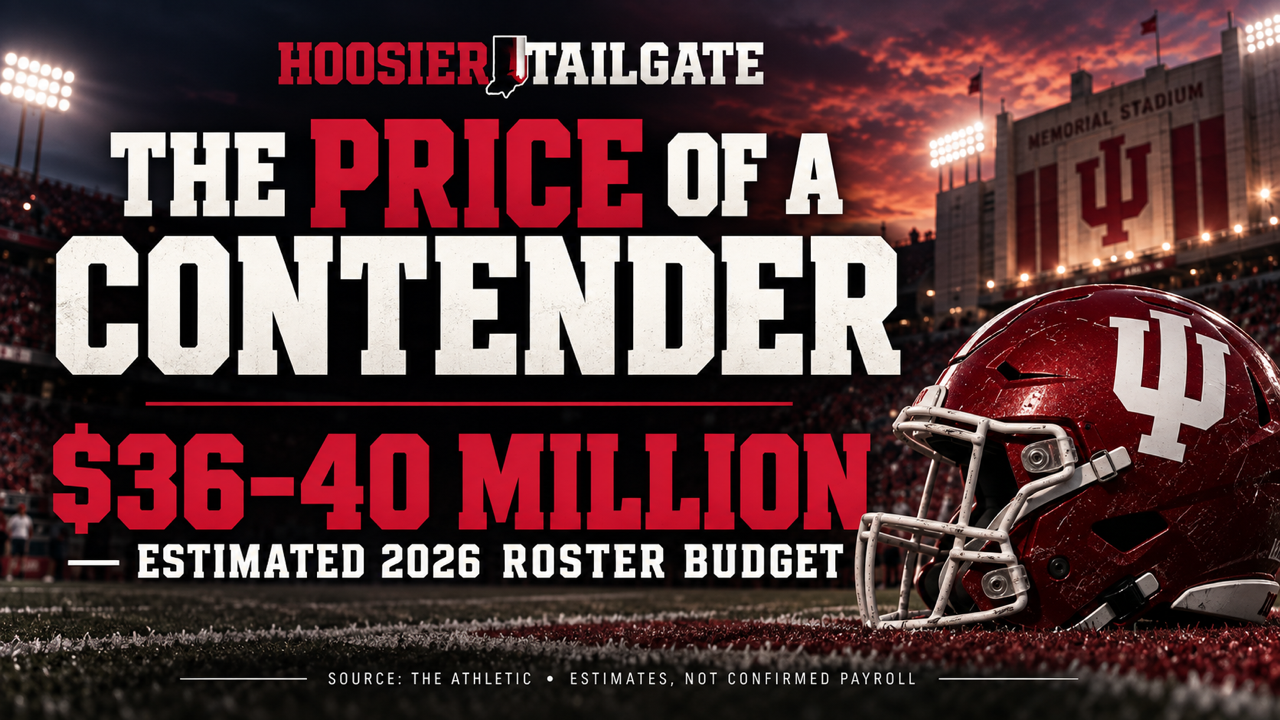
Analysis by Shannon Griffith / Coach Griff. Roster-budget figures below are estimates, not confirmed university payroll or audited player-compensation totals.
For decades, there were certain realities surrounding Indiana football that were difficult to escape.
The Hoosiers could find good players. They could develop players. They could occasionally put together a special season.
But when it came to the resources necessary to consistently compete with college football’s biggest programs, Indiana was usually playing a different game.
That isn’t the case anymore.
The Athletic released an extensive look this week at estimated football roster budgets across the Power Four, attempting to quantify one of the most closely guarded numbers in modern college football: how much programs are actually spending to assemble their rosters.
The number attached to Indiana should get everyone’s attention.
The Athletic estimates Indiana’s 2026 football roster budget at between $36 million and $40 million. RealGM’s September 16 summary of The Athletic’s reporting lists the same estimated range. Source
That number requires an important qualifier. These are estimates, not an Indiana University payroll report. Schools do not publicly disclose complete player-by-player compensation, and third-party NIL arrangements make precise accounting particularly difficult.
But even as an estimate, the range tells us something important.
Indiana football has entered a different financial neighborhood.
This Is Not the Indiana Football Model of the Past
The transformation didn’t happen overnight.
Indiana’s football operating budget had already grown substantially before the current player-compensation system fully developed. Reporting based on the Knight-Newhouse database showed Indiana’s football budget rising from approximately $24 million in 2021 to more than $61 million in 2024. Source
Facilities improved.
Coaching investment increased.
Support staff expanded.
And then college football itself changed.
The transfer portal turned roster management into something resembling year-round free agency. NIL created an open market for player value. The House settlement subsequently introduced direct revenue sharing between athletic departments and athletes.
The old question was whether Indiana could identify enough overlooked players to compete against programs with deeper rosters.
The new question is different:
What happens when Indiana combines talent evaluation and development with significant financial resources?
We got a pretty convincing answer in 2025.
Indiana won the national championship.
Money Matters — But Indiana Already Proved It Isn’t Everything
This is where the discussion becomes more interesting than simply ranking payrolls.
Money unquestionably matters in modern college football.
Quarterbacks cost money.
Starting offensive tackles cost money.
Edge rushers cost money.
Corners cost money.
And retaining an established player can be every bit as expensive as acquiring one through the portal.
But the 2025 Indiana season also demonstrated the limitations of treating roster spending as a standings prediction.
Indiana won the national championship without spending at the level sometimes assumed. On3 reported that the 2025 championship roster cost just under an estimated $20 million; that is a different season from the 2026 budget estimate discussed here. Source
That’s an important distinction.
Curt Cignetti’s program didn’t initially reach the top simply by outspending everybody.
Indiana identified players who fit its system, developed them, created competition and put them in positions where their value increased.
Now Indiana has something potentially more powerful.
The infrastructure that produced the championship is being paired with considerably greater purchasing power.
Indiana’s Greatest Advantage May Be Knowing What It Wants to Buy
Every coach has heard some version of the same lesson:
Having money doesn’t make you smart.
It simply allows you to make more expensive mistakes.
College football is beginning to learn that lesson.
As a hypothetical example, a $5 million player who doesn’t fit the scheme, culture or locker room can hurt a program more than a $500,000 player who becomes a dependable starter.
That’s why Indiana’s rise shouldn’t be viewed simply through the size of the checkbook.
Cignetti and his staff have shown an ability to define exactly what they want from individual positions.
They aren’t merely acquiring résumés.
They’re building a roster.
There is a major difference.
The transfer portal has created an environment in which programs can chase recognizable names. Indiana’s approach under Cignetti has generally been more specific: identify a need, establish the traits required to fill it, find the player and then develop him within the system.
More financial resources expand the pool of players Indiana can pursue.
They don’t eliminate the need to evaluate them correctly.
The Big Ten Has Become an Expensive Neighborhood
The Athletic’s estimates also provide important conference context.
Public discussion of its data puts the average Big Ten football roster budget in roughly the $27–31 million range. The comparable estimate circulating from the same reporting for the SEC is approximately $33–38 million. Because these are derived from estimated ranges rather than audited school payrolls, they should be treated as directional rather than exact accounting. Big Ten estimate discussion; SEC estimate discussion.
Indiana’s estimated $36–40 million therefore isn’t merely evidence that the Hoosiers are spending more.
It suggests Indiana is operating above the estimated Big Ten average and within the financial territory associated with some of college football’s most heavily resourced rosters. Source
That is a dramatically different position from the one Indiana occupied historically.
The Hoosiers are no longer trying to figure out how to compete while bringing fewer resources to the fight.
They have resources.
Now the challenge is using them better than everyone else.
There Are Really Two Player-Payment Markets
One reason these numbers can become confusing is that “NIL” is increasingly used as a catch-all term.
It shouldn’t be.
Modern college athletics effectively has multiple compensation channels.
Schools can directly share revenue with athletes under the House-settlement framework. Separately, athletes can enter legitimate third-party NIL agreements. Those arrangements do not necessarily appear together on any publicly available university balance sheet.
That makes claims about exact “payrolls” inherently difficult.
It also explains why two credible estimates can produce different numbers for the same program.
What matters more for evaluating Indiana is the scale.
Whether the precise number ultimately lands at $36 million, $38 million or $40 million is less important than the larger conclusion:
Indiana has committed substantial resources to remaining nationally competitive.
Winning Creates Another Challenge: Retention
Building a championship roster is difficult.
Keeping one together can be even harder.
When Indiana develops a player into an All-Big Ten or All-American-caliber performer, the rest of college football notices.
That player’s market value changes.
A successful developmental program therefore creates its own financial pressure.
Indiana isn’t merely competing to acquire players from other programs.
It must continually re-recruit its own roster.
That may ultimately be where increased financial resources matter most.
There is value in landing the high-profile transfer.
There may be even greater value in preventing a proven starter who already understands your system from entering the market.
Retention has become recruiting.
Indiana Has Removed One of Its Oldest Excuses
For years, conversations about Indiana football eventually arrived at the same explanation.
Resources.
Facilities.
Coaching salaries.
Recruiting infrastructure.
Commitment.
Those conversations are becoming increasingly difficult to have.
Indiana has invested.
The university has upgraded its football infrastructure. It has committed to its coaching staff. And the latest roster-spending estimates indicate the Hoosiers are now willing to compete financially for players as well.
That doesn’t guarantee championships.
Nothing does.
Ohio State, Alabama, Georgia, Texas, Oregon and the rest of college football’s financial powers aren’t going anywhere.
But Indiana has already demonstrated that it can evaluate and develop a championship roster.
Now the program appears to have considerably more financial firepower behind that process.
And that may be the most important takeaway from these numbers.
For the first time in modern Indiana football history, the question is no longer:
Can Indiana afford to compete with college football’s biggest programs?
The more interesting question is:
What happens if Indiana continues evaluating players better while spending like one of them?