Indiana 55–0, But What Did We Really Learn About the Hoosiers?
Indiana did exactly what a championship-caliber football team is supposed to do against an overmatched opponent Saturday.
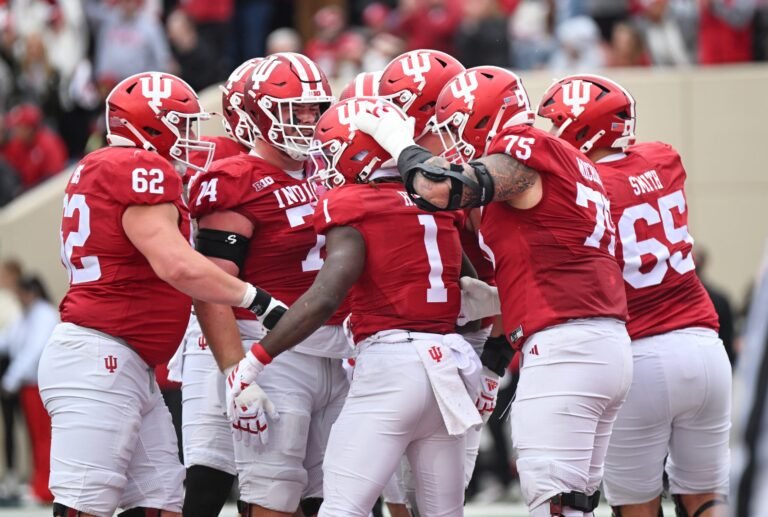
The Hoosiers beat Howard 55–0.
They controlled the line of scrimmage. They ran the football. They played clean. They created pressure defensively. They built a big lead and gave younger players opportunities to play.
But here is the question that matters: What did we actually learn about Indiana?
When the talent disparity is significant, the evaluation has to go deeper than the scoreboard. You look at alignment, assignment, technique, communication and finish. In coaching terms, we’re looking for one thing: What travels?
Indiana Controlled the Line of Scrimmage
This is where my evaluation begins. Indiana finished with 296 rushing yards, while Howard managed only 13 yards on the ground. Defensively, Indiana’s front consistently created penetration and disrupted Howard’s blocking schemes before they could develop.
When a defensive lineman resets the line of scrimmage, the running back has to alter his track. Pullers can’t get where they’re supposed to go. Combination blocks get disrupted. Linebackers remain clean. Howard finished with only 57 total yards. Regardless of the opponent, that is an impressive defensive performance — and Indiana’s ability to control the line of scrimmage is something that can travel.
Josh Hoover’s Numbers Were Good — But Watch the Feet
This is where statistical evaluation and film evaluation can tell you two different things. Josh Hoover operated the offense efficiently and Indiana consistently generated scoring opportunities. But there were throws — particularly down the field — where Hoover could have done a better job of getting his lower body into the throw.
The first touchdown to Charlie Becker is a good example. The result was excellent: touchdown Indiana. But watch the process rather than the result. Hoover doesn’t completely step through the throw, and the football ends up underthrown. Becker makes the play and Indiana scores, so nobody complains. Against better competition, that same ball can become a contested catch, a breakup or potentially an interception.
That’s why quarterbacks aren’t graded simply on whether a pass was completed. You grade: Base → Weight Transfer → Front Foot → Hip Rotation → Finish. Good results don’t always mean perfect execution.
The Run Game Looked Like Indiana Football
One of Indiana’s goals entering the game was to establish the run. Mission accomplished. The Hoosiers’ 296 rushing yards were important, but the number itself wasn’t what caught my attention. The offensive line created movement. Multiple backs contributed. Indiana stayed physical instead of allowing the game to turn into nothing more than a passing exhibition once the talent advantage became obvious.
There will be Saturdays later this season when the weather changes, the passing game isn’t clicking or Indiana needs four yards to finish a football game. A physical running game travels.
Indiana Played Clean Football
Against an opponent like Howard, one of the easiest things for a heavily favored team to do is become sloppy. Indiana largely avoided that. The Hoosiers were penalized only twice for 15 yards. Games like Howard test discipline differently than games against ranked opponents. The opponent shouldn’t determine your standard. You determine the standard.
The Defensive Details Were Better
After the season opener against North Texas, there were things defensively that Indiana needed to clean up. Howard presented a different challenge, so Saturday did not answer every defensive question. But Indiana looked more assignment-sound. The run fits were cleaner. The defensive front was disruptive. Howard struggled to generate anything consistently, and the Hoosiers repeatedly put the Bison behind the chains.
The Five Goals Report Card
We established five goals for Indiana entering the Howard game: Dominate the Line of Scrimmage. Fix the Defensive Details. Establish the Run. Play Clean Football. Build Depth.
Indiana checked all five boxes. The first four were evident in the numbers and on the field. The fifth may pay dividends later. Games like Howard are opportunities to develop your roster and give younger players meaningful snaps inside the actual offense and defense.
Now Comes the Important Question: What Travels?
Indiana was supposed to beat Howard. It did. Indiana was supposed to control the line of scrimmage. It did. Indiana was supposed to play cleaner football and continue developing its roster. It did.
But the standard for this program is no longer beating an overmatched nonconference opponent. Indiana is the reigning national champion. The question is whether the habits we’re seeing now are good enough to win the games that will determine another Big Ten championship and another College Football Playoff run.
Defensive-line penetration travels. Running the football travels. Playing disciplined football travels. Depth travels.
And the small technical issues — including quarterback footwork and downfield ball placement — become increasingly important as the level of competition rises.
Watch Hoosier Football Tailgate Tonight
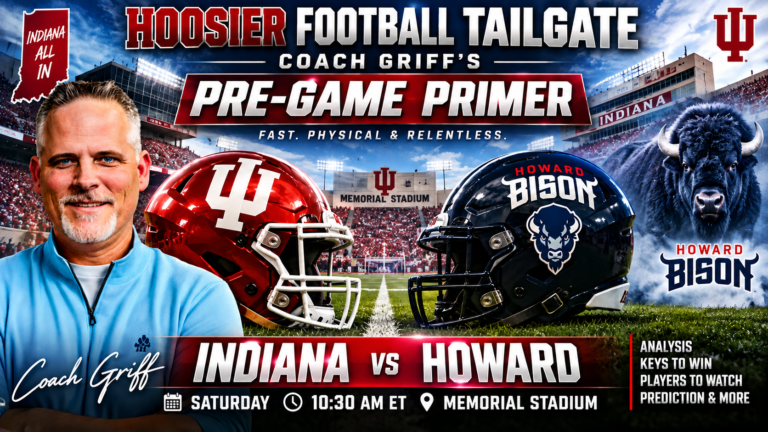
Coach Griff goes beyond Indiana’s 55–0 win over Howard to examine what the film actually tells us about the Hoosiers tonight at 7:30 PM ET on Hoosier Football Tailgate.
FAST. PHYSICAL. RELENTLESS.