Indiana PFF Grades: What the Numbers Actually Tell Us About the Northwestern Win
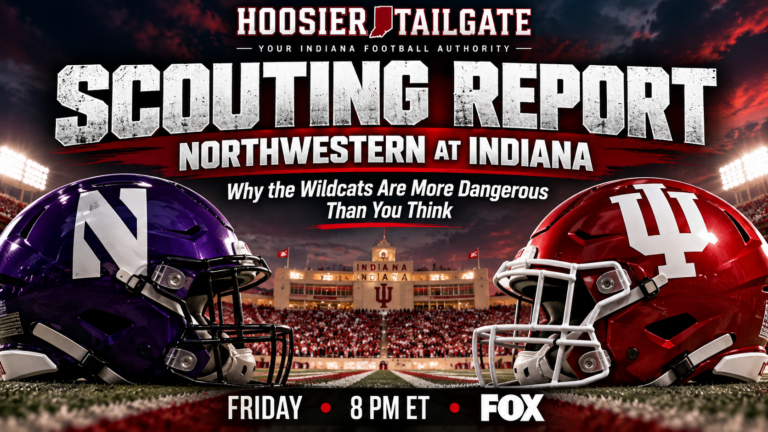
Indiana’s 29-23 victory over Northwestern wasn’t the type of dominant performance the Hoosiers produced during their first three games. That’s not necessarily a bad thing.
Indiana was pushed into a four-quarter Big Ten football game, dealt with the loss of Turbo Richard, watched Northwestern quarterback Aidan Chiles extend plays and challenge the defense, and still found a way to move to 4-0.
The PFF grades provide another layer to what happened Friday night. And as always, PFF shouldn’t be treated as the final answer. Grades are another tool. The value comes from combining the numbers with what actually happened on the field.
In this case, the numbers reinforce several things that stood out during the game — while revealing a few areas Indiana needs to address.
Indiana’s Run Game Was Better Than Its Run Blocking
Start with the most obvious strength. Indiana received an 81.9 rushing grade, its best rushing grade through four games.
The Hoosiers produced 293 rushing yards at 7.7 yards per carry, led by Lee Beebe Jr.’s 203-yard performance. But Indiana’s run-blocking grade was only 58.5.
That tells us the rushing production wasn’t simply the result of an offensive line consistently creating enormous running lanes. Indiana’s backs created yardage themselves.
- Beebe: 24 carries, 203 yards, 8.5 YPC
- 77.8 rushing grade
- 94 yards after contact
- 3.92 yards after contact per attempt
- 5 missed tackles forced
- 129 breakaway yards
- 70-yard long
Before leaving the game, Turbo Richard was equally productive: 9 carries for 68 yards, 7.6 per carry, a 78.8 rushing grade, 70 yards after contact and seven missed tackles forced.
Combined, Beebe and Richard generated 164 yards after contact. Indiana ran the football extremely well, but the numbers suggest much of that production came from its backs turning adequately blocked plays into much bigger gains.
Pass Protection Was Outstanding
While the run-blocking grade was mediocre, Indiana’s offensive line was considerably better protecting Josh Hoover. PFF gave Indiana an 88.6 pass-blocking grade, its second-best performance of the season.
- Drew Evans — 86.4
- Carter Smith — 84.3
- Bray Lynch — 83.9
- Joe Brunner — 81.2
Indiana was charged with only two pressures allowed, with no sacks and no quarterback hits attributed to the blocking unit. That’s an excellent performance, and it provides important context when evaluating Hoover.
Hoover Wasn’t at His Best — But He Didn’t Hurt Indiana
Hoover finished 19-of-29 for 201 yards, one touchdown and no interceptions.
- 66.3 overall grade
- 64.3 passing grade
- 11.6-yard average depth of target
- 1 big-time throw
- 1 turnover-worthy play
Those aren’t the spectacular numbers Hoover produced during Indiana’s first three games. But this was also his first Big Ten game as Indiana’s starting quarterback, and he did something extremely important: he didn’t turn the football over.
When kept clean, Hoover completed 19 of 27 passes for 201 yards, producing a 72.1 passing grade. Northwestern made Indiana work considerably harder for explosive plays than its previous opponents had.
That’s conference football. Sometimes quarterback development isn’t demonstrated by throwing four touchdowns. Sometimes it’s demonstrated by winning when you aren’t playing your best football.
Indiana’s Receivers Did More Than Catch the Football
Charlie Becker continued his productive start with seven receptions for 98 yards, a 71.7 receiving grade, zero drops and five first downs.
Nick Marsh added five receptions for 52 yards and Indiana’s lone receiving touchdown. But one of the most interesting numbers came from the receivers as blockers.
Marsh produced an 83.6 run-blocking grade, while Shazz Preston graded an outstanding 90.4.
Those numbers matter when evaluating Indiana’s rushing success. The offensive line’s 58.5 run-blocking grade doesn’t tell the entire story. Indiana’s perimeter players contributed to creating running lanes, particularly once the football reached the second level.
Stephen Daley Made an Immediate Impact
One of Indiana’s highest individual defensive grades belonged to Stephen Daley.
- 92.5 overall defensive grade
- 80.2 run-defense grade
- 77.4 tackling grade
- 82.6 pass-rush grade
- 4 pressures
Considering everything surrounding Daley’s eligibility situation, that’s an impressive performance. Indiana’s defense as a whole also remained strong against the run, receiving an 85.6 run-defense grade.
The problem wasn’t Indiana getting physically overwhelmed at the line of scrimmage. The problems developed when Chiles dropped back to throw.
Pressure and Coverage Work Together
Indiana’s 62.7 pass-rush grade and season-low 55.1 coverage grade immediately stand out. But those numbers shouldn’t be evaluated independently.
Aidan Chiles’ mobility changed the equation. Indiana was able to get Chiles moving on multiple occasions, but getting a quarterback off his spot isn’t the same as finishing the pressure.
Chiles repeatedly escaped, extended plays and forced Indiana’s defenders to remain in coverage longer than the original defensive call was designed to require.
The longer the quarterback has the football, the harder it becomes to cover.
A defensive back may execute his assignment properly through the initial route progression. Once the quarterback escapes the pocket and the play enters its second phase, receivers begin working back toward the quarterback, crossing zones and finding open grass. Coverage rules become scramble rules.
- 62.7 pass-rush grade
- 19 pressures
- 2 sacks
- 55.1 coverage grade
- 293 passing yards allowed
That doesn’t absolve the coverage unit. Indiana had snaps where it simply didn’t cover well enough. But the 55.1 grade wasn’t exclusively a secondary issue.
Pass rush and coverage are married together. If the rush can’t finish and a mobile quarterback extends the play, the secondary is being asked to cover longer than the defense was designed to cover. No coverage holds indefinitely.
Tackling Is Becoming a Trend Worth Watching
This may be the most important defensive issue coming out of the first four games.
Indiana received a 61.8 tackling grade against Northwestern and was charged with nine missed tackles. Normally, one poor tackling performance wouldn’t warrant much concern. But this isn’t the first one.
- North Texas — 51.8
- Howard — 79.7
- Western Kentucky — 72.3
- Northwestern — 61.8
That makes tackling something worth monitoring. And it stands out because of the standard Indiana has established defensively.
Indiana has been one of college football’s better tackling teams. Under Curt Cignetti and Bryant Haines, getting defenders to the football and finishing plays has been part of the identity. Through four games, that consistency hasn’t always been there.
Good tackling isn’t simply about effort. It’s leverage, angles, body position, eyes, pursuit and finishing.
Against Northwestern, Isaiah Jones was charged with three missed tackles and Josh Burnham with two. Those misses become particularly damaging when combined with the problems Indiana experienced finishing its pass rush.
Rush doesn’t finish → quarterback extends the play → coverage has to hold longer → completion occurs → missed tackle creates additional yardage.
A five-yard completion becomes 12. A third-down stop becomes a first down. Eventually those additional yards become points.
Coach Griff’s Take
The PFF numbers confirm something important about Friday night’s game.
Indiana didn’t play poorly everywhere.
The Hoosiers played extremely well in several areas and poorly in a few very specific ones.
Indiana ran the football exceptionally well. The pass protection was outstanding. Beebe demonstrated he could carry the rushing load after Richard left the game. The run defense remained strong. And Hoover won his first Big Ten start without turning the football over.
But there are corrections to make.
Indiana needs to finish pressures against mobile quarterbacks. The coverage must improve. And perhaps most importantly, the missed tackles are becoming a recurring theme rather than an isolated bad afternoon.
That’s what makes a game like Northwestern valuable. A 29-23 conference victory doesn’t require Indiana to pretend everything went perfectly.
It gives the coaching staff an opportunity to identify exactly where the standard wasn’t met — while still putting another win in the left-hand column.
The standard remains the standard.
The goal isn’t perfection. The goal is identifying what needs corrected before those mistakes cost you a football game.