Polls, Perception and the Problem With Instant Reaction: Did Anyone Give Northwestern Credit?
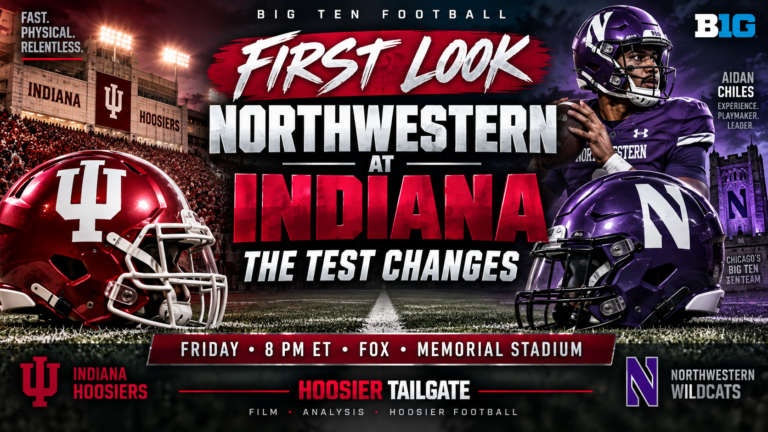
Indiana won a football game Friday night.
That seemingly simple fact has almost become secondary to everything that followed.
The Hoosiers defeated Northwestern 29-23, improved to 4-0, opened Big Ten play 1-0 and extended their winning streak to 20 games. Yet when the new polls arrived Sunday, Indiana moved backward.
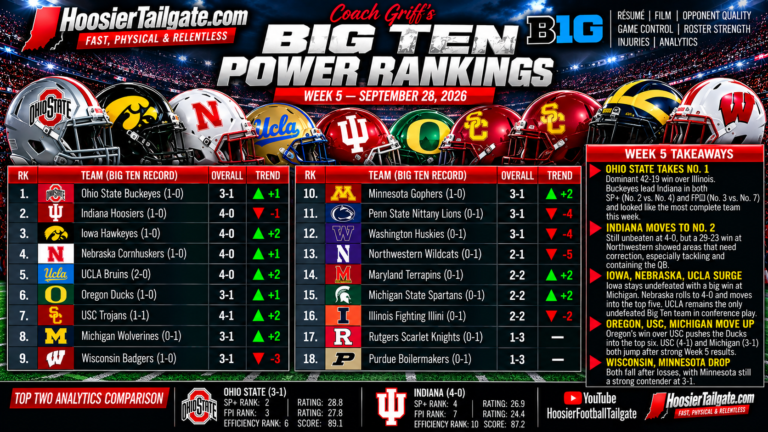
The Hoosiers dropped from No. 5 to No. 6 in the AP Top 25 and from No. 4 to No. 5 in the AFCA Coaches Poll. Ohio State, despite already having a loss, moved ahead of Indiana in the AP Poll. The Coaches Poll kept Indiana one spot ahead of the Buckeyes at No. 5.
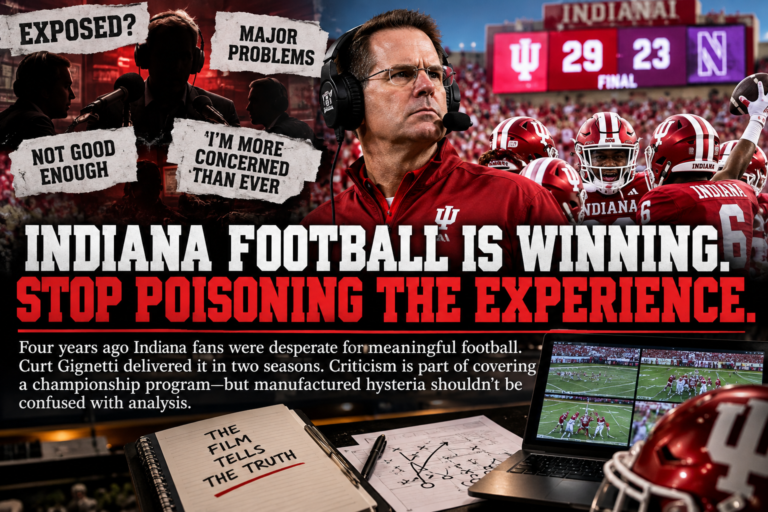
Maybe Indiana deserved criticism for Friday night’s performance. There was plenty to criticize.
But there is another question that deserves to be asked:
What if Northwestern is simply better than everyone assumed?
Cignetti Tried to Tell Everyone
After the game, Curt Cignetti made a revealing point: he had tried to tell everyone Northwestern was a good football team, but people weren’t buying it.
That wasn’t Cignetti pretending Indiana played well. He acknowledged his football team had substantial room for improvement. But he also understood something that disappeared from much of the immediate reaction to Friday night’s game.
There were two football teams on the field.
Northwestern wasn’t simply a prop against which Indiana failed to meet expectations. The Wildcats played well.
There Is a Difference Between Analysis and Instant Reaction
This is where college football’s weekly polling process can become problematic.
We live in an environment dominated by immediate reaction. A highly ranked team wins comfortably? Good. A highly ranked team wins by six against an opponent it was expected to beat easily? Something must be wrong.
Within minutes of the final whistle Friday night, the conversation centered on Indiana surviving, escaping or failing to look like the defending national champion. Some of that criticism was warranted.
Indiana committed too many penalties. There were missed opportunities offensively. The defense surrendered explosive plays. The Hoosiers didn’t consistently play to the standard Curt Cignetti has established.
But Indiana still won.
And that’s where evaluation needs to go deeper than the final margin.
The Film Usually Tells a More Complicated Story
Anyone who has coached football understands what happens after a game.
You think you know what happened Friday night. Then you turn on the film Saturday morning.
The end-zone copy shows something the television angle didn’t. The safety rotated differently than you thought. The offensive line slid the protection because of a pressure look. A receiver adjusted his route. A defender lost leverage because another player missed an assignment.
Suddenly, something that looked obvious in real time isn’t so obvious anymore.
That’s why I’ve always been cautious about making sweeping declarations immediately after a football game.
Television gives us the game. Film gives us the explanation.
Before dramatically changing an evaluation of a football team, shouldn’t we want the explanation?
Indiana Wasn’t Good Enough — And Still Found a Way
Let’s make something very clear. Indiana did not play championship-level football for four quarters Friday night.
Cignetti knows it. The players know it. Anyone who watched the game knows it.
But championship teams don’t play championship football every week. Sometimes they have to win when the game gets ugly.
Indiana faced adversity. Indiana responded. Indiana won.
There ought to be value in that, too.
Now Give Northwestern Its Due
Perhaps the strangest part of Sunday’s reaction is what happened to Northwestern.
The Wildcats pushed the defending national champions for four quarters on their home field. Their quarterback played extremely well. Their offense challenged Indiana’s defense in ways nobody else had this season.
Think about the contradiction.
If Indiana struggling against Northwestern is evidence that Indiana isn’t as good as previously believed, then shouldn’t Northwestern’s performance simultaneously provide some evidence that the Wildcats may be better than previously believed?
Both things can be true.
Indiana can need substantial improvement. And Northwestern can be a good football team.
Instead, the easiest narrative becomes: Indiana struggled, therefore Indiana drops.
That requires considerably less analysis.
Polls Are Snapshots. Football Is About Evidence.
Indiana is No. 6 in the AP Poll and No. 5 in the Coaches Poll.
Fine.
Those rankings don’t determine whether Indiana can win the Big Ten, and they certainly don’t determine what this football team will become over the next two months.
What matters is what Indiana does with what Northwestern exposed.
Correct the penalties. Get healthier. Improve the passing game. Fix the defensive breakdowns. Build the running-back depth while Turbo Richard recovers.
Then go play Rutgers.
Because four games into a football season, Indiana doesn’t need voters to tell it what kind of football team it is.
The film will do that.
And after watching that film, maybe people should spend a little less time asking what’s wrong with Indiana — and a little more time asking whether everyone underestimated Northwestern.
Coach Griff’s Final Word
This isn’t an argument that Indiana should still be No. 4. It’s an argument for consistent evaluation.
If you’re going to penalize Indiana because Northwestern played them close, intellectual consistency requires evaluating whether Northwestern was better than your preconceived opinion of Northwestern.
That’s football analysis.