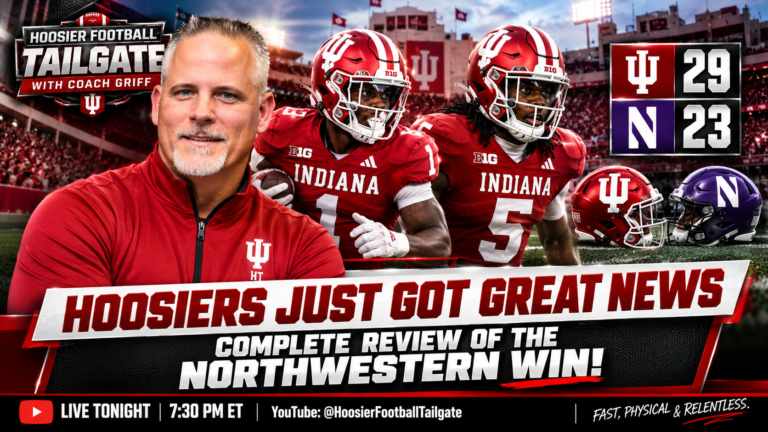
Josh Hoover vs. Fernando Mendoza: Are We Comparing the Same Four Games?
There is a growing conversation around Indiana quarterback Josh Hoover through the first four games of the 2026 season.
Some of it is fair. Hoover has missed throws, including opportunities down the field that Indiana will need its quarterback to hit as the schedule gets more difficult.
But there is another part of the conversation that deserves a closer look: Fernando Mendoza made those throws. At least, that is how we remember it.
The problem is that we may be comparing Josh Hoover through four games in 2026 with the finished version of Fernando Mendoza from 2025, rather than comparing Hoover with where Mendoza actually stood after his first four games.
Those are two very different comparisons. And when I went back and charted the explosive passing plays from the first four games of each quarterback’s season, the numbers told an interesting story.
The Mendoza We Remember
By the end of 2025, Fernando Mendoza had produced one of the great seasons in Indiana football history. There were huge throws, huge moments, road environments and pressure situations.
That is the Mendoza everyone remembers. But many of the throws that helped create that image came after the first four games.
- Iowa was Game 5.
- Oregon came later.
- Penn State came later still.
When we remember Mendoza now, we are remembering the quarterback who had already answered the question every quarterback eventually has to answer: When your team absolutely has to have a throw, can you make it?
Mendoza eventually answered yes. Hoover has not really been asked that question yet. So before we compare the two quarterbacks, let’s reset the clock: four games against four games.
The Traditional Numbers
Mendoza had the advantage in several conventional passing categories through four games in 2025. He completed 76 of 99 passes for 975 yards with 14 touchdowns and no interceptions.
Hoover through four games in 2026 is 56 of 80 for 850 yards with 11 touchdowns and no interceptions. Mendoza completed a higher percentage of his passes and produced more passing yards and touchdowns, while Hoover averaged 10.6 yards per attempt compared with 9.8 for Mendoza.
Neither quarterback had thrown an interception. Those numbers already suggest Hoover’s start has been considerably better than some of the reaction surrounding him would indicate. But the traditional numbers are not what interested me most.
I wanted to look at the explosive plays.
Coach Griff’s Film Study: Explosive Passing Plays
I charted every explosive pass play produced by both quarterbacks through their first four games. For this comparison, an explosive pass is a completion gaining 20 yards or more.
| Through Four Games | Josh Hoover — 2026 | Fernando Mendoza — 2025 |
|---|---|---|
| Explosive pass plays | 18 | 21 |
| Explosive-play yards | 641 | 597 |
| Explosive-play TDs | 10 | 5 |
| INTs on explosive plays | 0 | 0 |
| Yards per explosive | 35.6 | 28.4 |
| Explosives resulting in TD | 55.6% | 23.8% |
Mendoza actually had three more explosive completions through four games, but Hoover’s 18 explosive passes produced 44 more yards. More importantly, 10 of Hoover’s 18 explosive completions resulted in touchdowns. Mendoza had five explosive-play touchdowns through his first four games.
That is twice as many explosive touchdowns for Hoover despite having three fewer explosive completions. That does not fit neatly with the idea that Indiana’s explosive passing game under Hoover has somehow been deficient compared with Mendoza at the same stage.
Look at the Longest Completion Each Week
Hoover’s longest pass in each of Indiana’s first four games:
- North Texas — 43 yards
- Howard — 51 yards
- Western Kentucky — 79 yards
- Northwestern — 23 yards
Mendoza’s longest completion through Indiana’s first four games in 2025:
- Old Dominion — 22 yards
- Kennesaw State — 40 yards
- Indiana State — 58 yards
- Illinois — 43 yards
Again, this is not criticism of Mendoza. It is context for Hoover. Hoover has already demonstrated the ability to generate explosive passing plays.
But there is a difference between an explosive throw and a clutch throw. And that is where the Mendoza comparison changes.
The Question Hoover Hasn’t Had a Chance to Answer
When people remember Fernando Mendoza today, I do not think they are primarily remembering a September statistical line. They are remembering moments: Iowa. Oregon. Penn State.
Those moments came when Indiana needed its quarterback to make a play. And none of them had happened after Mendoza’s first four games.
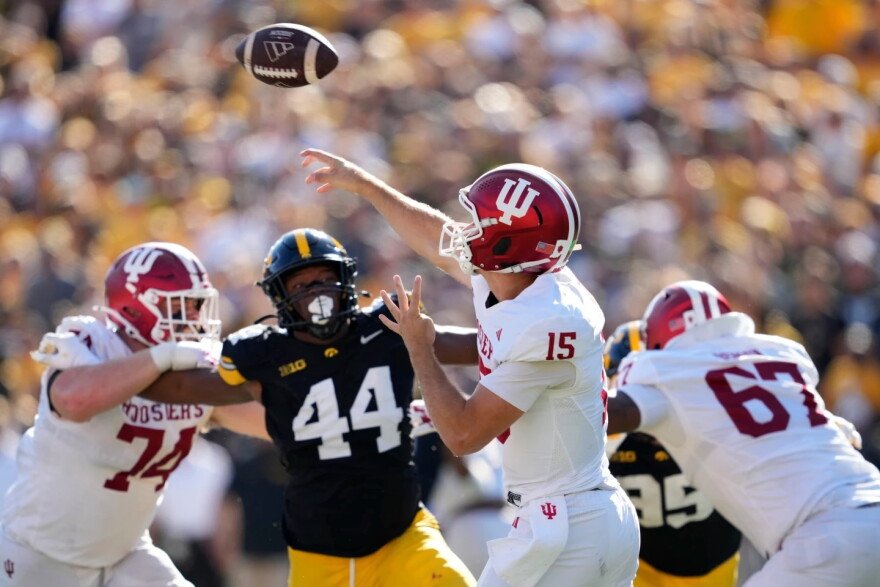
Iowa: The First Moment
At Kinnick Stadium in Game 5, Indiana and Iowa were tied 13–13 late in the fourth quarter. Indiana got the football at its own 24 with 2:01 remaining.
Mendoza hit Elijah Sarratt for 24 yards. Then, on third-and-10 from the Iowa 49, Mendoza beat the pressure and found Sarratt for the 49-yard game-winning touchdown with 1:28 remaining. Indiana had gone 76 yards in 33 seconds.
Indiana needed the throw. Mendoza made it.
Oregon: Responding After the Mistake
The Oregon example may tell us even more about what eventually defined Mendoza. In the fourth quarter at Autzen Stadium, Mendoza threw a pick-six with 12:42 remaining, tying the game at 20.
Indiana took possession at its own 25 and embarked on a 12-play, 75-yard drive. Mendoza converted a critical third down to Sarratt for 13 yards. Later, facing second-and-11 from the Oregon 37, Mendoza went back to Sarratt for 29 yards to the Oregon 8. On third-and-goal, Mendoza found Sarratt again for the 8-yard go-ahead touchdown.
That is clutch quarterback play. Not because Mendoza played a mistake-free game. He did not. It is because after making the kind of mistake that can change a game, he responded when Indiana needed him most.
Penn State: Now Go Win It
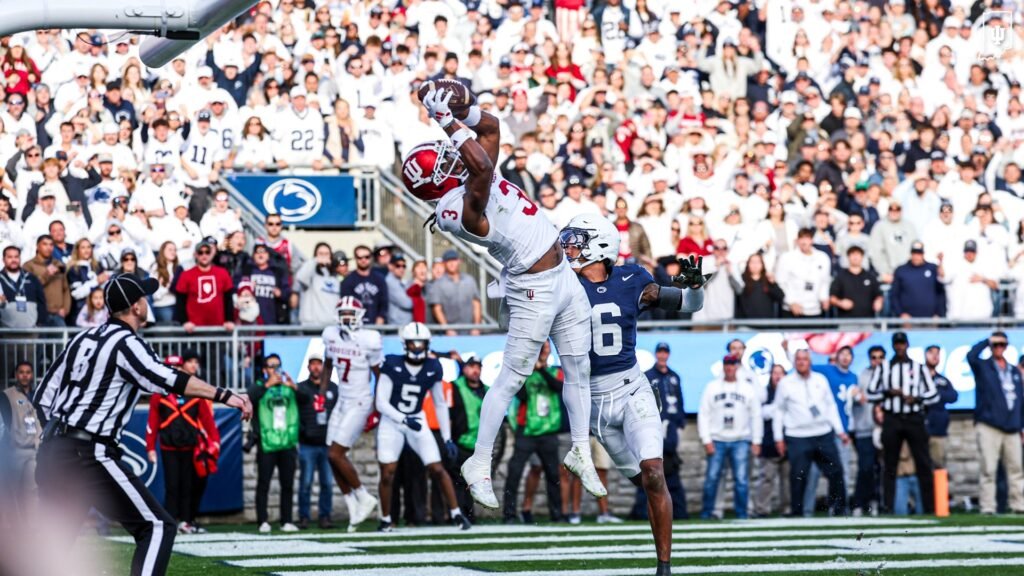
Then came Penn State. Indiana trailed 24–20 with 1:51 remaining and no timeouts. Indiana had to go 80 yards.
The Hoosiers eventually reached the Penn State 7. After incompletions on first and second down, Indiana faced third-and-7. Mendoza put the football at the back of the end zone, and Omar Cooper Jr. made the spectacular 7-yard catch for the go-ahead touchdown with 36 seconds remaining.
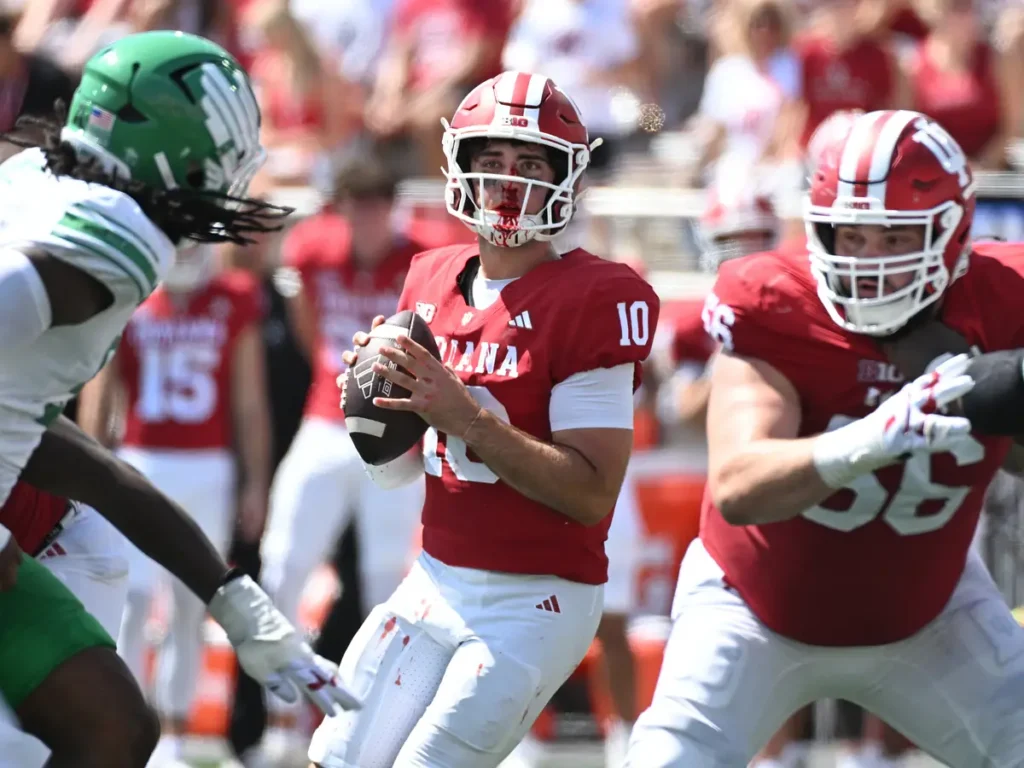
That is the question I think we should be asking. And my answer through four games is: not really.
Northwestern probably came closest. Hoover had two opportunities to Charlie Becker during the first half that could have resulted in explosive touchdowns. Those are throws he needs to make. I am not excusing them.
I have not yet completed the Film Room study necessary to quantify every potential touchdown opportunity Hoover has left on the field. That is something I intend to examine separately rather than guess at a number.
But those missed throws against Northwestern are not quite the same test Mendoza eventually faced.
Hoover has not failed that test. The test largely has not arrived yet.
Explosive Is Proven. Clutch Is Still an Open Question.
We can evaluate what we have actually seen. Through four games, Hoover has already shown he can create explosive plays:
- 18 explosive completions
- 641 explosive passing yards
- 10 explosive touchdowns
- 35.6 yards per explosive completion
- Zero interceptions on those plays
What we cannot evaluate yet is how Hoover will perform when Indiana’s margin for error disappears. That is where Mendoza ultimately separated himself.
- The big throw at Iowa.
- The response after the pick-six at Oregon.
- The final drive at Penn State.
Those are not merely explosive plays. Those are winning plays. And there is a difference.
Don’t Compare September Hoover With the Mendoza We Remember
This is ultimately where I think the conversation has gotten sideways. We know how Fernando Mendoza’s story ended. So when we remember him, Iowa, Oregon and Penn State are already baked into our evaluation.
We are remembering the finished product and subconsciously placing that version of Mendoza into Games 1–4. Hoover hasn’t had Games 5 through 16 yet.
That is why the proper conclusion from this comparison is not that Josh Hoover is better than Fernando Mendoza. That is not what the data says, and that is not the point.
The comparison says something more interesting: at the same four-game checkpoint, Hoover’s explosive passing production compares favorably with Mendoza’s—and in several categories exceeds it.
The next part cannot be measured yet. It has to happen.
Eventually Indiana will need its quarterback to make the throw—the throw when everyone in the stadium knows the game may depend upon what happens next.
Mendoza eventually got those opportunities, and he delivered. Hoover has not had that moment yet.
When Indiana finally needs Josh Hoover to make the clutch throw, will he make it?
We do not know. And through four games, that is the question that remains—not whether Josh Hoover can create explosive plays.
He has already answered that one.