Two Gunslingers, One Showdown: Josh Hoover vs. Anthony Colandrea
Saturday’s showdown in Lincoln features two undefeated Big Ten teams, but it also brings together two quarterbacks capable of taking over a football game in very different ways.
Indiana’s Josh Hoover has been the efficient gunslinger — distributing the football, creating explosive plays and, most importantly, protecting it. Nebraska’s Anthony Colandrea brings another dimension. He can beat a defense from the pocket, but when the pocket breaks down, the play may only be beginning.
Hoover vs. Colandrea. Two No. 10s. Two undefeated teams. Two very different problems for a defense to solve.
The Tale of the Tape
| Through 5 Games | Josh Hoover — Indiana | Anthony Colandrea — Nebraska |
|---|---|---|
| Record as starter | 5-0 | 5-0 |
| Completions | 76 | 94 |
| Attempts | 107 | 143 |
| Completion % | 71.0% | 65.7% |
| Passing yards | 1,101 | 1,142 |
| Passing TD | 15 | 13 |
| Pass yards/game | 220.2 | 228.4 |
| NCAA passer efficiency | 203.72 | — |
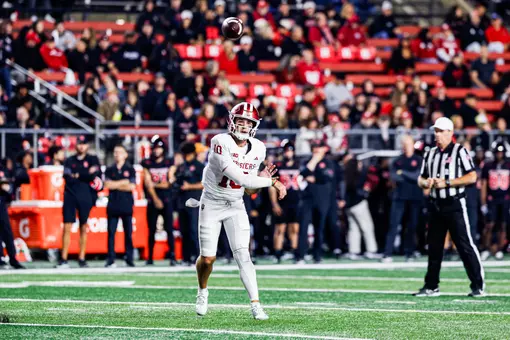
One number immediately jumps off the page for Hoover: 15 touchdown passes without an interception. Through five games he has completed 76 of 107 passes for 1,101 yards while completing 71 percent of his attempts.
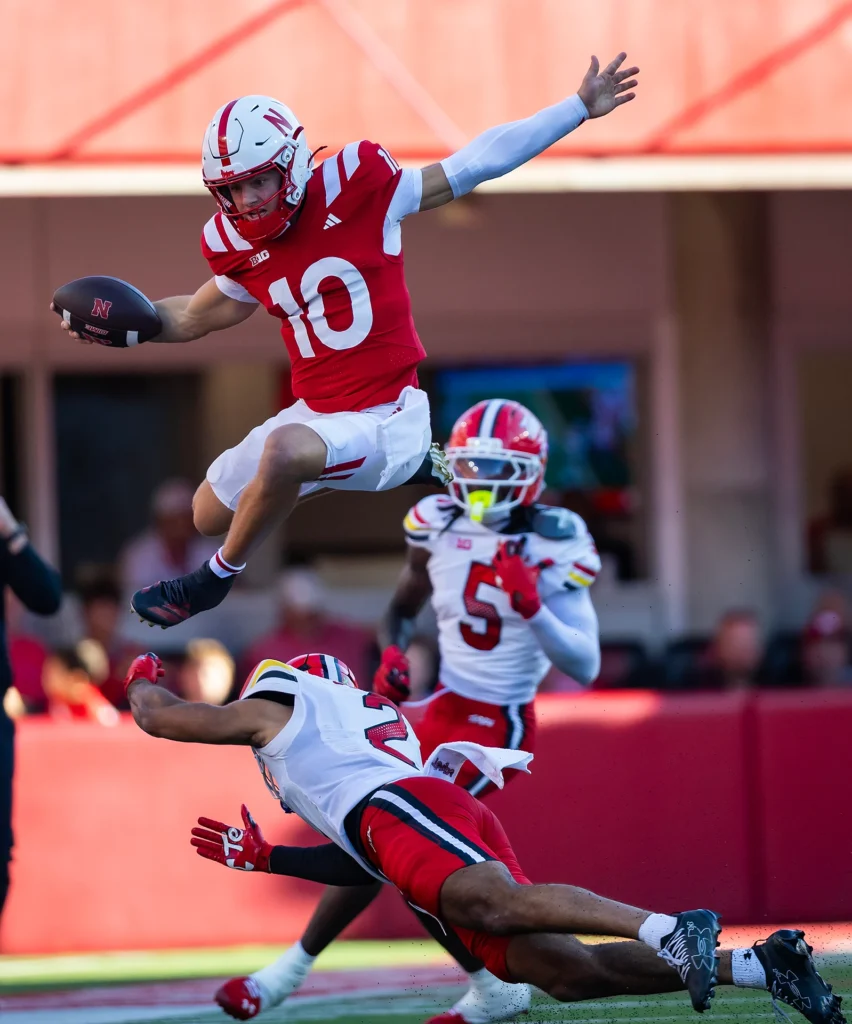
Colandrea has thrown for slightly more yardage, but his greatest impact cannot be measured by passing numbers alone. Against Maryland, he produced 346 yards of total offense, including 108 rushing yards on only 10 attempts.
Hoover: Efficiency, Distribution and Ball Security
Hoover’s game has been built around efficiency. He does not need to manufacture every explosive play himself. Indiana’s offense gives him multiple answers, and Hoover has consistently distributed the football while avoiding the mistake that flips a game.
That ball security becomes particularly important on the road. Nebraska would love to create short fields, steal a possession and allow Memorial Stadium to become a factor. Through five games, Hoover simply has not provided opponents with those interception opportunities.
The challenge Saturday will be maintaining that efficiency against a Nebraska defense capable of generating negative plays and affecting the quarterback.
Hoover Has His Own Pair of Six-Shooters
Indiana’s passing attack is not a one-man operation.
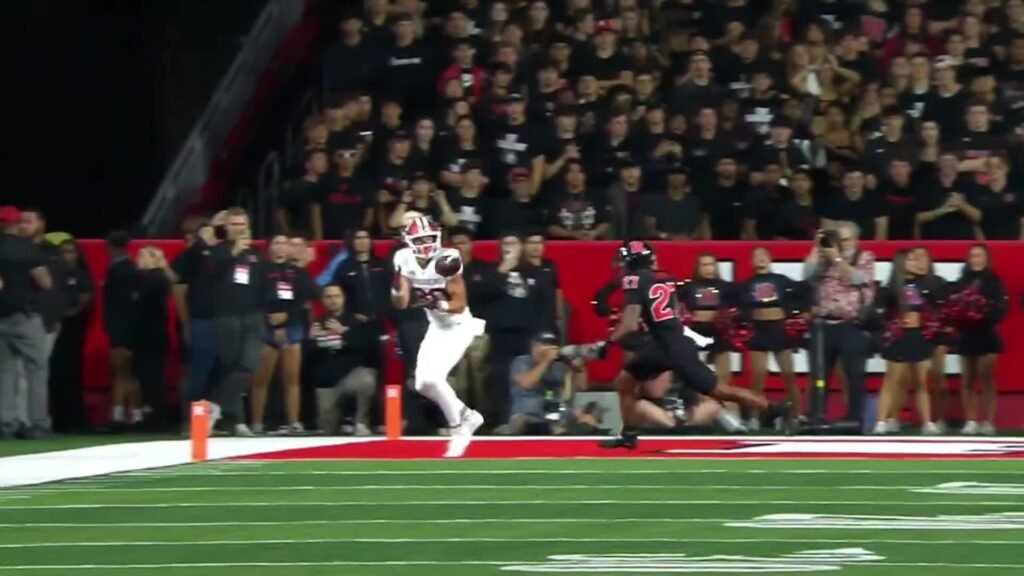
Charlie Becker has emerged as one of Hoover’s primary weapons and entered Nebraska week with 477 receiving yards through five games.
Nick Marsh gives Indiana another major target and is coming off a 120-yard performance against Rutgers.
At Rutgers, Becker produced 107 yards and two touchdowns while Marsh went for 120 yards. That gives Nebraska a significant coverage problem. Roll coverage toward one receiver and Hoover has another big target capable of winning the matchup on the opposite side.
That may be one of Indiana’s biggest advantages in the passing game: Hoover does not have to force the football to one receiver.
Colandrea: When the First Play Ends, Another Can Begin
Colandrea creates a completely different problem.
If Indiana covers the route correctly and generates pressure, the defensive snap is not necessarily over. Colandrea has the athletic ability to escape the pocket and turn a successful coverage play into an explosive quarterback run.
That is why Indiana defensive coordinator Bryant Haines must balance pressure with rush-lane integrity.
The Hoosiers want to affect Colandrea, but they cannot create escape lanes while doing it. A defensive end getting too far upfield or an interior rusher losing his lane can provide exactly the opening Colandrea needs.
As we discussed in our first look at Nebraska, this could also be a game where Indiana employs a situational quarterback spy, particularly on third down or in obvious passing situations.
Colandrea Has a Dangerous Target Too
Nebraska wide receiver Kwazi Gilmer deserves plenty of attention.
Gilmer has 29 receptions for 387 yards and six touchdowns and enters the Indiana matchup after consecutive 100-yard receiving performances. Against Maryland, he caught 11 passes for 147 yards and two touchdowns.
That complicates Indiana’s plan considerably.
The Hoosiers cannot devote so many resources to Colandrea’s running ability that they compromise their coverage against Gilmer and Nebraska’s other receiving threats.
What Do the Numbers Tell Us?
The statistics reveal two quarterbacks succeeding in different ways.
Hoover has been the more efficient pure passer.
Read it. Distribute it. Punish the coverage. Protect the football.
Colandrea has been the more dangerous creator outside the original structure of the play.
Read it. Throw it. But when the defense wins the initial snap, escape and create another opportunity.
That distinction may become one of the defining tactical battles Saturday.
Make One Play Equal One Play
Indiana’s defensive objective cannot simply be stopping Colandrea from completing passes.
The Hoosiers need to make one play equal one play.
If Indiana covers a third-and-8 correctly, that cannot become a 20-yard Colandrea scramble. If the defensive front wins the pass rush, getting near the quarterback cannot be enough. The Hoosiers have to finish the play.
Nebraska’s challenge is different.
Its defense must find a way to disrupt a quarterback who has thrown 15 touchdown passes without giving a defense an interception through five games — while also accounting for Becker, Marsh and Indiana’s ability to create offense on the ground.
Coach Griff’s Final Word
This is what makes Saturday’s quarterback matchup so interesting.
These are not two quarterbacks trying to win the same way.
Hoover wants to beat Nebraska from the pocket with decisions, accuracy, distribution and explosive throws to his playmakers.
Colandrea can beat Indiana from the pocket — but he also forces the Hoosiers to defend the second play, the one that begins when he escapes.
Two gunslingers. Two No. 10s. One major showdown in Lincoln.
Saturday, we find out which style creates the bigger problem.