Indiana’s Offensive Line Is Becoming Its Biggest Postseason Concern
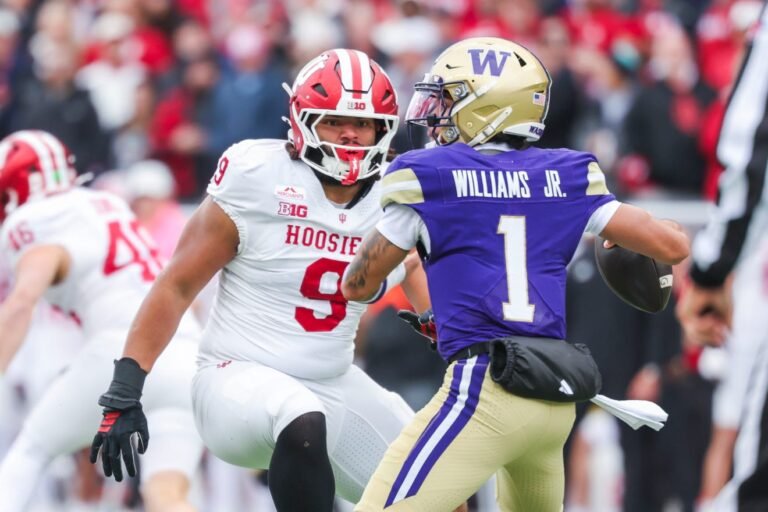
Much of the discussion surrounding Indiana football following Saturday’s 27-24 overtime loss at Washington has centered around the quarterback position, the College Football Playoff rankings and the Hoosiers’ remaining path to the Big Ten Championship Game.
However, from a coaching perspective, there is another area of concern that could ultimately have a greater impact on Indiana’s postseason aspirations than any of those storylines.
The offensive line.
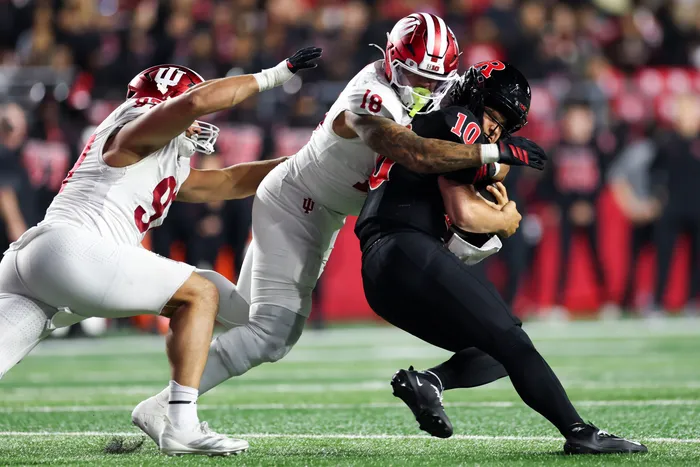
Indiana has already lost starting right guard Joel Brunner for the remainder of the season, and starting offensive lineman Bray Lynch left Saturday’s game at Washington and did not return. Ajani also exited the game but was able to return.
As of Wednesday afternoon, there has been no official availability report released for Saturday’s game against Purdue.
However, if Lynch is unable to play, Indiana could potentially be without two of its five starting offensive linemen at the most critical point of the season.
That is a significant concern for an offense that has struggled to establish consistency over the past several weeks.
The Offensive Numbers Tell a Story
Indiana’s offensive performance against Washington was not necessarily poor from a total yardage standpoint. However, the numbers do not tell the entire story.
| Offensive Category | vs. Washington |
|---|---|
| Total offense | 392 yards |
| Rushing offense | 158 yards |
| Passing offense | 234 yards |
| Third-down conversions | 2 of 15 |
| Third-down efficiency | 13.3% |
| Points scored | 24 |
Generating nearly 400 yards of total offense should ordinarily put a football team in a position to win.
But Indiana’s offense was extremely inconsistent.
There were explosive plays in the passing game and moments when the running game was productive. What was missing was the ability to consistently sustain drives, stay ahead of the chains and finish possessions.
Converting just 13.3 percent of your third-down opportunities is not a recipe for winning championship football games.
Certainly, the offensive line cannot be held solely responsible for those numbers. Quarterback execution, play calling, receiver performance and the ability of the running backs to create yards all factor into offensive efficiency.
However, everything offensively begins up front.
Losing Two Offensive Linemen Is More Than Losing Two Players
One of the most overlooked aspects of offensive line play is the importance of continuity.
Unlike other position groups, the offensive line must operate as a cohesive five-man unit on virtually every offensive snap.
Communication, combination blocks, protection adjustments, passing off defensive line movement and identifying pressure are all dependent upon the five players working together.
When you replace one offensive lineman, you are not simply inserting another player into the lineup.
You are potentially changing how the players on either side of him operate as well.
When you replace two offensive linemen, particularly this late in the season, those challenges become even more significant.
Consider some of the adjustments that must take place:
- Communication against defensive fronts and pressure packages.
- Timing of combination blocks in the running game.
- Identifying and passing off defensive line stunts.
- Maintaining the integrity of the pocket.
- Recognizing linebacker movement and late defensive adjustments.
- Developing trust between adjacent offensive linemen.
Those are things that cannot always be replicated during a week of practice.
The challenge is not necessarily whether Indiana’s backup offensive linemen are talented enough to play. The challenge is whether the entire unit can develop the necessary cohesion in a short period of time.
It Is Too Late in the Season to Reinvent the Offense
I have been critical of Indiana’s running game at various points throughout the second half of the season, particularly its reliance on inside zone and duo concepts.
However, we also need to be realistic about where we are in the football season.
Indiana is preparing to play its 12th regular-season game. The Hoosiers are not going to drastically change their offensive identity or install an entirely different running attack during Purdue week.
Nor should they.
At this point in the season, you must rely on the things your football team does best, identify the strengths of the personnel available and put those players in a position to be successful.
That may mean Indiana needs to lean more heavily on its passing game.
Traditionally, coaches talk about establishing the running game to open up opportunities in the passing game. However, there are circumstances when an offense needs to reverse that philosophy.
Indiana may need to throw the football to help establish its running game.
The Hoosiers have talented wide receivers in Nick Marsh and Charlie Becker, and both quarterbacks have demonstrated the ability to generate explosive plays through the passing game.
Indiana needs to utilize those strengths.
That does not mean abandoning the running game or becoming a one-dimensional offense. It means recognizing where your offensive strengths currently reside and allowing those strengths to create opportunities elsewhere.
The injuries along the offensive line will undoubtedly influence how the offensive staff approaches that balance.
The RPO Game Becomes Increasingly Important
Indiana needs to continue utilizing its run-pass option concepts, which have been an established component of its offensive structure.
The beauty of the RPO game is that it allows an offense to take advantage of how a defense chooses to defend the running game without necessarily changing its core blocking schemes.
If opposing defenses are going to commit additional defenders to the box or aggressively involve their linebackers in stopping Indiana’s inside running game, the Hoosiers need to take advantage of the opportunities that creates in the passing game.
Make those defenders wrong.
Force linebackers and perimeter defenders to respect the passing threat rather than allowing them to aggressively attack the line of scrimmage without consequence.
When Indiana can consistently complete those throws, it can influence how defenses align and react, potentially creating more favorable opportunities for the running game.
That becomes particularly important when an offensive line is dealing with personnel changes.
The quick passing game, established RPO concepts and selective opportunities to attack downfield can all help Indiana maintain offensive efficiency without asking its offensive line to consistently win against unfavorable numbers.
This is not about installing new plays.
It is about effectively utilizing the offensive concepts Indiana has been practicing and executing since fall camp.
The Quarterback Decision Is Directly Connected to Offensive Line Play
Much of the discussion this week will understandably focus on whether Josh Hoover or Grant Wilson should start against Purdue.
But that decision cannot be made independently of what is happening along the offensive line.
If Indiana is dealing with multiple personnel changes up front, the offensive staff must consider which quarterback gives the offense the best opportunity to function efficiently under those circumstances.
Hoover brings experience and the ability to distribute the football from the pocket. When healthy, his ability to process defensive coverage, make quick decisions and deliver the football on time can help neutralize pressure.
Wilson brings mobility and the ability to extend plays when protection breaks down.
Both quarterbacks have demonstrated the ability to make plays through the passing game, and both have had moments of inconsistency.
Ultimately, the decision should come down to health, execution and which quarterback gives Indiana the best opportunity to operate its existing offense efficiently.
If Indiana is going to rely more heavily on its passing game, quarterback decision-making becomes increasingly important, particularly within its RPO concepts.
Getting the football out on time, making the proper reads and avoiding unnecessary negative plays can help an offensive line that is dealing with injuries.
Staying Ahead of the Chains Must Become a Priority
One of the most difficult situations for an offensive line dealing with personnel changes is consistently playing in obvious passing situations.
When an offense faces third-and-seven, third-and-eight or third-and-long, the defense has a significant advantage.
Defensive linemen can attack the quarterback without having to respect the running game to the same degree. Defensive coordinators can become more aggressive with their pressure packages, simulated pressures and defensive line movement.
That puts tremendous stress on offensive line communication and pass protection.
Indiana needs to do a better job of winning first down.
However, winning first down does not necessarily mean running the football.
If the defense is presenting a favorable opportunity to throw the football, take advantage of it.
A five- or six-yard completion on first down is just as valuable as a five- or six-yard rushing attempt.
Productive early-down plays allow the offensive coordinator to maintain the entire playbook and prevent the defense from dictating the terms of the possession.
The difference between third-and-three and third-and-eight is enormous from a play-calling and protection standpoint.
Indiana’s inability to consistently sustain drives against Washington was one of the biggest factors in Saturday’s loss.
That is an area where the Hoosiers must improve regardless of who is playing quarterback or which five offensive linemen are on the field.
Finding the Best Five Available Offensive Linemen
Until Indiana releases its official availability report, we will not know exactly what the offensive line will look like Saturday night.
If Bray Lynch is unavailable, Indiana’s offensive coaching staff will have some important personnel decisions to make.
Do you maintain as much continuity as possible by inserting a replacement directly into the vacant position?
Or do you move an experienced offensive lineman to another position and insert a backup elsewhere?
There is no universal answer to that question.
As a coach, my preference would generally be to make the fewest necessary changes to preserve continuity, provided the replacement can adequately handle the responsibilities of the position.
Moving multiple players to compensate for one injury can sometimes create more problems than it solves.
Ultimately, the coaching staff must identify its best five available offensive linemen and determine where each can be most effective.
Once those decisions are made, the offensive game plan must reflect what that particular group is capable of executing.
You cannot ignore the impact personnel changes have on your ability to execute certain concepts.
That is where the offensive coaching staff must be realistic in its approach.
Purdue Presents an Opportunity
Saturday’s game against Purdue provides Indiana with an opportunity to regain some offensive confidence before a potential postseason appearance.
However, I am not necessarily concerned with whether Indiana rushes for 150 yards, 180 yards or 200 yards against the Boilermakers.
I am more concerned with whether Indiana can consistently move the football, sustain possessions, protect its quarterback and finish drives with touchdowns.
If that means Indiana throws the football more frequently than it runs it, so be it.
Offensive balance is not necessarily about having an equal number of rushing and passing attempts.
It is about having the ability to take advantage of what the defense is giving you.
Indiana needs to find its offensive rhythm again, and the most logical approach at this stage of the season is to rely on the things it executes best.
The Competition Only Gets More Difficult
Indiana could enter Saturday night’s game knowing that a victory over Purdue would send the Hoosiers to the Big Ten Championship Game.
That possibility makes the offensive line situation even more significant.
If Indiana advances to Indianapolis, the quality of the defensive front it faces will likely increase considerably.
The same can be said for the College Football Playoff.
Championship-caliber football teams typically possess talented defensive linemen, athletic linebackers and the ability to create pressure without necessarily committing additional defenders.
Those are the types of defenses that expose deficiencies along an offensive line.
Indiana cannot expect to consistently overcome protection breakdowns, negative running plays and third-and-long situations against that level of competition.
The margin for error becomes considerably smaller.
That is why finding offensive consistency against Purdue is so important.
Coach Griff’s Final Take
Everyone wants to discuss who should be Indiana’s starting quarterback.
That is certainly a legitimate discussion.
But I would argue that the health, personnel and overall performance of Indiana’s offensive line may ultimately determine how far this football team advances in the postseason.
Indiana’s offensive struggles did not begin Saturday at Washington. They have been evident for much of the second half of the season.
Now, injuries are creating additional challenges for an offensive unit that was already struggling to establish consistency.
The loss of Joel Brunner is significant. The potential loss of Bray Lynch would compound those concerns.
However, this is not the time to reinvent the offense.
Indiana needs to rely on the offensive concepts it executes best, continue utilizing its RPO game and recognize that its passing attack may need to create opportunities for the running game.
The offensive coaching staff must adapt its game plan to the personnel available without abandoning the foundation of its offensive system.
There is still plenty for Indiana to accomplish this season.
A 10-2 regular season remains within reach. A Big Ten Championship remains a possibility. And the College Football Playoff door has not been closed.
But if Indiana is going to accomplish those objectives, it must find a way to consistently execute offensively with the personnel it has available.
At this point in the season, it is not about how much offense you have. It is about how well you execute the offense you have.
Shannon Griffith is a former college football coach with 28 years of coaching experience, the host of Hoosier Football Tailgate and Lead Football Analyst for TheHoosier.com.