Coach Griff’s Take: Urban Meyer Needs One Standard for Indiana and Ohio State

Urban Meyer is a legend in the coaching profession. So is Nick Saban. Their experience deserves respect. But experience does not exempt anyone from applying a consistent standard.
That is my issue with Meyer’s recent assessment of Indiana. He dismissed the Hoosiers’ three nonconference victories and declared, “Indiana’s 2-0 to me.” He also suggested that games against those types of opponents should not count toward a team’s record. [1]
If that is the standard, Ohio State should be 2-1.
Remove the Buckeyes’ victories over Ball State and Kent State from their 4-1 record, and what remains is wins over Illinois and Iowa, plus the loss to Texas. [2]
Howard is an FCS opponent, while Ohio State’s two MAC opponents are FBS teams. But Meyer also discounted Indiana’s victories over North Texas and Western Kentucky, both FBS programs. His argument goes beyond objecting to an FCS matchup.
Schedule strength can change how we value a win. It cannot change whether the win happened.
Meyer has a point about scheduling
Jim Coyle and I have discussed on Indiana Sports Beat Radio that IU should consider scheduling a Power Four opponent now that it has won a national championship and a Big Ten title. A stronger nonconference matchup would give the Hoosiers another opportunity to demonstrate where they stand.
I can agree with Meyer on that concern without agreeing that Indiana’s existing victories should disappear.
The inconsistency becomes clearer when we revisit his advice last year. After Ohio State beat Texas in 2025, Meyer later advocated avoiding the return trip to Austin and replacing it with easier opponents. His suggested alternatives included Old Dominion and Kennesaw State. [3]
Now Ohio State has lost to Texas, and Meyer is emphasizing the value of that competitive defeat while dismissing Indiana’s easier victories. [1]
We cannot know whether the Texas loss changed his thinking. But we can compare the positions. Why was reducing scheduling risk sensible advice for Ohio State, while winning against weaker opponents is now grounds for discounting Indiana’s record?
To my ear, Meyer is starting to sound like an Ohio State advocate in the same way Saban can sound like an Alabama and SEC advocate. That is my impression, not proof of anyone’s motivation. The inconsistent standard is what invites the question.
Let the conference race develop
We are entering Indiana’s third conference game. Indiana and Ohio State are both 2-0 in Big Ten play. Ohio State’s loss to Texas matters to its overall résumé, but it does not put the Buckeyes behind Indiana in the conference standings.
The conference race already separates those two questions. Win conference games, earn a place in the championship game and compete for the title. Then evaluate the complete résumé when discussing the playoff field.
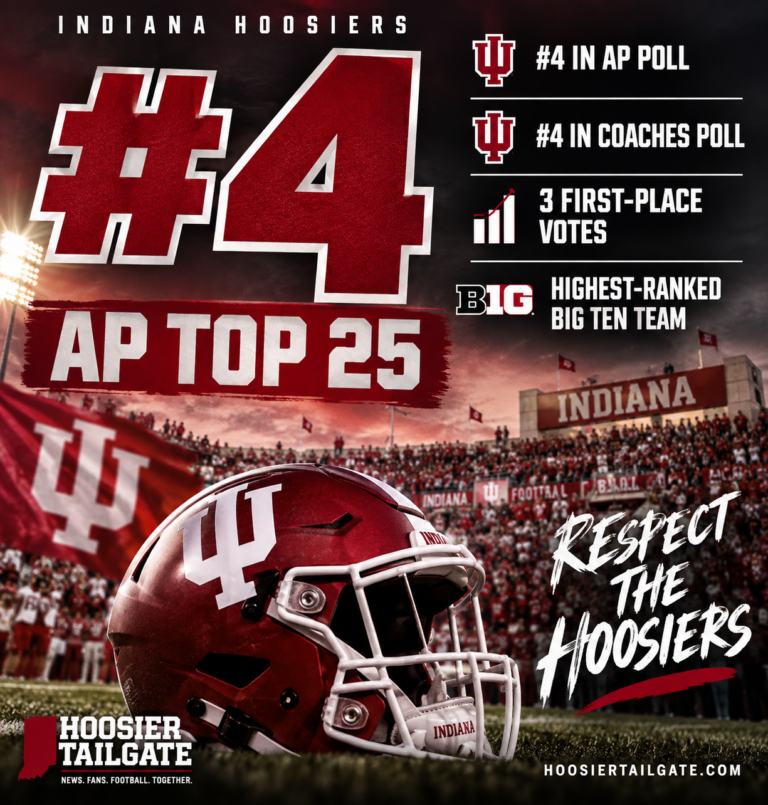
We also need more patience with weekly judgments. Indiana beat Rutgers 47-15, improved to 5-0 and still slipped from No. 6 to No. 7 in the AP poll, behind one-loss Ohio State. Northwestern, whose close game against Indiana drew criticism of the Hoosiers, received votes in that same poll. [4]
An unbeaten record does not automatically make a team better than every team with a loss. But a competitive defeat should not automatically earn one team respect while a competitive victory becomes evidence against another. Explain the difference using the games, not the program’s reputation.
Expansion would change the stakes
A potential 24-team playoff would likely make an easier nonconference schedule less consequential for a strong team’s access to the field. It would not make those games irrelevant. Depending on the eventual rules, they could still influence the final at-large selections, seeding and home games.
Expansion remains under evaluation; the confirmed 2026-27 playoff has 12 teams. [5, 6]
Whatever the field size, the principle stays the same: evaluate the complete body of work and apply the same standard to everyone.
This Saturday, October 10, Indiana visits 5-0 Nebraska. That gives us another meaningful data point for both teams. Nebraska is currently outside the AP Top 25, which makes its performance another test of how voters evaluate results beyond familiar reputations. [4, 7]
Let the games add to what we know. One win should not settle every question, and one loss should not erase everything a team has demonstrated.
Indiana’s wins count. Ohio State’s loss counts. How much each result tells us is a fair debate.
Whether the measuring stick changes with the team is the question Meyer needs to answer.
Sources
[1] Meyer’s current comments, reported by Yahoo Sports
[2] Ohio State Athletics: 2026 results
[3] On3: Meyer’s December 2025 scheduling advice
[4] The Daily Hoosier: October 4 AP rankings
[5] CFP: Evaluation of potential 24-team expansion