Indiana Is No. 4 in the CFP Rankings — But Are the Hoosiers Playing Like a Top-Four Team?
Coach Griff’s Football Analysis | Hoosier Football Tailgate
November 7, 2026
Indiana is ranked fourth in the initial College Football Playoff rankings of the 2026 season. The Hoosiers are 8–1, possess one of the strongest résumés in college football and have a defense that is performing at a championship level.
So why is there so much national criticism surrounding Indiana’s ranking?
Much of it centers on the Hoosiers’ offense, and quite frankly, I believe that criticism is warranted.
But there is something missing from much of the national conversation.
Indiana’s defense is playing championship football, and that must be part of any objective evaluation of this team.
The problem is that Indiana’s offense and special teams are not consistently performing anywhere near the same standard.
And that brings me to the question I believe we should be asking.
Has Indiana earned its No. 4 ranking, and is Indiana currently playing like the fourth-best football team in America?
Those are two different questions.
I believe the Hoosiers have earned their position in the CFP conversation. Their résumé supports that argument.
But based on the football I’ve watched over the last four games, I do not believe Indiana is presently playing like the fourth-best complete team in the country.
Let’s examine why.
The Objective Evidence: Indiana’s Résumé Is Legitimate
Before discussing what Indiana is doing poorly, we must recognize what the Hoosiers have accomplished.
Indiana is 8–1, with victories over Nebraska, Michigan and Minnesota during a demanding stretch of Big Ten competition.
The CFP committee has placed Indiana fourth nationally.
ESPN’s résumé and power-rating systems also recognize the Hoosiers as one of the nation’s leading contenders.
Indiana’s National Rankings
| Ranking system | Indiana |
|---|---|
| College Football Playoff | No. 4 |
| ESPN Strength of Record | No. 5 |
| ESPN FPI Power Rating | No. 8 |
| ESPN FPI Overall Efficiency | No. 11 |
| ESPN FPI Game Control | No. 17 |
| ESPN SP+ Overall | No. 6 |
Source: ESPN FPI, FPI Résumé and SP+ rankings reviewed November 7, 2026.
There is a significant distinction between Strength of Record and Game Control.
Strength of Record evaluates how impressive a team’s accomplishments are, considering the difficulty of achieving its results.
Game Control evaluates how consistently a team has controlled its games.
Indiana’s fifth-place Strength of Record ranking tells us the Hoosiers have accomplished something meaningful.
But their 17th-place Game Control ranking also suggests that Indiana has not consistently dominated opponents to the same degree as several other national contenders.
Both measurements deserve consideration.
And both help explain why Indiana can deserve a high CFP ranking while still leaving legitimate questions about its current level of performance.
ESPN FPI Playoff Projections
| Projection | Indiana |
|---|---|
| FPI power rating | +21.8 |
| Projected record | 10.9–1.8 |
| Win Big Ten | 37.8% |
| Make College Football Playoff | 82.5% |
| Reach National Championship Game | 15.7% |
| Win National Championship | 7.0% |
Source: ESPN FPI projections, November 7, 2026. Probabilities are model estimates, not guarantees.
An 82.5% probability of making the playoff is significant.
But making the playoff and being equipped to win a national championship are two different things.
That is where the evaluation becomes more complicated.
Indiana’s Defense Is Absolutely Championship Caliber
The national conversation about Indiana has become heavily focused on its offensive problems.
That criticism is understandable.
But evaluating the Hoosiers without acknowledging the defense is an incomplete analysis.
According to ESPN’s efficiency ratings, Indiana ranks fifth nationally in defensive efficiency.
SP+ ranks the Hoosiers’ defense first in the country.
Those are elite numbers.
Indiana’s Defensive Performance Against Its Last Three Opponents
| Opponent | Points allowed | Total yards allowed |
|---|---|---|
| Ohio State | 19 | 313 |
| Michigan | 6 | 224 |
| Minnesota | 16 | 215 |
| Three-game average | 13.7 | 250.7 |
Based on the game statistics reviewed for the Ohio State, Michigan and Minnesota matchups.
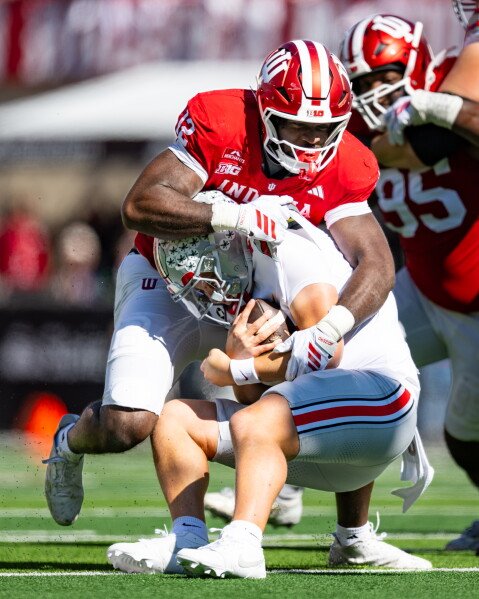
Those are outstanding defensive performances, particularly considering the pressure Indiana’s offensive struggles have placed on the team.
Against Ohio State, Indiana surrendered only 19 points.
Against Michigan, the Hoosiers held the Wolverines to six points and 224 yards.
Against Minnesota, Indiana limited the Gophers to 215 total yards and 16 points.
That is the kind of defensive production capable of winning football games against outstanding competition.
And consider the circumstances.
Indiana defeated Michigan 13–6 in overtime and Minnesota 23–16 in overtime.
The defense kept the Hoosiers in position to win both games despite inconsistent offensive production.
Indiana’s defense is not simply complementing the offense. It has been carrying a disproportionate share of the responsibility for winning football games.
That matters when evaluating Indiana as a complete team.
The CFP committee is not selecting the nation’s best offenses.
It is evaluating football teams.
And Indiana possesses one of the best defensive units in college football.
However, there is a limit to how much responsibility a defense can carry.
Eventually, the offense and special teams must contribute at a higher level.
The Offensive Problems Began Before Josh Hoover’s Injury
One of the most important conclusions from our four-game analysis is that Indiana’s offensive struggles did not begin with Josh Hoover’s shoulder injury against Ohio State.
They were evident against Nebraska.
That is why I believe the national conversation surrounding Indiana’s quarterback situation is missing the bigger issue.
Whether Hoover or Grant Wilson starts against USC, Indiana must correct problems that extend well beyond the quarterback position.
Consider the third-down production over the last four games.
Indiana’s Third-Down Efficiency
| Opponent | Conversions | Percentage |
|---|---|---|
| Nebraska | 1 of 10 | 10.0% |
| Ohio State | 8 of 16 | 50.0% |
| Michigan | 4 of 14 | 28.6% |
| Minnesota | 2 of 13 | 15.4% |
| Four-game total | 15 of 53 | 28.3% |
Source: Game statistics reviewed for Indiana’s four most recent contests.
Read that last number again.
Indiana has converted just 28.3% of its third-down opportunities over four games.
Three of those four performances were below 30%.
And against Michigan and Minnesota combined, Indiana converted only six of 27 third downs.
That is 22.2%.
Those are troubling numbers for any offense, much less one with aspirations of competing for a national championship.
The Ohio State game was the exception, with Indiana converting 50% of its third-down opportunities.
But the larger four-game trend is clear.
Indiana has struggled to consistently sustain possessions.
And that brings us to what I believe is the fundamental offensive issue.
First and Second Down: Where the Problems Begin
When I evaluate third-down efficiency, I don’t begin with the quarterback.
I begin with first and second down.
What is happening on those plays?
Are we gaining four or five yards on first down?
Are we creating second-and-manageable situations?
Are we consistently giving ourselves third-and-short opportunities?
Or are we repeatedly finding ourselves in third-and-seven, third-and-eight and third-and-nine situations?
The four-game conversion numbers establish that Indiana has a third-down problem. The exact frequency of third-and-seven-plus still needs to be measured from the play-by-play.
But from a coaching standpoint, the early-down execution deserves immediate scrutiny.
When an offense cannot establish the run or consistently gain positive yardage on early downs, the entire offensive structure becomes more difficult to execute.
Defenses can anticipate passing situations.
Pass rushers can attack.
Defensive coordinators can become more aggressive with pressure packages.
And the quarterback is forced to operate in unfavorable down-and-distance situations.
That is not simply a Josh Hoover problem.
That is an offensive problem.
And it is why changing quarterbacks alone will not automatically fix Indiana’s offense.
Indiana Has Faced Excellent Defenses — But That Doesn’t Explain Everything
We must acknowledge the quality of the defenses Indiana has faced.
Nebraska, Ohio State and Michigan have all demonstrated outstanding defensive ability.
The national defensive statistics we reviewed place Ohio State and Michigan among the country’s elite defensive units, while Nebraska has been particularly effective in total defense, rushing defense and third-down defense.
That context matters.
Defensive Quality of Indiana’s Recent Opponents
| Opponent | Defensive assessment | IU third-down rate |
|---|---|---|
| Nebraska | Top-tier total and third-down defense | 10.0% |
| Ohio State | Elite national defense | 50.0% |
| Michigan | Elite national defense | 28.6% |
| Minnesota | Strong third-down defense; less dominant overall | 15.4% |
The offensive struggles against Nebraska, Ohio State and Michigan become more understandable when considering the quality of those defensive units.
But Minnesota presents a different concern.
Minnesota has been effective defensively, particularly on third down, but I do not place the Gophers in the same overall category as Ohio State or Michigan.
Yet Indiana converted only two of 13 third downs against Minnesota.
And despite generating 419 yards of total offense, Indiana scored only 16 points in regulation.
That is a significant discrepancy between moving the football and producing points.
Did Minnesota’s defense shut down Indiana’s offense, or did Indiana’s offensive inefficiency make Minnesota’s defense look considerably better than it actually was?
I believe both contributed.
But Indiana’s execution deserves substantial scrutiny.
The Hoosiers cannot explain away every failed possession by pointing to the opponent.
At some point, championship-caliber offensive execution must become evident.
The Offensive Line Is at the Center of This Evaluation
Indiana has talented offensive skill players.
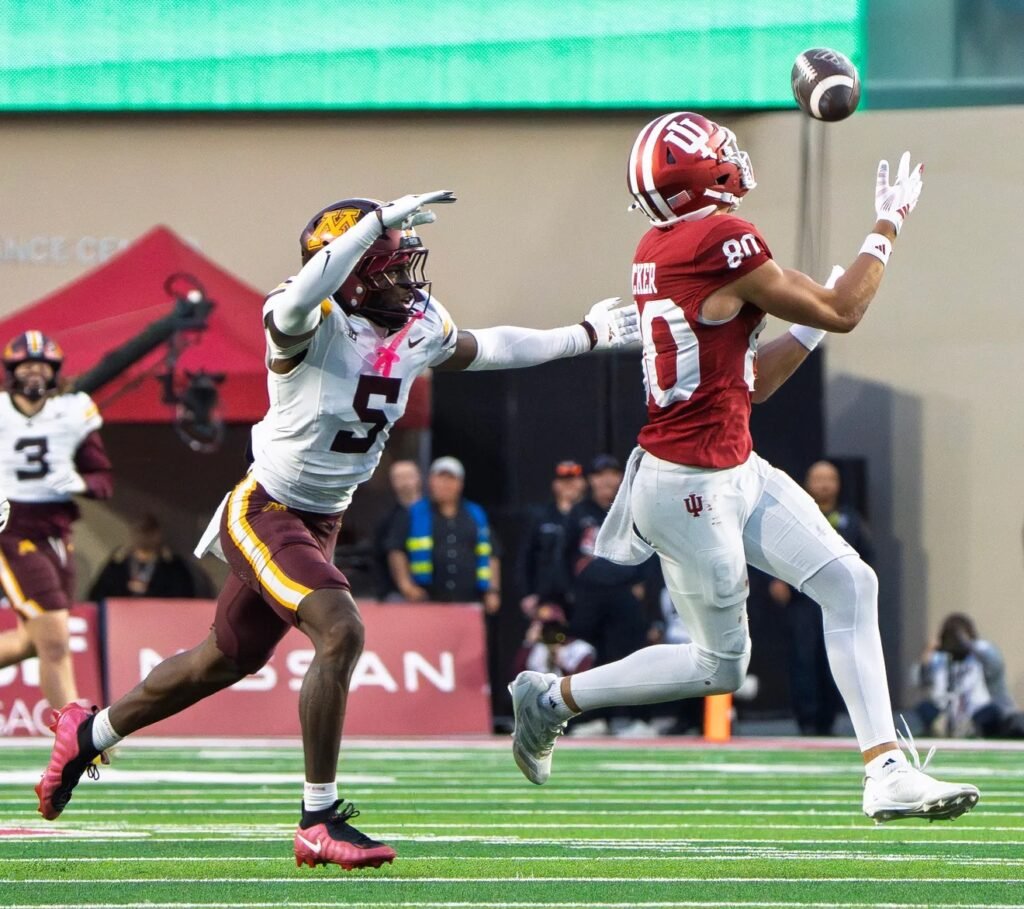
Nick Marsh and Charlie Becker give the Hoosiers two of the Big Ten’s most dangerous receiving threats.
Turbo Richards Jr. has demonstrated the ability to be a productive running back.
Yet Indiana has struggled to consistently establish its rushing attack.
That raises a fundamental question.
If Indiana possesses this level of talent at receiver and running back, why isn’t the offense producing more consistently?
For me, the investigation begins with the offensive line and the overall design of the running game.
Are Indiana’s offensive linemen consistently winning at the point of attack?
Are they creating movement and displacement?
Are combination blocks being executed properly?
Are defenders penetrating the backfield before the running backs reach their landmarks?
And are the blocking schemes providing enough variation to prevent defenses from anticipating the point of attack?
Consider the Nebraska game.
Indiana’s Offensive Production Against Nebraska
| Category | Production |
|---|---|
| Total offense | 328 yards |
| Rushing yards | 65 |
| Yards per rush | 3.0 |
| First downs | 13 |
| Third-down conversions | 1 of 10 |
| Time of possession | 20:27 |
Those numbers demonstrate how difficult it was for Indiana to consistently sustain offensive production.
The Hoosiers relied heavily on explosive passing plays to overcome those problems.
And that leads to another important issue.
Indiana has relied considerably on inside-zone and duo concepts in the running game.
Those are sound football schemes.
But when an offensive line is struggling to consistently create movement, the offense must provide additional answers.
Power.
Counter.
Perimeter runs.
Quarterback runs.
Complementary play-action concepts.
The objective is not simply to add more plays.
It is to create hesitation and uncertainty in the defense, change blocking angles and provide the offensive line with better opportunities.
Right now, Indiana needs that kind of adjustment.
The Lack of Explosive Plays Is Making a Difficult Situation Worse
When an offense struggles to consistently sustain possessions, explosive plays become even more important.
A 40-yard rushing play or a 50-yard touchdown pass can compensate for several unsuccessful possessions.
Explosive plays can change field position, create momentum and produce points without requiring a lengthy, mistake-free drive.
Indiana demonstrated that against Nebraska.
Josh Hoover connected with Nick Marsh on touchdown passes of 75 and 44 yards.
Those were game-changing plays.
But the Hoosiers have not consistently generated that type of explosive production during the subsequent stretch.
And that is especially troubling when the offense is struggling to convert third downs.
Think about the combination.
Indiana is not consistently running the football.
The Hoosiers are struggling to sustain possessions.
And they are not consistently producing explosive plays to overcome those difficulties.
That leaves an extremely thin margin for error.
A championship offense must be capable of sustaining drives, generating explosive plays or, preferably, doing both.
Indiana has not consistently demonstrated either ability recently.
That is a much deeper problem than simply deciding who should play quarterback.
Red-Zone Production Must Improve
Another major concern is Indiana’s ability to finish scoring opportunities.
When an offense is struggling to sustain drives, every possession that reaches scoring territory becomes especially valuable.
The difference between touchdowns and field goals can determine the outcome of close football games.
And empty possessions become even more costly.
Our preliminary review of the Ohio State, Michigan and Minnesota games identified a concerning red-zone touchdown trend. The exact possession counts still require verification against the official gamebooks before they should be published as final statistics.
But the scoring results themselves illustrate the concern.
Indiana scored only 13 points against Michigan and 23 against Minnesota, with both games requiring overtime.
Against Minnesota, the Hoosiers generated 419 yards but scored only 16 points in regulation.
That is not the scoring production expected from an offense with championship aspirations.
As a coaching benchmark, I would want a championship-caliber offense scoring on approximately 90% of its red-zone opportunities, with touchdowns on roughly 70–75% or more.
Those are demanding targets, not official NCAA averages.
But Indiana must become significantly more productive finishing drives.
The defense cannot be expected to hold every elite opponent below 20 points.
Eventually, the offense must consistently put touchdowns on the scoreboard.
Grant Wilson at QB1? Then Designed Quarterback Runs Must Be Part of the Offense
The quarterback discussion has understandably intensified following Hoover’s shoulder injury and Wilson’s performance in relief against Minnesota.
But I want to emphasize something.
Indiana’s offensive problems are not going to disappear simply because a different quarterback takes the field.
The offensive line must improve.
The running game must become more productive.
The offense must improve on first and second down.
And Indiana must generate more explosive plays.
However, Grant Wilson does offer one potential advantage that could help address those problems.
His ability to run the football.
If Wilson becomes Indiana’s starting quarterback, I believe the Hoosiers must incorporate designed quarterback runs into the offensive game plan.
Not merely an occasional scramble when a passing play breaks down.
Not simply a quarterback draw once or twice during a game.
Designed quarterback runs need to become a meaningful and consistent component of the offensive attack.
Why the Quarterback Run Changes the Numbers
In a traditional handoff, the quarterback gives the football to the running back and generally does not become an additional blocking threat.
The defense can concentrate its run fits on the running back and the blocking scheme.
But when the quarterback becomes a legitimate ball carrier, the defense must account for another potential runner.
That can change the arithmetic at the point of attack.
It can influence backside defenders.
It can create hesitation in defensive fits.
And it can potentially produce more favorable opportunities for the running backs.
Indiana could incorporate several concepts:
- Quarterback power & counter.
- Zone-read and split zone read concepts
- Designed quarterback draws.
- Read-option complements to the existing inside-zone and duo packages.
- Run-pass options that exploit defenses’ reactions to the quarterback run threat.
These concepts could also create additional opportunities for Marsh and Becker through play-action and perimeter passing concepts.
But Indiana must make the quarterback running game a legitimate threat.
If Wilson starts and the Hoosiers continue operating essentially the same rushing attack without using his mobility, what has fundamentally changed?
A quarterback change should create a schematic advantage.
It should not simply place a different player behind center.
Now, that doesn’t mean Wilson’s running ability automatically solves Indiana’s offensive-line problems.
The Hoosiers must still execute their blocks and improve at the point of attack.
And Wilson’s running workload must be managed intelligently.
But if he becomes QB1, his mobility offers one of the clearest opportunities to change how defenses must defend Indiana’s running game.
That is an advantage the coaching staff should use.
Special Teams: Indiana’s Other Major Problem
While the national conversation has concentrated on Indiana’s offense, another phase of this football team deserves serious scrutiny.
Special teams.
And the statistical evaluation is alarming.
Indiana’s Three-Phase Efficiency Rankings
| Phase | ESPN FPI efficiency | FPI national rank | SP+ national rank |
|---|---|---|---|
| Offense | 75.0 | #21 | #27 |
| Defense | 86.4 | #5 | #1 |
| Special teams | 35.4 | #126 | #90 |
| Overall | 82.9 | #11 | #6 |
Source: ESPN FPI efficiency and SP+ screenshots, November 7, 2026. FPI efficiency ratings and SP+ rankings use different methodologies.
Look at the contrast.
Indiana has a top-five defense according to FPI.
But its special teams rank 126th nationally.
SP+ is somewhat more favorable, placing Indiana 90th in special teams.
Neither ranking reflects the level of performance we should expect from a team competing for a national championship.
Coach Curt Cignetti recently described Indiana’s special-teams performance as solid.
I respect that assessment.
But I also believe the objective efficiency data raises legitimate questions about just how effective Indiana’s special teams have been.
There is a difference between avoiding obvious mistakes and consistently winning the special-teams phase.
And when an offense is struggling, special teams become even more important.
Punt Returns: Where Is the Field-Position Advantage?
Indiana needs greater production from its punt-return operation.
The goal cannot simply be to secure possession.
The Hoosiers need to create positive return opportunities, improve blocking execution and generate the occasional explosive return that changes field position.
A productive punt-return game can shorten the field for an offense struggling to sustain long drives.
And Indiana desperately needs that kind of assistance.
Kickoff Returns: Creating Better Starting Field Position
The same principle applies to kickoff returns.
Indiana must evaluate its return decisions, blocking execution and average starting field position.
Is the return game consistently creating an advantage?
Or would the offense be better served by taking available touchbacks?
Those decisions must be evaluated through actual field-position results rather than simply the appearance of a successful return.
Punting: Net Production Matters More Than Gross Average
When evaluating punting, I am interested in much more than how far the football travels.
Net punting.
Hang time.
Directional placement.
Punts inside the opponent’s 20-yard line.
Coverage execution.
And the ability to prevent significant return yardage.
Those are the measurements that determine whether a punting unit is helping its football team.
When Indiana’s offense is struggling, field position becomes even more valuable.
The Hoosiers need their punting operation to consistently support the defense.
Field Goals, Extra Points and Operation
The kicking game must be dependable.
That includes the entire operation.
Snap.
Hold.
Protection.
Timing.
And execution of the kick.
A missed field goal or failed operation can become decisive when games are being decided by one possession.
Indiana cannot afford to squander scoring opportunities when its offense is already struggling to generate touchdowns.
Kickoff and Punt Coverage
Coverage units must consistently control return lanes, maintain leverage and tackle effectively.
Allowing unnecessary return yardage places additional pressure on the defense.
And while Indiana’s defense has been outstanding, it should not continually be asked to compensate for unfavorable field position.
What the Efficiency Rankings Actually Tell Us
The FPI and SP+ numbers are composite evaluations.
They do not, by themselves, establish that every individual special-teams unit is performing poorly.
A complete unit-by-unit statistical review is necessary to determine precisely which components are responsible for Indiana’s low rankings.
But the overall results are difficult to dismiss.
No. 126 in FPI special-teams efficiency and No. 90 in SP+ are serious warning signs for a team ranked fourth in the CFP.
Indiana needs measurable improvement in its return production, kicking operation, coverage execution and field-position performance.
Special teams must become an asset.
Not simply a phase that avoids obvious mistakes.
Objective Data and Subjective Evaluation Must Work Together
One of the things that concerns me about the national college football conversation is how frequently opinions become more important than evidence.
Subjective evaluation has a legitimate place in football.
Coaches evaluate technique, effort, execution, scheme and personnel through film study.
Those judgments matter.
But they must be supported and challenged by objective evidence.
And the same is true of statistics.
Numbers tell us what happened.
Film study helps explain why.
The strongest evaluation combines both.
Indiana’s statistical profile gives us a clear picture of a football team with significant strengths and weaknesses.
The Hoosiers are fourth in the CFP rankings.
Fifth in Strength of Record.
Sixth in overall SP+.
Eighth in FPI.
Fifth in FPI defensive efficiency.
But only 21st in FPI offensive efficiency and 126th in special-teams efficiency.
Those are not insignificant differences.
They tell us that Indiana’s overall success is being supported by an outstanding defense and a strong résumé, while the other two phases have not consistently performed at the same level.
And our four-game offensive evaluation reinforces that conclusion.
A 28.3% third-down conversion rate is not the standard expected of a championship-caliber offense.
Neither is an inability to consistently establish the running game or produce explosive plays.
The evidence does not suggest Indiana is a bad football team.
Quite the opposite.
It suggests Indiana is a very good football team with an elite defense and significant problems that must be corrected.
What Must Change Before USC?
Indiana’s upcoming matchup with USC presents an important test.
The Hoosiers have had the benefit of a bye week to evaluate their personnel, offensive structure and overall execution.
Now those adjustments must become evident on the football field.
From my perspective, there are several critical priorities.
First, improve offensive-line execution.
Indiana must become more physical and consistent at the point of attack. The offensive line must create better opportunities for the running backs and reduce the frequency of negative or unproductive early-down plays.
Second, diversify the running game.
The Hoosiers need more than a steady diet of inside zone and duo. Power, counter, perimeter concepts and complementary runs should be evaluated as ways to challenge defensive fits.
Third, incorporate designed quarterback runs if Wilson becomes QB1.
Wilson’s mobility must be used as a schematic weapon. It offers a potential way to change the defensive arithmetic and create additional rushing opportunities.
Fourth, improve early-down efficiency and third-down conversions.
Indiana cannot continue converting fewer than 30% of its third-down opportunities over extended stretches and expect to consistently defeat elite competition.
Fifth, create more explosive plays.
The Hoosiers need more chunk gains in both the running and passing games. Those plays can compensate for occasional stalled possessions and reduce the burden on the offense to execute long drives perfectly.
Sixth, finish scoring opportunities with touchdowns.
Moving the football is not enough. Indiana must become more productive when it reaches scoring territory.
Seventh, demand significant special-teams improvement.
The return game, punting operation, kicking execution and coverage units all deserve close examination. The goal must be to create positive field-position value and dependable scoring support.
These are not minor adjustments.
They are fundamental requirements for a team hoping to compete for a national championship.
Final Assessment: Indiana Has a CFP Résumé and a Championship Defense — But Is Not Yet a Complete Championship Team
Let me be clear.
Indiana deserves recognition for what it has accomplished.
The Hoosiers are 8–1.
They own one of the strongest résumés in college football.
They have a defense capable of competing with the best teams in the country.
And they remain a legitimate College Football Playoff contender.
But I do not believe Indiana is presently playing like the fourth-best complete football team in America.
The defense is performing at a championship level.
The offense is not.
And special teams must improve dramatically.
That is not simply a subjective opinion.
It is an evaluation supported by the statistical evidence and the football we have watched over the last four games.
The offense has converted only 28.3% of its third-down opportunities during that stretch.
The rushing attack has struggled to consistently establish itself.
Explosive plays have not been produced consistently enough to compensate.
And the special-teams efficiency rankings are nowhere near the standard expected of a national championship contender.
None of those issues can be solved simply by changing quarterbacks.
Josh Hoover’s health matters.
Grant Wilson’s mobility could provide a valuable new dimension.
But Indiana must address the underlying problems with its offensive line, running game, early-down execution and overall offensive design.
If Wilson becomes the starter, designed quarterback runs must become a legitimate part of the offense.
And regardless of who starts at quarterback, special teams must become a positive contributor rather than another phase requiring the defense to compensate.
The national criticism of Indiana’s offense is deserved. But the national conversation must also acknowledge that Indiana possesses one of the best defenses in college football.
That defense is why the Hoosiers remain a serious playoff contender.
The résumé supports their place in the discussion.
But there is a significant difference between earning a College Football Playoff invitation and being equipped to win a national championship.
Right now, Indiana has demonstrated the first.
To accomplish the second, the Hoosiers must become a more complete football team.
Because championship defense can keep you in the game.
But championship football requires all three phases to help you win it.
— Coach Griff
Hoosier Football Tailgate | Coach Griff’s Football Analysis
One Comment