2026 Indiana Football Season Preview
Indiana enters the 2026 season in a place the program has never occupied before.
The Hoosiers are the defending national champions.
That sentence changes everything. Indiana is no longer the surprise team trying to earn national respect. Every opponent has spent the offseason studying what Curt Cignetti’s program does, how it practices and why it wins. Every stadium will be louder when Indiana arrives. Every mistake will be magnified, and every victory will be measured against a 16-0 championship standard.
That does not make the 2026 challenge impossible. It makes it different.
The central question in this 2026 Indiana football season preview is not whether the Hoosiers can recreate last year play for play. They cannot, and they should not try. The real question is whether Cignetti and his staff can build a new team with the same habits: preparation, toughness, discipline and an expectation of winning.
The program has changed
Championship seasons are often followed by transition. Star players leave, assistants draw attention, and the roster turns over. Indiana faces its share of those realities, but the program is operating from a stronger foundation than it had a year ago.
The Hoosiers return proven players at every level of the defense. The offensive line brings back multiple experienced starters. The transfer portal supplied a veteran quarterback, a proven running back and more receiving talent. Most importantly, the standards inside the building have already been tested at the highest level.
Cignetti’s message has been consistent: last season is over. That is the right message. A championship ring cannot win a third down in October, and a preseason ranking cannot protect the football in a hostile road environment.
Indiana must earn its identity again.
Josh Hoover takes over at quarterback
No position will receive more attention than quarterback, where TCU transfer Josh Hoover follows Heisman Trophy winner Fernando Mendoza.
Hoover does not need to become Mendoza. He needs to become the best version of Josh Hoover inside Mike Shanahan’s offense.
He arrives with substantial experience, including 31 starts at TCU and 16 career 300-yard passing games. That experience matters because Indiana is not asking a first-time starter to learn college football while also replacing a Heisman winner. Hoover has seen pressure, handled hostile environments and carried an offense.
The coaching points are straightforward. He must protect the football, master the timing of the system and understand that this roster should not require him to force the game. A strong running game and an excellent defense can be a quarterback’s best friends.
If Hoover plays efficiently in critical situations, Indiana can again field a championship-caliber offense.
The offensive line sets the ceiling
The biggest offensive question may not be quarterback. It may be the five players in front of him.
Indiana returns Carter Smith, Drew Evans and Bray Lynch from one of the nation’s best offensive lines. Smith is the anchor, with 41 consecutive starts at left tackle entering the season. The Hoosiers also have Adedamola Ajani and Wisconsin transfer Joe Brunner among the candidates competing to complete the unit.
Replacing center Pat Coogan’s production and leadership will require more than inserting a new name. The center organizes protections, communicates adjustments and stabilizes the entire operation. Indiana must identify its best five, establish their positions and allow that group to develop chemistry.
If the offensive line is merely adequate, the offense can be good. If it becomes a dominant, connected unit, Indiana can play for another championship.
New weapons, familiar expectations
The skill-position rooms offer a useful mix of returning production and transfer experience.
Michigan State transfer Nick Marsh provides size and proven big-play production. Charlie Becker returns after catching 34 passes for 679 yards and four touchdowns during the championship season. Tyler Morris adds veteran experience, while Shazz Preston, Lebron Bond and the rest of the receiver room give Hoover multiple ways to attack a defense.
At running back, Boston College transfer Turbo Richard brings speed, receiving ability and experience as a starter. The important issue will be building a rotation that keeps the position fresh without losing offensive rhythm.
Indiana does not need one player to replace every departed yard. It needs a collection of players who understand their roles and consistently win the moments the scheme creates for them.
Could the defense be even better?
It sounds unreasonable to ask whether a defense can improve after helping produce a 16-0 national championship season. Then the names go on the board.
Tyrique Tucker and Mario Landino lead a defensive line that may be the deepest unit on the roster. Rolijah Hardy and Isaiah Jones give defensive coordinator Bryant Haines an experienced linebacker tandem. Jamari Sharpe and Amare Ferrell return in the secondary, where transfers A.J. Harris and Preston Zachman add experience and versatility.
There are major players to replace, including D’Angelo Ponds and Aiden Fisher. Indiana will not replace either player with a carbon copy. Haines instead has the personnel flexibility to distribute those responsibilities across a fast, deep and multiple defense.
The front is the key. If Indiana can create pressure with four rushers, Haines can keep seven defenders in coverage and save his most aggressive pressure packages for the moments when they are most dangerous.
The schedule demands championship consistency
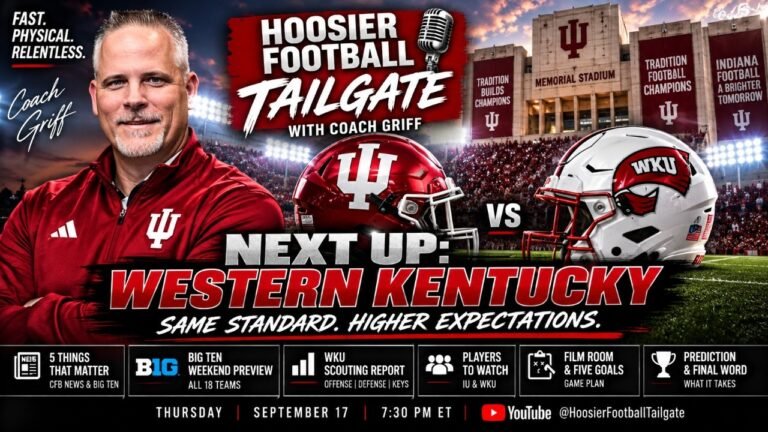
Indiana opens with three home nonconference games against North Texas, Howard and Western Kentucky before Big Ten play begins against Northwestern.
The middle of the schedule will reveal whether the Hoosiers are ready to defend their title. Indiana travels to Rutgers and Nebraska, hosts Ohio State, visits Michigan and then returns home for Minnesota.
After a November bye, the final three games are USC at home, Washington in Seattle and Purdue in Bloomington.
There is no single defining game. The challenge is the accumulation of physical football, travel and emotional peaks. Ohio State and Michigan will receive the headlines, but championship teams are also judged by how they handle the week after a major game and how they perform when conditions are imperfect.
The trip to Washington, followed by rivalry week against Purdue, is exactly the kind of closing stretch that tests depth and leadership.
Three keys to Indiana’s season
1. Win the turnover margin
The offense does not need to chase explosive plays at the expense of ball security. Hoover’s decision-making and the offense’s situational discipline will determine whether Indiana plays on schedule.
2. Find the best five offensive linemen
Talent matters. Communication and continuity matter more. Indiana must settle the offensive line early enough for the unit to grow together before the schedule reaches Ohio State and Michigan.
3. Let the defensive depth become a weapon
The Hoosiers have enough defensive linemen to play in waves. If the rotation remains productive, Indiana can stay fresh in fourth quarters and over the course of a long season.
The outlook
The range of outcomes is wide because the schedule is difficult and the standard is exceptionally high.
A 12-0 regular season would make Indiana a clear national-title contender. An 11-1 finish would almost certainly keep the Hoosiers near the center of the Big Ten and CFP discussion. At 10-2, Indiana could still produce an outstanding season with a playoff path. A 9-3 finish would represent a step back, but it would not erase what the program has become.
The most reasonable starting point is to view Indiana as a legitimate Big Ten and College Football Playoff contender—not because of last year’s trophy, but because of the roster, staff and standards returning in 2026.
Indiana will get everybody’s best shot.
Now the Hoosiers must prove their best is still good enough.
Watch the complete four-part Hoosier Tailgate schedule preview
Coach Griff broke Indiana’s 2026 schedule into four episodes, analyzing three opponents at a time. Watch the entire series below.
Part 1: North Texas, Howard and Western Kentucky
Part 2: Northwestern, Rutgers and Nebraska
Part 3: Ohio State, Michigan and Minnesota
Part 4: USC, Washington and Purdue
Watch and subscribe to Hoosier Football Tailgate on YouTube
Fast. Physical. Relentless.