The 200-Yard Line: Why Indiana’s Running Game Could Decide the Big Ten Opener
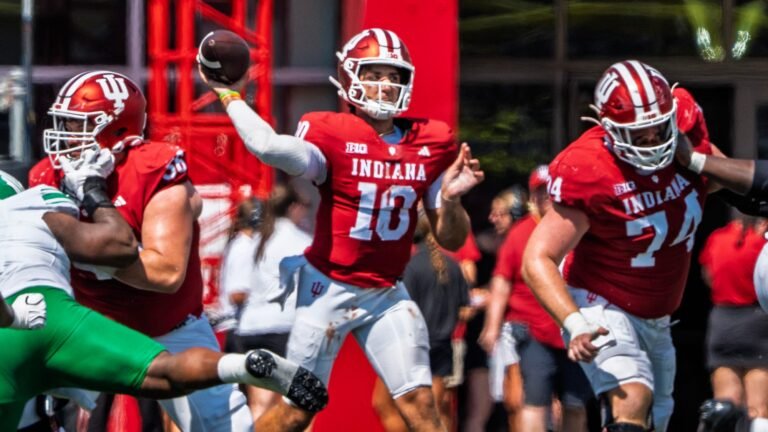
Indiana enters Big Ten play Friday night against Northwestern with Josh Hoover and the passing game receiving plenty of attention.
But the number that may matter most isn’t Hoover’s passing yardage.
It’s 200.
Under Curt Cignetti, reaching 200 rushing yards has been one of the clearest indicators of Indiana controlling a football game.
By the end of the 2025 regular season, Indiana was 12-0 under Cignetti when rushing for at least 200 yards — 5-0 when finishing between 200 and 299 and 7-0 when surpassing 300.
That makes Indiana’s ability to establish the run against Northwestern one of the most important areas to watch Friday night.
Indiana Has Found Its Running Game
Through three games, Indiana is averaging 221.0 rushing yards per game and 5.7 yards per carry.
The Hoosiers have rushed for seven touchdowns.
Turbo Richard has emerged as the centerpiece of the attack, while Lee Beebe Jr. gives Indiana another proven option in the backfield.
Against Howard, Richard and Beebe became Indiana’s first pair of 100-yard rushers in the same game since 2017.
Richard followed that performance by rushing for 149 yards on 15 carries against Western Kentucky, an average of nearly 10 yards per attempt.
Indiana finished that game with 233 rushing yards, three rushing touchdowns and 513 yards of total offense.
That is the formula Indiana would like to carry into Big Ten play.
Northwestern Presents a Different Challenge
Northwestern’s defense has been opportunistic, particularly when it comes to creating turnovers.
The Wildcats forced four turnovers against Colorado and enter Bloomington with a plus-four turnover margin.
But there is an area Indiana should test.
Northwestern is allowing 163.5 rushing yards per game.
Compare that with an Indiana offense averaging 221.0.
That’s a difference of 57.5 yards per game between what Indiana normally produces and what Northwestern has been surrendering.
Northwestern defensive lineman Michael Kilbane strengthens the front after returning to the lineup against Colorado. He earned a 91.9 PFF defensive grade and a 92.4 run-defense grade in that performance.
Indiana shouldn’t expect the 200-yard mark to come easily.
But it should attack it.
Don’t Forget Northwestern Can Run It, Too
This isn’t a one-sided rushing matchup.
Northwestern enters the game averaging 203.0 rushing yards per game.
That makes Indiana’s defensive performance through three games even more significant.
The Hoosiers are allowing only 77.0 rushing yards per game and 2.5 yards per carry.
Something has to give.
Northwestern wants to run for more than 200. Indiana’s defense is giving up 77.
Indiana wants to run for more than 200. Northwestern’s defense is giving up 163.5.
That could become the central battle Friday night.
Why 200 Matters
Reaching 200 rushing yards isn’t simply about accumulating statistics.
It usually means Indiana is winning first down. It means the offensive line is controlling the line of scrimmage. It means the Hoosiers aren’t living in third-and-long.
It makes play-action and the RPO game more difficult to defend.
And most importantly, it puts Josh Hoover in favorable situations rather than requiring the quarterback to carry the offense.
That’s where Indiana becomes particularly difficult to defend.
Hoover has completed 41 of 57 passes for 720 yards, 12 touchdowns and zero interceptions through three games.
If Northwestern has to commit additional defenders to Richard and Beebe, Indiana can create one-on-one opportunities for Charlie Becker, Nick Marsh, Tyler Morris and the rest of its receiving corps.
Conversely, if Northwestern chooses to defend Indiana with lighter boxes and protect against Hoover’s passing game, the Hoosiers have to be willing to keep handing the football to their backs.
Take what the defense gives you.
The Number to Watch Friday Night
Northwestern deserves Indiana’s attention.
The Wildcats are averaging roughly 460 yards of offense, better than 200 yards rushing, and quarterback Aidan Chiles has yet to throw an interception.
They’ve also shown an ability to create takeaways defensively.
But Indiana’s statistical profile is significantly different on the other side of the football.
The Hoosiers are allowing only 203.3 total yards and 5.3 points per game.
That’s what makes the rushing battle so intriguing.
Northwestern’s offense wants to establish the run against one of the nation’s better run defenses. Indiana’s offense gets a Northwestern defense allowing more than 160 rushing yards per game.
For Indiana, the path is clear.
Get Turbo Richard and Lee Beebe Jr. established. Control the line of scrimmage. Protect the football. Make Northwestern defend the entire field.
Then watch the scoreboard.
Because under Curt Cignetti, when Indiana gets across that 200-yard rushing line, winning has followed.