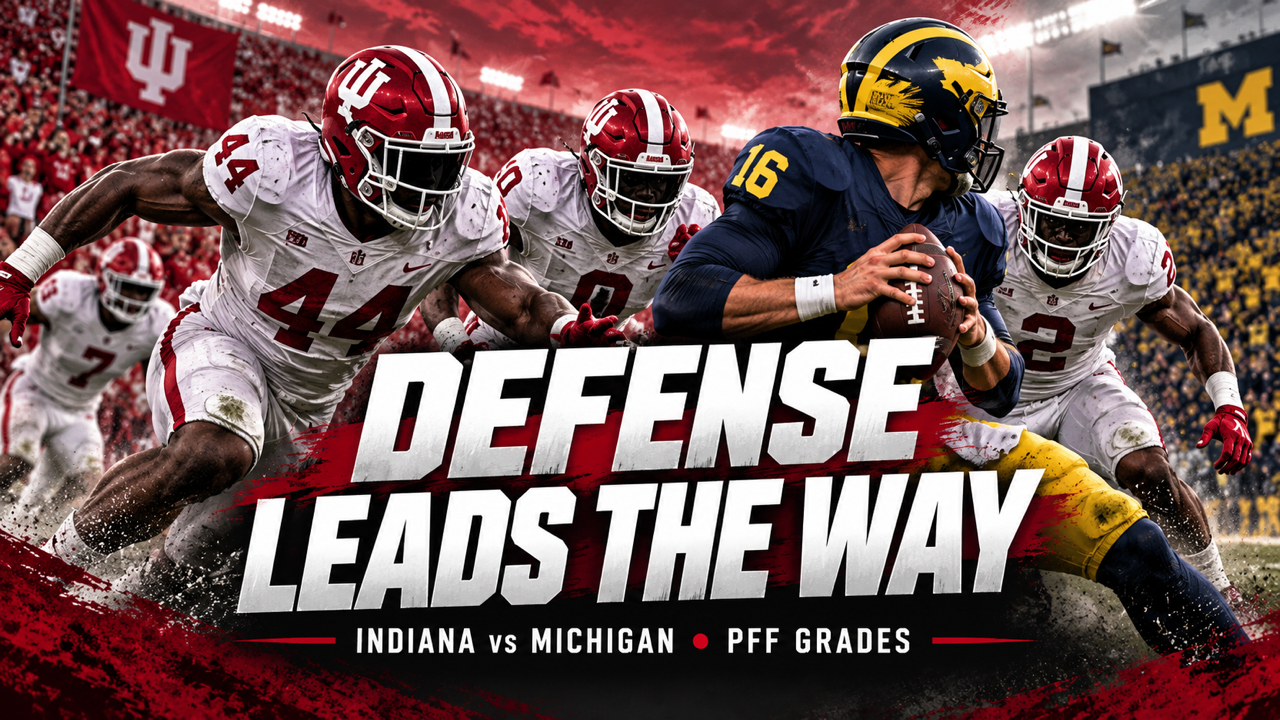
PFF Grades: Indiana’s Defense Delivers as Offense Struggles in 13–6 Victory at Michigan
By Coach Griff | HoosierTailgate.com
October 25, 2026
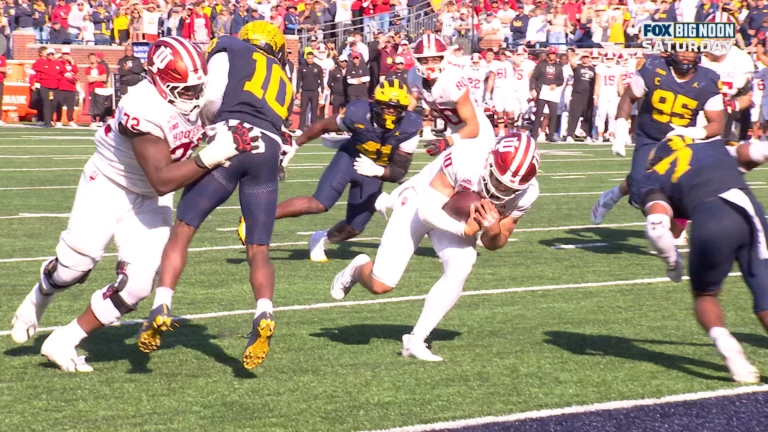
ANN ARBOR, Mich. — It wasn’t pretty, and it certainly wasn’t an offensive masterpiece. But Indiana’s 13–6 victory over Michigan in the Big House demonstrated something that championship-caliber football teams must be able to do: find a way to win when one phase of the game isn’t performing at its best.
The Pro Football Focus (PFF) grades from Saturday’s contest paint a remarkably clear picture. While Indiana’s offense struggled to establish consistency in either the passing game or rushing attack, Bryant Haines’ defense delivered an outstanding performance.
The Hoosiers’ defense earned an 82.1 overall PFF grade, compared to just 58.9 for the offense. The contrast tells much of the story.
Indiana’s Team PFF Grades
| Category | PFF Grade |
|---|---|
| Overall Offense | 58.9 |
| Passing | 48.6 |
| Pass Blocking | 72.8 |
| Receiving | 60.5 |
| Rushing | 62.8 |
| Run Blocking | 58.7 |
| Overall Defense | 82.1 |
| Run Defense | 91.2 |
| Tackling | 86.3 |
| Pass Rush | 56.4 |
| Coverage | 79.4 |
The two numbers that immediately jump off the page are Indiana’s 91.2 run-defense grade and 48.6 passing grade. One side of the football played at an exceptionally high level. The other struggled to sustain offensive production.
Bryant Haines’ Defense Was the Difference
When discussing Indiana’s victory, the conversation must begin with the defensive performance. Michigan managed only six points, and the Hoosiers’ defensive front and linebackers consistently disrupted the Wolverines’ attempts to establish their running game.
Indiana’s 91.2 run-defense grade was its second-highest of the season, trailing only the 94.2 earned against Howard. That is significant considering the opponent and the venue.
The Hoosiers also earned an 86.3 tackling grade, demonstrating sound fundamentals, pursuit angles and the ability to finish plays.
Amare Ferrell Leads the Defensive Grades
Safety Amare Ferrell turned in Indiana’s highest individual defensive grade at 83.7, including an outstanding 88.2 coverage grade. Ferrell also recorded an interception, providing another example of Indiana’s ability to create defensive opportunities.
Indiana’s Top Defensive Performers
| Player | Overall PFF Grade |
|---|---|
| Amare Ferrell | 83.7 |
| Isaiah Jones | 76.2 |
| Tyrique Tucker | 74.4 |
| Mario Landino | 74.0 |
| Jacob Savage | 72.9 |
| Josh Burnham | 72.7 |
| Jamari Sharpe | 71.1 |
| Tobi Osunsanmi | 70.6 |
| Joe Hjelie | 68.8 |
The play of Isaiah Jones and Jacob Savage deserves particular recognition. Jones earned an 80.6 run-defense grade, while Savage recorded an 80.4. Their production at linebacker was instrumental in Indiana’s ability to control Michigan’s ground attack.
Meanwhile, defensive tackles Mario Landino and Tyrique Tucker earned run-defense grades of 79.4 and 76.0, respectively.
The defense report credits Indiana’s defenders with 21 total pressures: three sacks, two hits and 16 hurries. Those are summed player pressure credits, rather than a count of distinct pressured dropbacks. Rolijah Hardy led the team with six pressure credits, including two sacks.
Coach Griff’s Take: Defensive football begins with controlling the line of scrimmage, maintaining gap integrity and tackling. Indiana demonstrated those fundamentals throughout Saturday’s contest. The defense didn’t need to manufacture negative plays through reckless pressure packages. It consistently won its assignments and forced Michigan to earn everything.
The Passing Game: A Difficult Afternoon for Josh Hoover
Indiana quarterback Josh Hoover completed just eight of 18 passes for 81 yards, with no touchdowns and one interception. His PFF grades reflected those struggles.
| Quarterback Metric | Result |
|---|---|
| Overall PFF Grade | 46.3 |
| Passing Grade | 48.6 |
| Completions/Attempts | 8/18 |
| Completion Percentage | 44.4% |
| Passing Yards | 81 |
| Passing TDs | 0 |
| Interceptions | 1 |
| Big-Time Throws | 1 |
| Turnover-Worthy Plays | 1 |
| Average Depth of Target | 10.5 yards |
Perhaps the most revealing statistic was Hoover’s performance on throws traveling 20 yards or more downfield. He attempted three such passes without a completion.
On intermediate throws between 10 and 19 yards, Hoover completed three of six attempts for 49 yards, but also threw his interception. The offense simply could not consistently stretch Michigan’s defense vertically.
Was It All on Hoover? Absolutely Not.
One of the mistakes commonly made when evaluating quarterback performance is focusing entirely on completion percentage and passing yardage without examining the surrounding circumstances. Quarterback play involves considerably more than throwing the football.
Protection, receiver separation, route concepts, defensive coverage and play-calling all contribute to the final result.
Interestingly, Hoover was under pressure on just three of his 20 PFF-charted dropbacks. That is 15% of those opportunities, meaning Hoover operated from a clean pocket on the overwhelming majority of his dropbacks.
The pass-blocking report separately charges Indiana’s blockers with two pressures allowed, both hurries credited to Drew Evans, with no sacks or hits charged to blockers. Hoover’s passing report records three pressured dropbacks and one sack. These reports measure different things; blocker pressure charges should not be treated as the total number of pressured quarterback dropbacks.
That statistic deserves attention. It suggests Indiana’s passing difficulties cannot be explained solely by pass protection. Hoover’s timing, accuracy, decision-making, receiver separation and the design of the passing concepts must all be evaluated.
Coach Griff’s Take: When a quarterback completes eight passes for 81 yards, it is easy to place the responsibility on one individual. But evaluating the position requires examining the entire offensive operation. The quarterback, offensive line, receivers and offensive coordinator all share responsibility for the execution of the passing game.
Offensive Line: Pass Protection Better Than Run Blocking
Indiana’s offensive line produced an interesting contrast in the PFF evaluations. The Hoosiers earned a respectable 72.8 pass-blocking grade but only a 58.7 run-blocking grade. Individually, several linemen performed well in pass protection.
Offensive Line PFF Grades
| Player | Overall | Pass Block | Run Block |
|---|---|---|---|
| Joe Brunner | 67.5 | 63.5 | 67.5 |
| Carter Smith | 65.5 | 79.4 | 60.2 |
| Adedamola Ajani | 63.6 | 77.4 | 64.4 |
| Bray Lynch | 58.2 | 81.4 | 55.0 |
| Drew Evans | 55.4 | 20.0 | 59.3 |
Lynch earned Indiana’s highest individual pass-blocking grade at 81.4, followed by Smith at 79.4 and Ajani at 77.4. However, Evans struggled considerably in pass protection, earning a 20.0 grade and allowing two quarterback hurries.
It is important to recognize that an individual blocking grade does not necessarily reflect the performance of the entire offensive line. In fact, Indiana’s overall pass protection was considerably better than the passing statistics might suggest.
The larger concern remains the run blocking. No offensive lineman earned a run-blocking grade above 67.5. For an Indiana offense built around physicality and controlling the line of scrimmage, that is an area requiring improvement.
The Running Game: Productive Enough, but Not Dominant
Indiana rushed for 135 yards on 34 attempts in PFF’s rushing report, averaging 4.0 yards per carry. Turbo Richard led the way with 69 yards on 19 carries, while Lee Beebe Jr. added 56 yards on 12 attempts. Hoover contributed another 10 rushing yards, including Indiana’s lone rushing touchdown.
Indiana Rushing Production
| Player | Carries | Yards | Average | PFF Rush Grade |
|---|---|---|---|---|
| Turbo Richard | 19 | 69 | 3.6 | 65.8 |
| Lee Beebe Jr. | 12 | 56 | 4.7 | 60.5 |
| Josh Hoover | 3 | 10 | 3.3 | 55.0 |
| Team | 34 | 135 | 4.0 | 62.8 |
What stands out is the relatively modest production despite Indiana’s commitment to running the football. PFF’s offensive snap classification lists 33 run plays and 21 pass plays across 54 snaps, while its rushing report includes 34 rushing attempts. The reports classify plays differently, including a quarterback scramble in the rushing totals.
The ground game produced only two runs of 10 yards or more. Indiana also forced seven missed tackles on rushing attempts, suggesting that creating consistent explosive opportunities remained difficult.
The Run-Game Design Question
For several weeks, I have questioned whether Indiana’s rushing attack has become too predictable against quality defensive fronts. Inside zone and duo concepts remain important components of any physical rushing offense.
However, against disciplined defenses, those concepts must be complemented by perimeter runs, gap-scheme variations, misdirection and quarterback involvement. Michigan’s defensive front presented challenges, but Indiana must continue finding ways to create favorable blocking angles and stress defenses horizontally.
Coach Griff’s Take: Physical football does not simply mean lining up and running directly into a defensive front. It means forcing defenders to defend the entire field, creating leverage advantages and allowing offensive linemen to execute blocks with favorable angles. Scheme and execution must work together.
Brock Schott Leads Indiana’s Offensive Grades
One of the encouraging developments was the performance of tight end Brock Schott. Schott earned Indiana’s highest overall offensive grade at 73.4, including a 74.2 receiving grade.
Charlie Becker finished with a 67.2 overall grade, while Richard earned a 66.4. Nick Marsh, meanwhile, finished with a 52.7 overall grade and 57.9 receiving grade.
Top Offensive Grades
| Player | PFF Overall |
|---|---|
| Brock Schott | 73.4 |
| Joe Brunner | 67.5 |
| Charlie Becker | 67.2 |
| Turbo Richard | 66.4 |
| Carter Smith | 65.5 |
| Adedamola Ajani | 63.6 |
| Lee Beebe Jr. | 60.7 |
| Bray Lynch | 58.2 |
The challenge for Indiana moving forward will be finding ways to get its most dangerous receiving threats involved consistently. Marsh and Becker possess the ability to change games, but the passing offense must provide opportunities for them to create explosive plays.
What the PFF Grades Tell Us Moving Forward
Indiana leaves Ann Arbor with a victory, but the PFF evaluations reveal several areas requiring attention.
First, the defense continues to establish itself as the foundation of this football team. Second, the offensive line must improve its consistency in the running game. Third, Indiana’s passing attack needs more efficient production, particularly on intermediate and vertical concepts. Finally, the coaching staff must continue examining how offensive design can create more favorable opportunities for its personnel.
None of these observations diminish the significance of winning at Michigan. Winning on the road in the Big Ten is difficult, and winning when your offense struggles is a testament to the team’s overall resilience. But championship football requires continued improvement.
Coach Griff’s Final Word
There is an important distinction between evaluating a football team’s performance and simply criticizing individual players. PFF grades provide valuable information, but they are not a substitute for studying the film, understanding assignments and recognizing the decisions being made within each play.
Indiana’s defense played at a championship level against Michigan. The offense did not. Both statements can be true while recognizing the significance of another Big Ten road victory.
The Hoosiers found a way to win because their defense was disciplined, physical and relentless. Now the challenge is getting the offense back to the same standard.
Fast. Physical. Relentless.
That’s the standard Curt Cignetti has established. And Saturday in Ann Arbor, the defense demonstrated exactly what that standard looks like.
Coach Griff is a former college football coach with 28 years of coaching experience and a former member of the NCAA Division III National Football Championship Selection Committee. He provides football analysis for TheHoosier.com and hosts Hoosier Football Tailgate.
Source: Pro Football Focus (PFF), Indiana vs. Michigan, October 24, 2026. PFF grades are proprietary evaluations of individual and team performance and should be considered alongside game film and traditional statistics.