Fast, Physical & Relentless: Indiana’s Defense Is Carrying the Hoosiers
By Coach Griff | HoosierTailgate.com | October 25, 2026
ANN ARBOR, Mich. — When the offense isn’t clicking and every possession becomes a battle, somebody has to step forward. For Indiana, that somebody has been Bryant Haines and his defense.
Beginning with the second half against Nebraska and continuing through the 13–6 overtime victory at Michigan, Indiana’s defense has become the stabilizing force of Curt Cignetti’s football team. The relevant span is 10 regulation quarters plus Michigan’s overtime defensive possession—not 12 full quarters.
The Turnaround in Lincoln
Nebraska’s ability to extend drives and stress Indiana with quarterback Anthony Colandrea challenged the Hoosiers early. After halftime, Indiana’s defense adjusted, allowing seven second-half points in the 20–17 win.
Jamari Sharpe intercepted a Nebraska pass in the third quarter. That takeaway was a valuable defensive stop, but it left Indiana at its own two-yard line. The ensuing offensive series went three-and-out and ended in a punt. It was not an example of a short field or a squandered red-zone possession.
Ohio State: Creating the Opportunity to Win
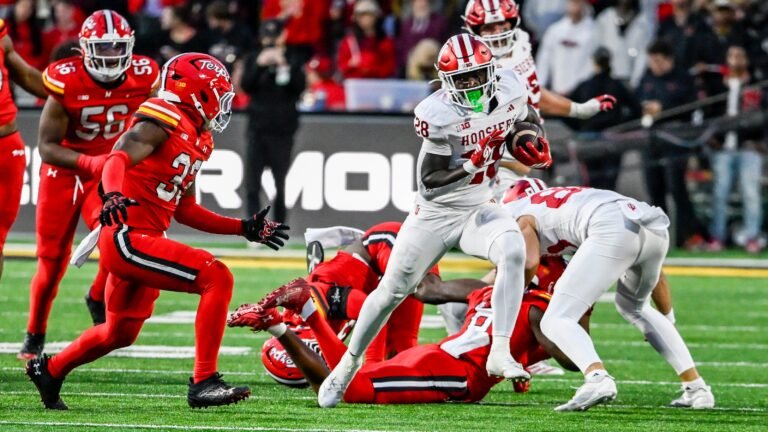
Indiana’s 19–15 loss to Ohio State ended its 22-game winning streak, but the defensive performance deserved more recognition. The Hoosiers held a talented Buckeyes offense to 19 points and 78 rushing yards.
Amare Ferrell intercepted two passes. On the first, his 23-yard return positioned Indiana at the Ohio State seven-yard line. Turbo Richard scored two plays later: the defense had manufactured a touchdown opportunity, and the offense finished it.
Ferrell’s second interception gave Indiana possession at its own 17-yard line. That drive eventually ended in a missed 55-yard field goal. This takeaway, like Sharpe’s against Nebraska, was an important defensive play but did not hand the offense immediate scoring position.
Michigan: Two Short Fields, Two Field Goals
Against Michigan, the Hoosiers’ defense was dominant. The Wolverines scored only six points, rushed for 57 yards on 42 attempts, and finished with 224 total yards on 74 offensive plays. Indiana produced four sacks and 10 tackles for loss, and Michigan never reached the end zone.
More importantly, Indiana’s defense created two first-half scoring opportunities. Ferrell intercepted a pass following a disruption by A.J. Harris, and Indiana took possession at the Michigan 28-yard line. Later, Isaiah Jones recovered a fumble to set up the offense at the Michigan 21.
Both drives ended in field goals. The defense handed the offense possession deep in Michigan territory twice, but those two opportunities produced six points instead of the possible 14. That difference helped keep Michigan within striking distance until overtime.
When the Wolverines received their overtime possession, the Hoosiers again delivered the decisive stop, preserving the 13–6 win and Indiana’s first victory at Michigan Stadium since 1967.
Five Takeaways, 13 Points: What the Numbers Actually Show
| Opponent | Defensive takeaway | Next Indiana possession |
|---|---|---|
| Nebraska | Jamari Sharpe interception | Started IU 2; punt, 0 points |
| Ohio State | Amare Ferrell interception, 23-yard return | Started OSU 7; touchdown, 7 points |
| Ohio State | Amare Ferrell interception | Started IU 17; missed 55-yard field goal, 0 points |
| Michigan | Amare Ferrell interception | Started Michigan 28; field goal, 3 points |
| Michigan | Isaiah Jones fumble recovery | Started Michigan 21; field goal, 3 points |
Totals: four interceptions, one recovered fumble, five takeaways, and 13 points on the five ensuing offensive possessions.
That total needs context. Three takeaways handed Indiana possession inside the opponent’s 30-yard line: once against Ohio State and twice against Michigan. Those three short-field opportunities produced 13 of a possible 21 points. The other two takeaways occurred deep in Indiana territory, and neither was an automatic scoring opportunity.
Ferrell deserves particular recognition: he accounted for three interceptions across the Ohio State and Michigan games, including the Ohio State return that set up Indiana’s touchdown.
Why Haines’ Defense Is Working
Indiana’s defensive front has consistently challenged opponents at the line of scrimmage, producing negative plays and limiting rushing production. Haines has combined disruption up front with disciplined coverage and selective pressure rather than relying exclusively on all-out blitzes.
Equally important is situational football. Against Nebraska, the defense adjusted after halftime. Against Ohio State, it created two interceptions and held an explosive opponent to 19 points. Against Michigan, it protected a narrow lead for most of the afternoon, produced two takeaways, and made the final stop in overtime.
Complementary Football: The Offense Must Finish
Indiana’s defense is doing more than preventing points. It is generating possessions and, in several cases, giving the offense outstanding field position. Yet the offense cannot assume those opportunities will keep arriving.
The Michigan game provides the clearest illustration. Twice the defense delivered the football inside the Wolverines’ 30. Twice Indiana settled for three points. Against high-level opponents, the difference between field goals and touchdowns can decide a season.
This is not an argument for blaming one quarterback, lineman, or play-caller. Offensive production is a collective responsibility, just as defensive success is. But when the defense manufactures a short field, the offense must be prepared to capitalize.
Coach Griff’s Final Word
As a former college football coach, I’ve always believed that the best defenses are defined by their response to adversity. Can they get off the field when the offense struggles? Can they defend a short field? Can they force a turnover when the game needs one? Can they make the final stop?
Over this stretch, Indiana’s defense has answered those questions repeatedly. Bryant Haines, his staff, and the players deserve credit for the discipline, toughness, and execution they have displayed against three consecutive Big Ten opponents.
But championship football requires both sides of the ball to contribute. The defense has supplied stops, takeaways, and scoring chances. Now the offense must consistently turn those chances into touchdowns.
Indiana’s defense has become the backbone of this football team. The next step is making sure its outstanding work is rewarded on the scoreboard.
Fast. Physical. Relentless.
Coach Griff is a former college football head coach with 28 years of collegiate coaching experience, lead football analyst for TheHoosier.com, and host of Hoosier Football Tailgate.