What Head Coaches Really Expect in Week 1: The Non-Negotiables
The first game of a season is rarely about perfection.
Coaches know that.
They understand that timing will not be exact, communication can still be developing, and players are transitioning from controlled practice environments into the speed and unpredictability of a real game.
What head coaches are looking for in Week 1 is something different.
They want to know whether their team can function.
Can players communicate? Can they align correctly? Can they handle substitutions? Can the quarterback get everyone on the same page? Can the defense adjust to motion? Can special teams avoid giving away hidden yardage?
Those are the things that tell a staff whether its football team is truly ready to play.
The opener is not just a game.
It is an evaluation.
Communication Comes First
Before coaches can worry about scheme, they have to know whether the team can communicate.
That sounds simple, but it affects everything.
Offensively, the quarterback has to receive the call, communicate it clearly, identify the front, recognize pressure indicators and make whatever checks are required.
The offensive line has to hear the protection.
Receivers have to understand adjustments.
Running backs have to know whether a pressure changes their responsibility.
Defensively, communication may be even more important.
Linebackers and safeties are often responsible for getting the defense lined up. They have to recognize formations, communicate strength, handle motions and shifts, and make sure everyone understands the call.
If one player does not hear the adjustment, the entire structure can break down.
That is why coaches pay so much attention to communication during an opener.
It is the foundation of everything else.
Alignment Is a Coaching Staff’s First Warning Sign
Coaches can live with a player getting beaten physically.
What frustrates them is when a player is beaten before the ball is snapped.
Bad alignment is one of the fastest ways to tell that a team is not mentally prepared.
A linebacker lined up a yard too far inside changes a run fit.
A defensive back playing with the wrong leverage can compromise the coverage.
An offensive lineman using the wrong split can affect a combination block.
A receiver lined up incorrectly can create an illegal formation before the play even begins.
Week 1 exposes those details quickly.
The goal is not simply to get lined up.
The goal is to get lined up correctly, quickly and consistently.
Good football teams do not waste time figuring out where they belong.
Procedural Penalties Are Often More Important Than the Final Score
False starts.
Illegal formations.
Too many men on the field.
Delay of game.
Offsides.
Substitution penalties.
Those are the mistakes coaches hate in an opener because most of them are preventable.
A holding penalty can happen because a player gets beaten.
A pass-interference call may come from a difficult coverage situation.
But a false start before the snap? That is usually concentration.
Twelve men on the field? Communication.
Delay of game? Operation.
Those mistakes tell coaches that the mechanics of the team are not yet where they need to be.
The best teams in Week 1 are not always the teams that execute everything perfectly.
They are often the teams that simply avoid beating themselves.
Assignment Football Matters More Than Highlight Plays
Every player wants to make a play.
Coaches want players to do their job.
There is a difference.
A defensive end may chase a quarterback and make a spectacular tackle, but if he abandons the edge responsibility and allows a reverse to run behind him, the staff will notice.
A linebacker may make ten tackles, but if he repeatedly fits the wrong gap, the defense has a problem.
A receiver may catch a touchdown, but if he runs the wrong route on third down earlier in the game, that mistake can be just as important.
Week 1 is where coaches begin to find out whether players can execute assignments under pressure.
Talent matters.
Discipline matters more.
The great teams eventually combine both.
Quarterback Checks Tell Coaches How Far the Offense Has Come
For quarterbacks, the first game reveals much more than arm talent.
It reveals command.
Can the quarterback identify the defensive front?
Can he recognize a pressure look?
Can he adjust protection?
Can he change a route?
Can he get the offense out of a bad play?
Can he operate the tempo of the game without looking rushed?
Those are the things coaches are watching.
A quarterback may not have gaudy statistics in Week 1, but if the offense consistently operates correctly, the staff may come away very encouraged.
The opposite is also true.
A quarterback can throw for 300 yards and still leave coaches concerned if protections are missed, checks are late or the operation is disorganized.
The box score rarely tells the entire story.
Linebacker Communication Is the Defensive Equivalent
If the quarterback is the traffic controller of the offense, the linebacker often fills that role for the defense.
The linebacker has to see the formation, communicate strength, adjust to motion, anticipate pressure responsibilities and make sure the front and secondary are connected.
That is difficult enough against a familiar offense.
In Week 1, when teams are often seeing new personnel and new wrinkles, that responsibility becomes even more important.
Coaches want linebackers who can think quickly without playing slowly.
That balance matters.
The best defensive communicators do not simply know the call.
They understand why the call is being made.
Adjustments May Be the Biggest Test of the Day
Every coaching staff enters the opener with a plan.
That plan rarely survives the entire first quarter unchanged.
Opponents always show something unexpected.
Maybe the offensive formation is different.
Maybe the defensive pressure package is more aggressive.
Maybe a player is being used differently than expected.
Maybe the tempo is faster.
Maybe the protection plan has changed.
That is when coaching staffs begin adjusting.
The first series is information.
The second series is confirmation.
By the third series, good teams should begin having answers.
That is one of the biggest things coaches evaluate in Week 1.
Can players absorb a sideline adjustment and execute it immediately?
A team that cannot adjust becomes predictable.
A team that can adjust becomes difficult to beat.
Special Teams Reveal Discipline Quickly
Special teams are often overlooked by fans during the preseason.
Coaches do not overlook them.
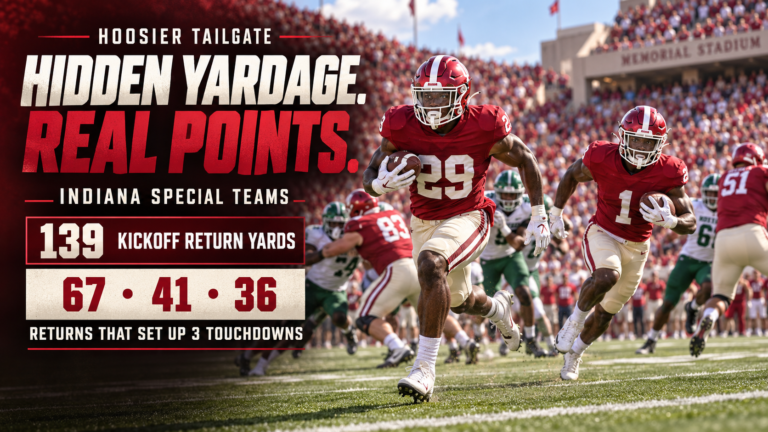
They understand how quickly special teams can change a game.
A missed assignment on punt protection can create a blocked kick.
Poor lane discipline can produce a long return.
A bad substitution can force a timeout.
A penalty can flip field position.
Indiana has already seen how significant those moments can be under Curt Cignetti.
In the national championship game, a blocked punt recovered by Isaiah Jones for a touchdown became one of the defining plays of the night.
That is exactly why special teams matter so much in an opener.
They reveal organization.
They reveal effort.
They reveal discipline.
And they can change momentum faster than almost any other phase of football.
Week 1 Is About Finding Out What You Have
Coaches spend months preparing for an opener.
Spring practice.
Summer workouts.
Preseason camp.
Scrimmages.
Meetings.
Walkthroughs.
But eventually, the opponent is wearing a different-colored jersey and the scoreboard is turned on.
That changes everything.
Week 1 is when coaches begin finding out what they actually have.
Who communicates?
Who responds to adversity?
Who handles a mistake?
Who can make an adjustment?
Who can be trusted?
That last question may be the biggest one of all.
Because by the time conference play arrives, coaches need to know exactly which players they can trust when the game gets tight.
The opener is where that process begins.
Teams do not have to be perfect in Week 1.
But the best ones already look organized, disciplined and connected.
And for a head coach, those are the real non-negotiables.