Indiana Controls Its Own Destiny: Three Games, One Opportunity, and No Excuses
By Coach Shannon Griffith | Hoosier Football Tailgate
Oregon’s upset of Ohio State has opened the door for Indiana to reach the Big Ten Championship Game and strengthen its College Football Playoff position. Now the Hoosiers must walk through it.
There comes a point during every championship season when the conversation changes. The discussion is no longer about what other teams must do, which opponents need to lose, or whether the rankings committee will give a program the respect it deserves.
Instead, the conversation becomes remarkably simple.
Win your football games, and take care of your own business.
That is precisely where the Indiana Hoosiers find themselves entering the final three weeks of the 2026 regular season.
Following Oregon’s impressive 41–28 victory over Ohio State in Columbus on Saturday, Indiana (8–1 overall, 5–1 Big Ten) controls its own path to the Big Ten Championship Game in Indianapolis.
There are no complicated scenarios Indiana needs to navigate. No scoreboard watching. No hoping another program stumbles.
Beat USC. Beat Washington. Beat Purdue.
Do those three things, and Indiana finishes 11–1 overall and 8–1 in the Big Ten, earning a place in the conference championship game.
And if the Hoosiers fail to capitalize on this opportunity, there will be nobody else to blame.
Not the College Football Playoff committee. Not the conference schedule. Not the national media. Not the officials.
Indiana has been handed control of its own destiny. What happens next belongs entirely to the Hoosiers.
Oregon’s Victory Changes Everything
Saturday’s biggest development for Indiana occurred hundreds of miles away in Columbus, Ohio.
Oregon entered Ohio Stadium needing a signature victory and delivered one, defeating Ohio State 41–28. The result handed the Buckeyes their second Big Ten defeat and third overall loss, significantly altering the conference championship race.
For Indiana, the implications were enormous.
The Hoosiers entered their bye week knowing that Ohio State owned the head-to-head advantage following its victory in Bloomington earlier this season. That result potentially complicated Indiana’s championship prospects if the two teams finished with identical conference records.
Oregon eliminated that particular obstacle.
Indiana now sits one conference loss behind undefeated UCLA, while Ohio State, Oregon, Iowa, USC, Illinois, and Wisconsin each have two Big Ten defeats.
The opportunity is clear.
Indiana doesn’t need help anymore.
But opportunity and accomplishment are two entirely different things.
The Big Ten Championship Race: Far From Settled
The conference standings entering November 8 illustrate just how competitive the Big Ten has become.
| Team | Overall | Big Ten |
|---|---|---|
| UCLA | 9–0 | 6–0 |
| Indiana | 8–1 | 5–1 |
| USC | 7–2 | 4–2 |
| Iowa | 7–2 | 4–2 |
| Oregon | 6–3 | 4–2 |
| Ohio State | 6–3 | 4–2 |
| Illinois | 6–3 | 4–2 |
| Wisconsin | 6–3 | 4–2 |
UCLA remains the conference’s only undefeated team. The Bruins have earned their position, but their remaining schedule is hardly a formality.
UCLA must face Illinois, travel to Michigan, and then host rival USC.
Indiana’s road is equally challenging, beginning with a USC program that already owns a victory over Ohio State.
If both Indiana and UCLA win their final three games, they would meet in Indianapolis for the Big Ten Championship.
But with so many conference teams sitting at two losses, another upset could dramatically reshape the championship picture.
The important distinction for Indiana is that those other outcomes no longer need to dictate its future.
The Hoosiers can settle the matter themselves.
USC: The Most Important Game of Indiana’s Season
Saturday’s matchup against USC at Memorial Stadium represents much more than another conference game.
It is arguably the most consequential game remaining on Indiana’s regular-season schedule.
First, a victory keeps Indiana on course for the Big Ten Championship Game.
Second, it strengthens the Hoosiers’ College Football Playoff résumé.
Third, it gives Indiana an opportunity to demonstrate that its recent offensive struggles can be corrected against a quality opponent.
And fourth, it prevents a two-loss USC team from gaining another significant victory while handing Indiana a potentially damaging second defeat.
Consider what USC brings to Bloomington.
The Trojans are 7–2, with a victory over Ohio State already on their résumé. They also have losses to Wisconsin and Oregon, making their postseason outlook particularly interesting.
A victory at Indiana would provide USC with another major résumé-building win and potentially reopen the conference championship race.
For the Hoosiers, that makes Saturday a practical must-win.
A loss would not automatically eliminate Indiana from the College Football Playoff, but it would surrender the control the Hoosiers currently possess and make the final two weeks considerably more complicated.
At 10–2, Indiana could still receive serious consideration for an at-large playoff berth. However, its résumé would include losses to Ohio State and USC, with the latter having direct implications for how the committee evaluates the Big Ten’s crowded group of contenders.
That is not a position Indiana should want to occupy.
The Hoosiers have an opportunity to remove much of the uncertainty by winning Saturday.
Oregon Has a Legitimate College Football Playoff Argument
While much of the national discussion surrounding the Big Ten has focused on Indiana, UCLA, Ohio State, and USC, Oregon deserves considerably more attention.
The Ducks are 6–3 overall, which immediately creates a challenge when comparing their résumé against teams with one or two losses.
But simply counting losses without examining the quality of victories and defeats is an incomplete method of evaluating a football team.
Oregon has now defeated USC and Ohio State, both on the road.
Those are two significant victories, particularly when considering the difficulty of winning in hostile conference environments.
The Ducks also suffered a narrow two-point loss to undefeated UCLA in a game whose controversial finish has been part of the discussion surrounding that result.
The committee should examine the entire résumé rather than treating a three-loss record as an automatic disqualification.
That does not mean Oregon should automatically be included in the 12-team playoff field. Three losses matter, and the committee must evaluate the complete body of work.
But the Ducks have demonstrated that they can defeat quality opponents away from home.
How many teams competing for the final at-large playoff positions can make that same claim?
Oregon’s 41–28 victory at Ohio State only strengthens that argument.
If the Ducks win their remaining games and finish 9–3, their case deserves a serious examination.
The question becomes whether three losses should outweigh two substantial road victories when comparing Oregon with teams whose records may be better but whose schedules and quality wins are less impressive.
That is precisely the type of discussion the College Football Playoff committee should be having.
Iowa, USC, and Illinois Deserve Consideration Too
Oregon is not the only Big Ten team whose postseason résumé deserves scrutiny.
Iowa (7–2) remains a legitimate contender in the broader playoff discussion. The Hawkeyes have been particularly effective defensively, allowing just 110 points through nine games, an average of approximately 12.2 per contest.
Iowa’s defense gives the Hawkeyes an opportunity to compete against quality opponents, but the committee must still examine their strength of schedule and the quality of their victories.
A strong record alone cannot settle the argument.
USC (7–2) may have the most immediate opportunity to transform its playoff résumé.
The Trojans already own a victory over Ohio State and still have games against Indiana and UCLA.
Win those contests, and USC would have a compelling collection of high-profile victories. But its losses to Wisconsin and Oregon must remain part of the evaluation.
The Trojans’ ceiling is high, but their margin for error is extremely small.
Illinois (6–3) is another program that should not be dismissed simply because it has three losses.
The Fighting Illini have won four consecutive games and sit at 4–2 in Big Ten play. Their upcoming trip to UCLA gives them a major opportunity to establish a signature victory.
Illinois has more work to do than Iowa or USC to construct a convincing playoff argument. However, if the Illini continue winning against quality competition, the committee should evaluate their improvement and complete résumé.
The larger point is that the Big Ten has several teams capable of presenting credible arguments for playoff consideration.
The conference’s depth should not be overlooked simply because several contenders have accumulated two or three losses while competing against one another.
Will the CFP Committee Apply the Same Standards to the Big Ten and SEC?
This is where the national playoff conversation becomes especially interesting.
The SEC has received substantial recognition in the initial College Football Playoff rankings, and several of its teams remain positioned to compete for postseason berths.
That recognition may be justified based on the quality of individual teams and their schedules.
However, the same standards must be applied to the Big Ten.
If a three-loss SEC program can receive consideration because of its strength of schedule and quality victories, then Oregon deserves an opportunity to present the same argument.
The committee cannot emphasize quality wins for one conference while using total losses as the overriding consideration for another.
Strength of schedule matters. Head-to-head results matter. Common opponents matter. Game control matters. Injuries and player availability can matter.
But those factors should be applied consistently.
Oregon’s road victories against USC and Ohio State are meaningful. Iowa’s defensive performance is meaningful. USC’s victory over Ohio State is meaningful. Illinois’ late-season momentum could become meaningful if accompanied by additional quality victories.
The committee should evaluate those accomplishments against the complete résumés of competing SEC, ACC, and Big 12 programs.
Conference affiliation should not become a substitute for objective evaluation.
Indiana’s Biggest Obstacle May Still Be Indiana
For all the excitement surrounding the championship race, Indiana has significant football issues that must be addressed.
The Hoosiers are 8–1, ranked fourth in the initial CFP rankings, and positioned to compete for a conference championship.
Those accomplishments deserve recognition.
But anyone who has watched Indiana closely over the past month understands that the offense has not consistently performed at a championship level.
The Hoosiers have struggled to establish a reliable rushing attack, generate explosive plays, and consistently finish possessions.
The quarterback discussion surrounding Josh Hoover’s health and Grant Wilson’s potential role is important, but Indiana’s offensive problems extend beyond one position.
Changing quarterbacks does not automatically fix run blocking, offensive-line execution, limited explosive production, or an offensive approach that has become too predictable.
If Wilson becomes the starter, Indiana must incorporate designed quarterback runs and additional elements that force defenses to account for another legitimate rushing threat.
Power, counter, perimeter runs, and greater involvement from receivers in the running game should all be part of the discussion.
Indiana must find ways to create explosive plays rather than relying on sustained drives requiring nearly flawless execution.
The defense has carried a substantial portion of the burden.
Through nine games, Indiana has allowed just 112 points, an average of approximately 12.4 points per game.
That is championship-level production.
But even an outstanding defense cannot be expected to repeatedly overcome offensive inefficiency and poor field position.
Special teams must improve as well.
Field position, return production, coverage execution, and the overall consistency of the kicking game all contribute to winning close football games.
Indiana has reached November with championship opportunities despite inconsistency in two of football’s three phases.
That speaks to the quality of its defense and the resilience of the program.
It also underscores just how narrow the Hoosiers’ margin for error has become.
Three Games. Three Different Challenges.
Indiana’s final three opponents present distinct challenges.
November 14 — USC at Indiana
The Trojans represent the most immediate threat to Indiana’s championship and playoff ambitions. USC has demonstrated the ability to defeat quality competition, and the Hoosiers must produce a more complete offensive performance.
This is the game that could determine whether Indiana remains in complete control of its postseason future.
November 21 — Indiana at Washington
Traveling to the Pacific Northwest presents a different challenge.
Washington’s record may not generate the same national attention as USC’s, but conference road games are rarely straightforward.
Indiana cannot afford to treat this matchup as a bridge between USC and Purdue.
November 28 — Purdue at Indiana
The Old Oaken Bucket rivalry closes the regular season.
Regardless of Purdue’s record, rivalry games carry their own emotional challenges.
If Indiana handles its business against USC and Washington, the Hoosiers could enter the Purdue game needing one final victory to secure their conference championship opportunity.
That would make an already significant rivalry even more consequential.
A Big Ten Championship and a First-Round Bye Are Within Reach
Indiana entered the first College Football Playoff rankings at No. 4.
That positioning gives the Hoosiers a realistic opportunity to compete for one of the four first-round byes awarded to the highest-ranked teams.
But the ranking alone guarantees nothing.
Indiana must continue winning, and its performance against quality opponents will influence how the committee evaluates the Hoosiers as the season progresses.
An 11–1 Indiana team entering the Big Ten Championship Game would have a strong argument for inclusion in the playoff field.
Winning the conference championship could further strengthen its position for a first-round bye.
However, a bye is not automatically guaranteed by winning the Big Ten, nor is a conference championship required to receive one under the current format.
The committee’s final rankings will determine those positions.
The opportunity is there.
The challenge is converting opportunity into results.
Coach Griff’s Final Word: No More Excuses
Indiana has reached the point in the season every serious championship contender wants to reach.
The Hoosiers control their own destiny.
They do not need Ohio State to lose again. They do not need UCLA to stumble. They do not need Oregon, Iowa, USC, or Illinois to provide assistance.
They simply need to win three football games.
That sounds straightforward, but the final three weeks will test everything Indiana has built throughout the season.
The defense must continue playing at an elite level.
The offense must become more productive, more diverse, and more explosive.
Special teams must begin contributing positively rather than adding to the burden placed on the other two phases.
And the coaching staff must make the adjustments necessary to put its players in the best possible position to succeed.
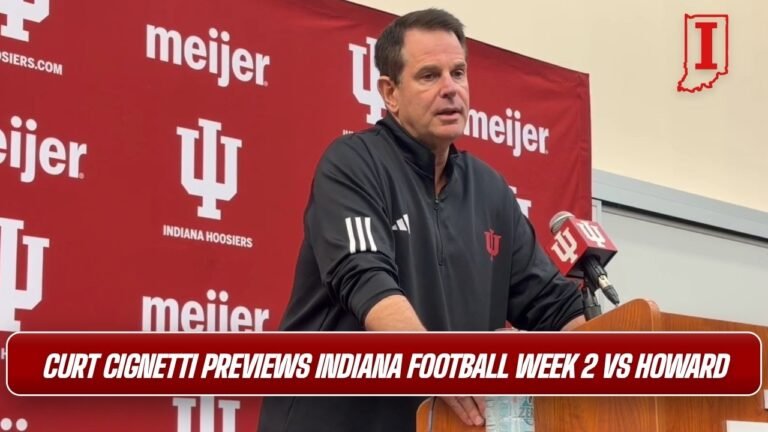
Curt Cignetti has built a program capable of competing for championships. Now comes the opportunity to demonstrate that Indiana can finish the job.
There will be legitimate questions about the College Football Playoff committee’s evaluation of teams. There will be arguments about conference strength, quality victories, and the treatment of two- and three-loss programs.
Those discussions are important, and they should continue.
But Indiana has something more valuable than an argument.
It has control.
Three games remain.
Three opportunities to prove the Hoosiers belong among the nation’s elite.
Three chances to secure a place in Indianapolis and strengthen their pursuit of the College Football Playoff.
If Indiana takes care of business, nobody can take those victories away.
And if the Hoosiers fail to capitalize, there will be no need to search for someone else to blame.
The road is right in front of them.
Now go earn it.
— The Coach Shannon Griffith, Hoosier Football Tailgate
Hoosier Football Tailgate provides independent Indiana football coverage, film analysis, Big Ten commentary, and College Football Playoff evaluation at HoosierTailgate.com.