
What Travels Into Big Ten Play? Indiana vs. Northwestern by the Numbers
Indiana has spent three weeks building a 3-0 record. Northwestern arrives in Bloomington 2-0. The records are clean, but Friday night’s Big Ten opener is a better test of what each team has actually built.
The question is not simply which team has the better record. It is what travels when the competition changes?
Running the football travels. Quarterback efficiency travels. Protecting the football travels. Creating short fields travels. Explosive plays travel. And through the first three weeks, the numbers suggest Indiana owns advantages in several of those areas — but not enough to treat Northwestern like an ordinary early-season opponent.
The Offenses Are Closer Than the Scores Suggest
Indiana has been the more dominant team on the scoreboard, averaging 48.3 points per game while allowing just 5.3. Northwestern is averaging 37.5 points through two games. But offensively, the teams are producing remarkably similar yardage.
| Category | Indiana | Northwestern |
|---|---|---|
| Rushing Yards/Game | 221 | 203 |
| Passing Yards/Game | 240 | 257 |
| Total Offense/Game | 461 | 460 |
| Points/Game | 48.3 | 37.5 |
That is the first thing that jumps off the page. Indiana has generated 461 yards per game. Northwestern is essentially right there at 460.
The difference is how the two offenses are getting there.
Indiana’s Running Game Has the Slight Edge
The Hoosiers are averaging 221 rushing yards per game and 5.7 yards per carry. Turbo Richard has already rushed for 315 yards, including back-to-back 100-yard games, while Lee Beebe Jr. has added 195.
Northwestern is hardly one-dimensional. The Wildcats are averaging 203 rushing yards per game and have already scored five rushing touchdowns. Gavin Sawchuk, Joseph Himon II and Caleb Komolafe give Chip Kelly multiple backs, while quarterback Aidan Chiles adds another element the defense must account for.
So the advantage belongs to Indiana, but it is not overwhelming. Both teams want to stay balanced, and both have shown they can create explosive runs.
Northwestern’s Passing Game Deserves Attention
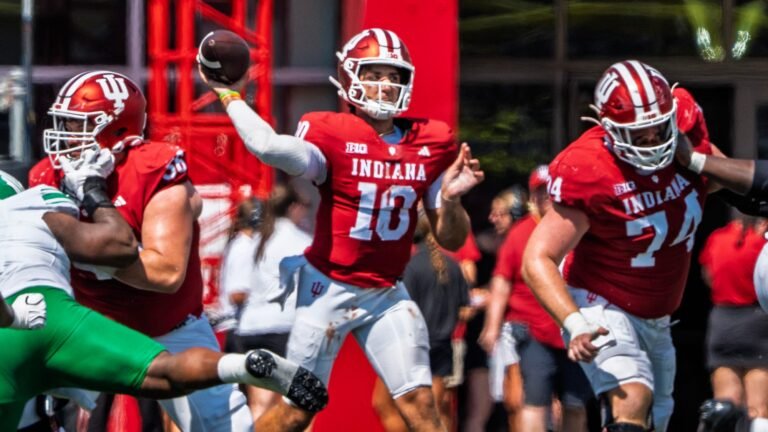
Indiana’s passing numbers are built around extraordinary efficiency. Josh Hoover has completed 72 percent of his passes with 10 touchdown passes and no interceptions through his first three games as a Hoosier.
Northwestern counters with Chiles, who has completed 31 of 46 passes for 514 yards, four touchdowns and no interceptions. He is averaging more than 11 yards per attempt, and the Wildcats have created significant yards after the catch.
Indiana’s passing game has been more explosive by the advanced numbers, but Northwestern has been efficient enough that Bryant Haines cannot simply sell out to stop the run.
Turnovers May Be the Most Important Number Friday Night
This is where Northwestern has made its biggest early-season statement.
The Wildcats are plus-four in turnover margin through two games. Indiana is plus-two through three. Curt Cignetti noted this week that Northwestern has turned its turnover advantage into 17 points, while Indiana has generated 14 points off turnovers.
| Turnover Category | Indiana | Northwestern |
|---|---|---|
| Turnover Margin | +2 | +4 |
| Points Off Turnovers | 14 | 17 |
| QB Interceptions Thrown | 0 | 0 |
Northwestern forced four turnovers against Colorado and converted those opportunities into 17 points. That is not a small detail in a 41-7 final score. It is central to understanding how the Wildcats won the game.
Indiana has been extremely good at protecting the football, especially at quarterback, but the Hoosiers have put the ball on the ground multiple times without always losing it. Against a Northwestern defense that has already produced five takeaways, that is an area Indiana cannot leave to chance.
The Explosive-Play Battle Favors Indiana — Especially Through the Air
Indiana’s official game notes credit the Hoosiers with 21 offensive plays of 20 yards or more through three games: 13 passes and eight runs. The biggest has been Charlie Becker’s 79-yard touchdown against Western Kentucky.
The advanced numbers reinforce what the film has shown. Indiana enters the week ranked near the top nationally in passing explosiveness, while Northwestern has been productive but not quite at the same level.
That does not mean the Wildcats lack home-run ability. Against South Dakota State, Northwestern opened the season with a 71-yard completion from Chiles to Griffin Wilde and later got an 80-yard touchdown run from Himon. Against Colorado, Chiles hit another 25-yard touchdown.
The contrast is important. Indiana has generated explosive plays with greater frequency. Northwestern has shown it can change a game with one.
South Dakota State Provides a Warning
The 34-18 score from Northwestern’s opener looks comfortable. The box score tells a more complicated story.
South Dakota State produced 432 total yards and 27 first downs. The Jackrabbits reached the red zone seven times but repeatedly settled for field goals. They kicked four of them — from 21, 33, 27 and 26 yards — before finally scoring a fourth-quarter touchdown.
If those four field-goal possessions had become touchdowns with extra points, South Dakota State would have gained another 16 points. In simple arithmetic, that turns an 18-point night into 34 — the same total Northwestern scored. Football does not work as a straight substitution exercise, because every score changes the game that follows, but the point is clear:
Northwestern’s opener was much more competitive than the final 34-18 margin suggests.
The Wildcats deserve credit for forcing field goals instead of touchdowns. That is winning football. But Indiana should also see evidence that Northwestern can give up yardage and drives when an opponent stays on schedule.
So What Actually Travels?
Three weeks into Indiana’s season and two games into Northwestern’s, the most transferable numbers point to a fascinating matchup:
- Indiana has the stronger rushing production: 221 yards per game to 203.
- Northwestern has the slight passing-yardage edge: 257 per game to Indiana’s 240.
- Total offense is virtually even: 461 yards per game for Indiana, 460 for Northwestern.
- Indiana has been the more explosive passing offense.
- Northwestern has created the bigger turnover margin: +4 to +2.
- Both starting quarterbacks have yet to throw an interception.
- Northwestern’s 17 points off turnovers are already a major part of its identity.
That does not paint the picture of one team owning every statistical advantage. Indiana has been more dominant, more explosive and far stingier defensively. Northwestern, however, has been balanced offensively, opportunistic defensively and extremely efficient when opponents give it extra possessions.
Coach Griff’s Take
Indiana should enter Friday night believing its advantages are real. The Hoosiers have run the football better, created more explosive offense and played vastly better defense through three weeks.
But this is where conference football changes the conversation.
The margin between winning and losing gets smaller. One fumble becomes seven points. One missed fit becomes an 80-yard run. One red-zone stop becomes four points saved. And one explosive pass can change the entire complexion of the game.
Northwestern has already shown it knows how to win that kind of football game.
Indiana’s job Friday is to make sure the things that traveled through September — balance, ball security, explosives and defensive control — still travel when the Big Ten season begins.
Statistics through games played Sept. 19. Sources: Indiana Athletics, Northwestern Athletics, South Dakota State Athletics and 2026 advanced matchup data.



One Comment