Indiana Debuts No. 4 in CFP Rankings as SEC Favoritism and Big Ten Questions Take Center Stage
By Coach Shannon Griffith | Hoosier Football Tailgate | November 3, 2026
BLOOMINGTON, Ind. — Indiana has opened at No. 4 in the first College Football Playoff rankings, earning a projected first-round bye despite recent offensive concerns. The rankings also raise difficult questions about how generously the committee views two-loss SEC teams compared with the Big Ten.
Indiana earns a top-four spot
The defending national champion Indiana Hoosiers (8-1) debuted at No. 4 in Tuesday night’s first College Football Playoff rankings, behind Miami, Georgia and Utah. If the season ended today, Indiana would receive a first-round bye. That is significant recognition for a program that has been winning despite a month of uneven offensive football.
Respect for the résumé — and the defense
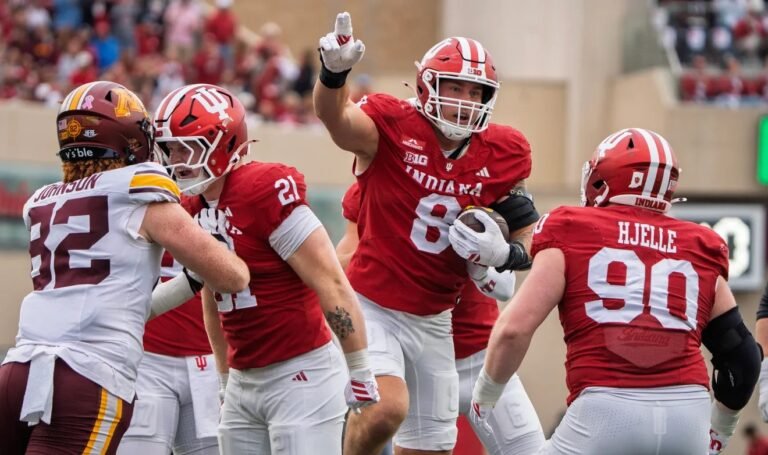
Indiana’s 23-16 overtime escape against Minnesota followed a 13-6 overtime victory at Michigan. The offense has struggled to establish a consistent running game, protect the quarterback and finish drives. Josh Hoover’s shoulder issue adds another complication as the Hoosiers enter their bye week. Yet Bryant Haines’ defense has repeatedly given Indiana the opportunity to win. The committee appears to have evaluated the complete nine-game body of work rather than just the recent offensive struggles. Indiana’s only loss is to Ohio State, and its resilience in close games is part of its résumé. From my perspective, Indiana has not looked like a top-four team over the last month offensively, but rankings cannot ignore what the defense and the overall team have accomplished.
The Heather Dinich discussion
ESPN commentator and Indiana graduate Heather Dinich was reportedly surprised by Indiana’s lofty placement. Her precise on-air remarks have not yet been independently verified, so they should not be presented as a direct quotation. The larger question is legitimate: why does Indiana’s place among the nation’s elite still seem to surprise some observers? There are fair reasons to question the Hoosiers’ recent play. But those same standards must be applied to the traditional powers. The helmet should not determine the ranking; the résumé should.
SEC receives generous treatment
Five SEC teams occupy the top ten: Georgia No. 2 (7-1), Alabama No. 5 (6-2), Kentucky No. 6 (7-1), Texas No. 7 (6-2) and Ole Miss No. 10 (6-2). Alabama and Texas sit ahead of undefeated UCLA, ranked eighth. Alabama is eight places ahead of Tennessee, despite Tennessee’s head-to-head victory. Strength of schedule, quality wins and complete résumés can justify differences, but the committee must explain why two losses carry relatively little penalty for some teams while other conferences face a narrower path. The SEC has ten ranked teams in the initial Top 25, compared with six for the Big Ten.
Ohio State at No. 12 is the warning
Ohio State (6-2) is ranked No. 12 — not No. 13 — and is nevertheless the first team outside the projected bracket. Boise State, ranked No. 25, occupies the projected automatic berth for the highest-ranked Group of Six champion. Ohio State owns a head-to-head win over No. 4 Indiana, but losses to Texas and USC and uncertainty around quarterback Julian Sayin have complicated the Buckeyes’ outlook. If Ohio State is currently outside the field with two losses, what happens to Indiana if it finishes 10-2? What about USC or Iowa? The committee has not answered those questions, but its first ranking makes them urgent.
Could a three-loss SEC team get in?
Tennessee and LSU are ranked 13th and 14th with two losses; Missouri is 18th. Three-loss South Carolina is 21st and Florida 24th. None is presently in the playoff field. Still, the committee has left open a path for a three-loss SEC team to build a compelling résumé with additional ranked victories. If that happens, would an SEC team with three losses be selected over a 10-2 Big Ten team? That is a plausible December debate, not a settled outcome.
UCLA and Notre Dame illustrate the committee’s approach
UCLA is 8-0 but sits No. 8, behind two-loss Alabama and Texas. Notre Dame, fourth in the AP poll, debuted 11th in the CFP rankings. Both placements underscore how differently the committee evaluates schedule and résumé from the media polls. The rankings are not merely a win-loss table, but the criteria must be transparent and consistently applied.
Big Ten picture
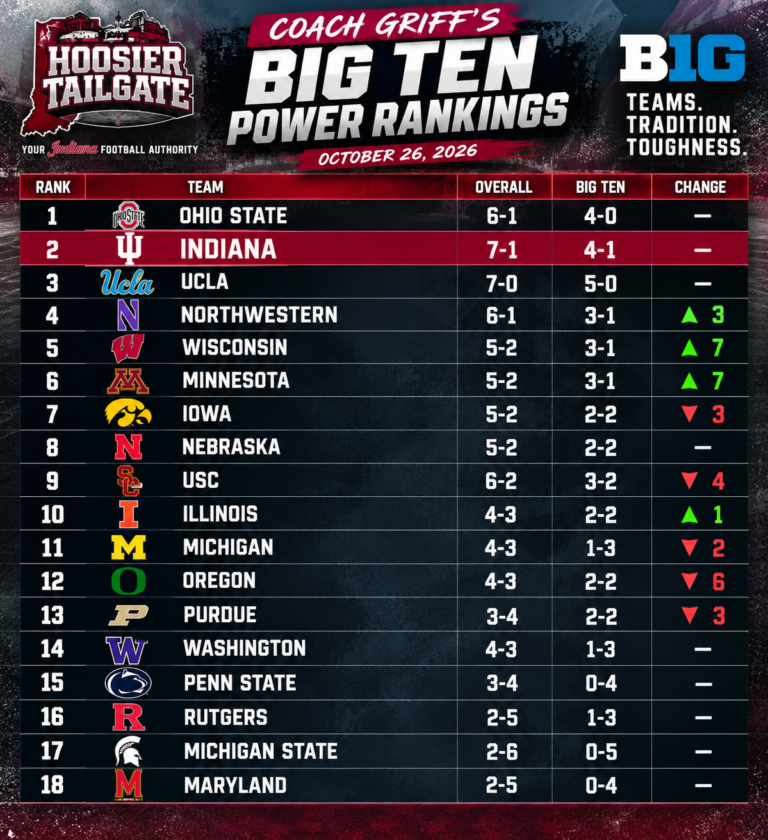
The six ranked Big Ten programs are Indiana (4), UCLA (8), Ohio State (12), Iowa (19), USC (20) and Oregon (23). Indiana and UCLA have the clearest early position. Ohio State is on the bubble; USC and Iowa need significant upward movement. Indiana’s remaining matchup with USC could reshape both teams’ postseason arguments.
Coach Griff’s take
Having served on an NCAA Division III national ranking committee, I know this process is more complicated than comparing records. Head-to-head results, common opponents, strength of schedule, quality wins, player availability and film all matter. There is no perfect formula, but consistency is essential. Indiana has real offensive problems to correct during the bye week, particularly in the running game, along the interior offensive line and at quarterback. None of that erases an 8-1 record or championship-level defensive play. The committee recognized the full body of work Tuesday. Now Indiana must validate that faith. If two losses do not automatically eliminate Alabama or Texas from top-seven consideration, they should not automatically eliminate a deserving Big Ten team either. The committee has made its opening statement. The games — and the consistency of the evaluation — will decide the rest.
Sources: College Football Playoff selection committee rankings and selection procedures, November 3, 2026; Associated Press.