Indiana’s Offensive Identity Crisis: Four Games, Two Different Teams, and a Bye Week That Demands Answers
By Coach Shannon Griffith | Hoosier Football Tailgate
Indiana is 8–1, but its offensive production over the past four FBS games is a warning sign. The Hoosiers have shown tremendous toughness in close contests, yet the offense must use the bye week to rediscover the balance and efficiency that made it so difficult to defend early in the season.
Four Games, Two Different Offenses
For a fair comparison, we exclude the FCS game against Howard. The first four FBS opponents were North Texas, Western Kentucky, Northwestern and Rutgers; the most recent four were Nebraska, Ohio State, Michigan and Minnesota.
| Metric | First four FBS | Last four |
|---|---|---|
| Total offense per game | 485.8 | 332.0 |
| Rushing yards per game | 241.8 | 103.3 |
| Passing yards per game | 244.0 | 228.8 |
| Points per game | 41.5 | 17.8 |
| Yards per play | 7.80 | 5.65 |
The most dramatic change is on the ground: nearly 139 fewer rushing yards per game. Passing production has declined only modestly, but without a credible running threat, the offense is forced into more predictable passing situations. The drop from 41.5 to 17.8 points per game cannot be explained by one missed throw or one bad blocking assignment.
Defensive Quality Matters, but It Is Not the Whole Explanation
Nebraska, Ohio State and Michigan brought strong defensive personnel and schemes. Indiana was never going to reproduce its early-season averages automatically against that stretch. Still, the same problems have resurfaced: limited first-down efficiency, too many third-and-long situations, and an inability to impose the running game when opponents know what is coming.
Where Is the Offensive Variety?
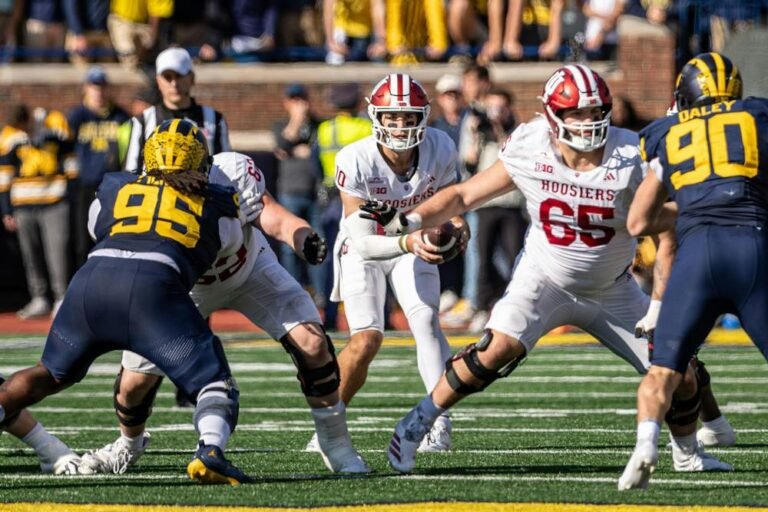
Inside zone and Duo can be excellent foundational concepts. They cannot be the entire answer when defenses consistently compress the interior. Indiana must make opponents defend the width of the field as well as the middle. Power and counter, perimeter runs, receiver involvement, motion, and selective quarterback-run packages can create hesitation and improve angles for the offensive line.
The point is not to abandon the offense’s identity. It is to give that identity answers when the defense takes away its first choice.
Quarterback Health and Protection
Josh Hoover’s throwing-shoulder issues complicated the Minnesota game, and Grant Wilson was called upon to help rescue it. Indiana must be honest about quarterback health and about which concepts each available quarterback can execute effectively. Protection calls, route timing and run-pass balance all need to reflect the quarterback actually on the field.
Third Downs and the Red Zone
Against Minnesota, Indiana was just 2-for-12 on third down despite gaining 419 yards. That disconnect illustrates the larger issue: movement between the twenties means little without sustained drives and touchdowns. Early-down play calling should create manageable third downs; red-zone planning should produce defined answers against compressed coverage.
What the Bye Week Demands
Every member of the offensive staff should participate in an honest self-scout. Chart run concepts and direction, formation tendencies, defensive responses, third-down distances, red-zone calls and the production of each personnel group. Identify where predictability has crept in, and then make specific corrections. Coaching egos must stay outside that meeting room.
Coach Griff’s Final Take
Indiana’s players deserve enormous credit for finding ways to win. But grit cannot be the offensive game plan. The defense has carried the team through a difficult stretch; the offense must now carry its share. With USC approaching, the Hoosiers do not need an entirely new system. They need a more complete, less predictable and better-executed version of the one that made them so dangerous.