Indiana Survives Northwestern 29-23 — and Gets the Test It Needed
Indiana finally got pushed.
After three games in which the Hoosiers controlled opponents by increasingly comfortable margins, Northwestern came to Bloomington Friday night and forced Indiana to play four quarters of Big Ten football.
The result was still what mattered most.
Indiana 29, Northwestern 23.
The Hoosiers are 4-0. They won their Big Ten opener. They dealt with the loss of one of their most explosive offensive players when Turbo Richard left in the first half with an undisclosed injury. They watched a 12-0 halftime advantage turn into a one-score football game. And when Northwestern kept coming, Indiana found a way to finish.
There is plenty for Curt Cignetti and his staff to correct. There is also something to be said for getting punched and still winning.
Beebe Answers the Bell
Lee Beebe Jr. became the story of the Indiana offense.
With Richard unavailable after leaving in the first half, Beebe was asked to shoulder a much larger portion of the running game and responded with more than 200 yards rushing.
That’s significant for more than the box score.
Before Friday, Beebe had 195 yards on 47 carries through Indiana’s first three games. Richard had been the explosive half of Indiana’s backfield combination, producing 315 yards on 41 attempts—7.7 yards per carry—and four touchdowns.
Friday required Beebe to become something different. He wasn’t merely part of the rotation. Indiana needed him to carry the football, move the chains, handle the physical punishment of a Big Ten game and keep the offense functioning after losing Richard.
He answered that challenge.
Indiana’s offensive line deserves considerable credit as well. When everyone in the stadium understands that the running back is carrying the load and you can still run the football effectively, that’s not just a running-back statistic. That’s offensive football.
Richard’s Injury Is One to Watch
The victory doesn’t eliminate one significant concern. Indiana can ill afford to lose Turbo Richard for an extended period.
Richard entered the Northwestern game as Indiana’s leading rusher and one of the offense’s most explosive players. Beebe proved Friday that Indiana has another back capable of carrying a substantial workload, but Beebe playing well doesn’t make Richard’s explosiveness less important.
Until Indiana provides additional information, there is no reason to speculate about the nature or severity of the injury. Richard’s status will be one of the most important developments to follow coming out of this game.
Chip Kelly vs. Bryant Haines Was the Chess Match We Expected
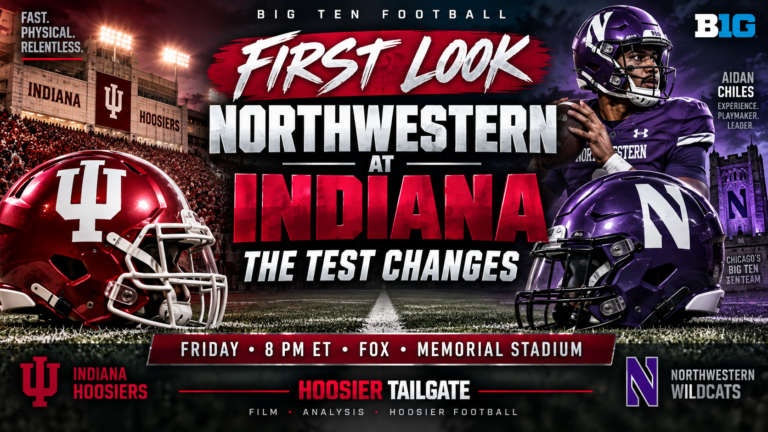
I talked about this matchup during the week on Hoosier Football Tailgate. Chip Kelly against Bryant Haines was going to be one of the most fascinating parts of this football game.
It was.
The challenge for Indiana was never simply to pressure Aidan Chiles. It was to control him.
My key throughout the week was keeping Chiles in the pocket. Indiana needed disciplined rush lanes, good edge control and a secondary capable of staying connected when Chiles extended plays.
For much of the first half, Indiana accomplished that. The second half was different.
Northwestern began putting Indiana’s defense in conflict. Chiles became more dangerous when plays extended, Indiana wasn’t as effective at keeping him contained, and the Hoosiers’ pass coverage wasn’t as sharp as it needed to be.
Those things are connected.
A mobile quarterback changes coverage because defenders are eventually forced to make decisions: stay attached to the receiver, trigger toward the quarterback, pass a route to another defender, or continue matching when the original structure of the play has broken down.
That is where an offense can create conflict. Kelly found some of those pressure points Friday night.
The Film Is Now Out There
This may be the most important defensive takeaway from the game.
Northwestern didn’t give every future Indiana opponent a magic formula for beating Bryant Haines’ defense. But Chip Kelly gave them film to study.
That’s what happens in football. When one offense finds something that stresses a defense, the next offensive staff studies it. They don’t necessarily copy the exact play. They study the problem the play created.
- Was Indiana vulnerable to a particular formation?
- Did motion force a communication adjustment?
- Could the edge defender be placed in conflict?
- Did quarterback movement alter the rush plan?
- What happened to coverage when Chiles escaped?
- Could certain route combinations stress Indiana’s rules?
Good offensive coordinators copy problems—not necessarily plays.
If something Kelly did forced Indiana to choose between two bad answers, expect another opponent to recreate that conflict.
That’s why the response from Haines and his defensive staff matters. The correction doesn’t have to mean changing the defense. It can be an adjustment to technique, leverage, rush integrity, communication or how Indiana handles a particular offensive concept.
But it has to get corrected. Once something appears on film, opponents will keep testing it until Indiana demonstrates that the answer has changed.
Don’t Lose Sight of the Most Important Number
There will be plenty for Cignetti to dislike when he watches this film: the second-half coverage, losing containment on Chiles, the defensive conflicts Kelly was able to create, whatever offensive opportunities Indiana left on the field, and certainly Richard’s health.
But there is another number that matters: 4-0.
Indiana hadn’t experienced this kind of football game during the first three weeks. North Texas couldn’t make Indiana play four quarters. Howard couldn’t. Western Kentucky couldn’t. Northwestern did.
Indiana got tested. Indiana had one of its most important offensive players leave the game. Indiana’s defense struggled in the second half. Northwestern made a legitimate push.
And Indiana still won.
There is value in that. The job now isn’t to pretend the problems didn’t happen because Indiana survived them. It’s to use the win to fix them.
That’s what good football teams do.
Coach Griff’s Take: Chip Kelly didn’t hand Indiana’s future opponents a blueprint for beating the Hoosiers. He did give them a starting point for asking some uncomfortable questions of this defense. Now it’s Bryant Haines’ job to provide the answers.
Indiana 29. Northwestern 23.
Not perfect. But 4-0—and for the first time this season, Indiana has some genuinely difficult game film from which to get better.
Fast. Physical. Relentless.