Indiana PFF Grades: What the Numbers Actually Tell Us About the WKU Win
Indiana’s 38-0 victory over Western Kentucky looks overwhelming on the stat sheet.
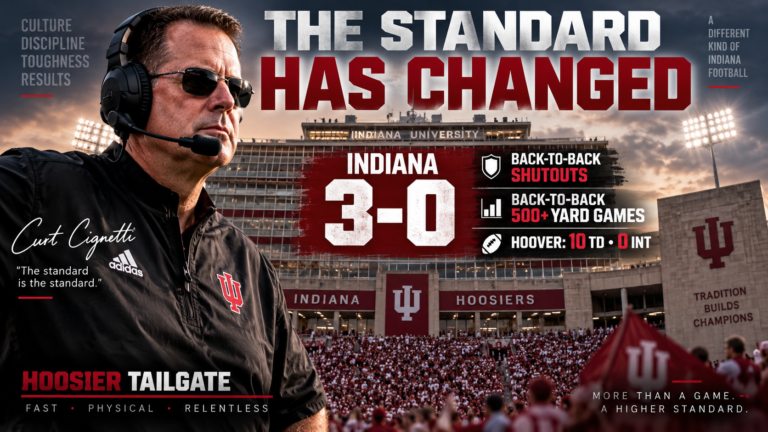
The Hoosiers accumulated 513 yards of offense, rushed for 233, didn’t turn the football over and held WKU to just 186 total yards. It was Indiana’s second consecutive shutout and improved Curt Cignetti’s team to 3-0.
But one of the reasons I like looking at the PFF grades after reviewing a game is that they can help separate production from execution.
Those aren’t always the same thing.
Indiana’s latest grades provide several good examples. The Hoosiers ran the football effectively without receiving dominant run-blocking grades. The offensive line protected Josh Hoover extremely well, even though some individual overall grades don’t immediately suggest it. And defensively, Indiana’s highest-graded player also had an area of his performance that will undoubtedly receive attention in the meeting room.
That’s why these grades need context.
Indiana’s Offensive Grade Tells Two Stories
PFF gave Indiana an 80.5 offensive grade against Western Kentucky.
- Passing: 73.4
- Pass Blocking: 78.3
- Receiving: 77.8
- Rushing: 71.5
- Run Blocking: 67.1
That fits reasonably well with what we saw Saturday. Indiana was productive — extremely productive — but the execution wasn’t always as clean as the final numbers suggest.
Hoover finished 18-of-24 for 273 yards, two touchdowns and no interceptions. PFF graded him 77.9 overall with a 74.1 passing grade.
We’ve already discussed that there were a few throws Hoover would probably like back. That’s part of quarterback evaluation. But it shouldn’t obscure what he’s doing well.
Through three games, Hoover has completed 72.5% of his passes for 649 yards with 10 touchdowns and zero interceptions. Against WKU, he again protected the football and generated explosive plays. That’s a pretty good foundation to coach from.
Becker, Marsh and Preston Give Indiana a Deep Receiving Group
The receiving grades reinforce something else we’re beginning to see with this offense: Indiana doesn’t have to rely on one receiver.
- Charlie Becker: 78.3 overall / 77.0 receiving — 5 catches, 127 yards, TD, 25.4 yards per reception
- Nick Marsh: 77.3 overall / 75.1 receiving — 7 catches, 81 yards
- Shazz Preston: 76.5 overall / 73.7 receiving — 3 catches, 32 yards
- Davion Chandler: 66.5 overall / 68.2 receiving — 2 catches, 24 yards, TD
Marsh was targeted 10 times and continues to be a significant part of Indiana’s passing game even when somebody else produces the explosive numbers. Against WKU, that somebody was Becker.
The Offensive Line Grades Require Context
Here’s where simply looking at an overall PFF grade can become misleading. Indiana’s five starting offensive linemen played all 60 primary offensive snaps together.
| Player | Overall | Pass Block | Run Block | Pressures Allowed |
|---|---|---|---|---|
| Adedamola Ajani | 72.1 | 73.5 | 68.8 | 1 |
| Carter Smith | 70.3 | 62.9 | 69.8 | 1 |
| Drew Evans | 67.7 | 62.9 | 67.8 | 0 |
| Bray Lynch | 63.0 | 77.4 | 59.2 | 0 |
| Joe Brunner | 57.0 | 85.3 | 51.5 | 0 |
Look at Joe Brunner. If somebody sees only his 57.0 overall grade, the natural conclusion might be that he struggled. That’s not the whole story.
Brunner received an 85.3 pass-blocking grade, the highest among Indiana’s starting offensive linemen, and allowed zero pressures. His overall grade was pulled down substantially by his 51.5 run-blocking grade.
Bray Lynch presents something similar. His overall grade was 63.0, but his pass-protection grade was a strong 77.4, and he also allowed zero pressures. This is precisely why positional grades matter.
Indiana’s Pass Protection Was Better Than the Overall Grades Suggest
Collectively, Indiana’s starting offensive line allowed only:
- 3 total pressures
- 0 sacks
- 1 quarterback hit
- 2 hurries
That’s winning football.
Ajani and Smith were each charged with one pressure. The interior combination of Evans, Lynch and Brunner allowed none.
Quarterbacks play differently when they trust the pocket. Indiana gave Hoover enough protection to work through the passing game and attack vertically. The offensive line doesn’t need five 80-plus overall PFF grades to have accomplished its primary objective in pass protection.
It protected the quarterback.
How Do You Rush for 233 Yards With a 67.1 Run-Blocking Grade?
Now we get to what may be the most interesting offensive number. Indiana rushed for 233 yards. PFF graded the Hoosiers’ run blocking at only 67.1.
Those two numbers can coexist.
A team can produce a strong rushing total without consistently winning every block. Explosive runs can significantly affect the final yardage. Backs can create yards beyond what is blocked. Scheme can put defenders in conflict. And one missed assignment can negatively affect a PFF grade even when the overall rushing attack remains productive.
Turbo Richard is a good example. Richard rushed 15 times for 149 yards and a touchdown, averaging 9.9 yards per carry. His PFF rushing grade was 70.7. His blocking grade was actually higher: 75.1 in pass protection.
That’s a complete-player number that deserves attention. It also gives us something specific to watch on film this week: how much of Indiana’s 233 rushing yards came from cleanly blocked runs versus yards created after the blocking structure began to break down?
That’s where PFF can point us toward the film rather than replace it.
The Defense Was Every Bit as Good as the Scoreboard Suggests
There isn’t nearly as much ambiguity on the other side of the football.
- Overall Defense: 87.4
- Run Defense: 86.1
- Tackling: 77.2
- Pass Rush: 75.5
- Coverage: 82.1
WKU finished with only 186 total yards, including just 66 rushing yards, and never scored. Indiana has now gone eight consecutive quarters without allowing a point.
Tobi Osunsanmi Jumps Off the Page
The most impressive individual defensive grade belongs to Tobi Osunsanmi.
- 88.7 overall defensive grade
- 93.2 pass-rush grade
- 13 pass-rush snaps
- 4 pressures
- 1 sack
- 1 quarterback hit
- 2 hurries
Generating four pressures on only 13 pass-rush opportunities means Osunsanmi affected the quarterback on nearly 31% of those snaps.
But here’s where our weekly PFF analysis becomes more interesting. PFF also charged Osunsanmi with three missed tackles.
So was it a great game or a poor tackling game? Both can be true.
He was extremely disruptive rushing the passer while having something significant to correct as a tackler. That’s football evaluation.
The Secondary Had an Excellent Afternoon
- Jamari Sharpe: 78.3 defense / 76.8 coverage
- Preston Zachman: 76.1 defense / 73.8 coverage / 85.5 tackling
- Byron Baldwin Jr.: 79.7 coverage
- Ryland Gandy: 70.9 defense / 69.0 coverage
WKU finished with only 120 passing yards. That’s not simply the product of pass rush. Indiana’s coverage held up.
One of the things that has stood out about this defense through three games is its ability to play complementary football. Pressure helps coverage. Coverage creates additional time for the rush. Good tackling prevents routine completions from becoming explosive plays.
Isaiah Jones Is Another Example of Why One Grade Doesn’t Tell the Story
Isaiah Jones provides another fascinating evaluation. Jones produced two sacks, but PFF gave him a 64.9 overall defensive grade and a 61.7 pass-rush grade.
His run-defense grade was a better 70.2, while his tackling grade was only 50.1.
Again, the box score and PFF are measuring different things. Two sacks jump off the stat sheet. PFF is attempting to grade the entirety of the player’s snaps rather than simply the result of his biggest plays.
As a coach, I want both pieces of information. I want the disruptive plays. But I also want to know what happened on the other 50-plus snaps.
Coach Griff’s Take: Use PFF as a Tool, Not the Answer
This is exactly how I want us to use PFF throughout the season.
The grade should never be the end of the evaluation. It should create the next question.
Joe Brunner graded 57.0 overall. Why? Look deeper and we discover an 85.3 pass-blocking grade and zero pressures allowed, offset by a 51.5 run-blocking grade.
Indiana rushed for 233 yards. Great. Then why did the team receive only a 67.1 run-blocking grade? That’s something worth putting on the film.
Osunsanmi received an 88.7 defensive grade and 93.2 pass-rush grade. Outstanding. Then we see three missed tackles. That’s something to coach.
This is precisely the point we made when evaluating Indiana’s 38-0 victory.
The standard is the standard. Perfection isn’t.
Indiana can play extremely well and still have corrections. In fact, that’s probably the most encouraging position a football team can occupy.
The Hoosiers are 3-0, have posted consecutive shutouts and have produced more than 500 yards of offense in consecutive games.
And when Cignetti and his staff turn on the tape, they’ll still have plenty to coach.
That’s not evidence that Indiana isn’t playing well. It’s evidence that there remains room between how well Indiana is playing now and how well this team may eventually play.