
The Hoosiers' RPO Offensive Scheme: A Deep Dive into Its Effectiveness
Posted on April 12, 2025, by [Shannon Griffith aka Coach Griff | TheHoosier.com Powered On3.com
The Indiana Hoosiers’ 2024 football season was nothing short of a revelation, with their explosive offensive output turning heads across the college football landscape. At the heart of this resurgence was their mastery of the Run-Pass Option (RPO) scheme—a system that blended simplicity with devastating effectiveness. In this deep dive, we’ll unpack how the Hoosiers leveraged the RPO to fuel their Cinderella story, analyze its strengths and weaknesses, and explore why it became a nightmare for opposing defenses while revealing cracks that emerged against elite competition.
The Blueprint: What Makes the Hoosiers’ RPO Tick?
The Hoosiers’ RPO scheme isn’t a reinvention of the wheel; it’s a modern evolution of classic option football, infused with spread-option principles and tailored to their personnel. Built around a balanced spread formation (often 2x2 or 3x1 sets), the system hinges on pre-snap reads and post-snap decisions that exploit defensive alignments. At its core, the RPO gives the quarterback three to five options: hand off to the running back on an inside zone, keep it himself, pitch it to a motioning player, or throw a quick pass (think slants, bubbles, or back-shoulder fades).
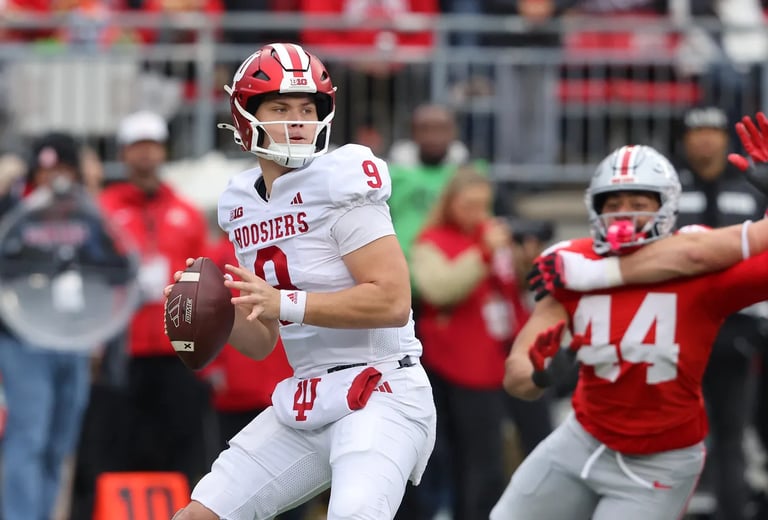
In 2024, quarterback Kurtis Rourke—before his injury—served as the linchpin, showcasing a veteran’s poise and precision. His ability to read defenses pre-snap and deliver with touch (especially on sideline throws) opened up the playbook. Paired with a bruising yet agile backfield featuring the likes of Justice Ellison (averaging 7 yards per carry) and a receiving corps led by Elijah Sarratt (957 yards, 8 TDs), the Hoosiers had the pieces to make this scheme hum.
The offensive line, often the unsung hero, executed combo blocks and zone schemes with discipline, creating creases for the run game while selling the run fake to freeze linebackers. Motion—whether a jet sweep or orbit action—added another layer, forcing defenders to hesitate just long enough for the Hoosiers to strike.
Strengths: Why It Worked in 2024
1. Adaptability: The beauty of the Hoosiers’ RPO lies in its flexibility. Against slower, less disciplined defenses, Indiana could pound the ball with Ellison or let Rourke exploit underneath coverage with quick slants. Posts on X noted how the RPO “worked this year for Indiana vs slower teams with bad defenses,” the eye test backs this up—teams like Nebraska struggled to match the Hoosiers’ tempo and decisiveness.
2. Stress on Defenders: The RPO put defenders in a no-win situation by combining inside zone reads with triple-option elements and quick-pass threats. Linebackers had to choose: crash the run and risk a slant over the middle, or sit back and watch Ellison gash them for 7 yards a pop. This unpredictability turned games into a chess match Indiana often won.
3. Explosive Play Potential: The Hoosiers weren’t afraid to take deep shots off RPO looks, especially with Rourke’s arm strength. Back-shoulder throws down the sideline became a signature, stretching defenses vertically and keeping safeties honest.
The result? An offense that averaged over 30 points per game in Big Ten play, torching opponents with a blend of efficiency and fireworks. It was simple enough for rapid execution yet complex enough to keep defenses guessing—a perfect storm for a breakout season.
Cracks in the Armor: Where It Faltered
The RPO scheme wasn’t invincible for all its brilliance, and the postseason exposed its limits. Against Notre Dame in the College Football Playoff opener, Indiana’s Cinderella run hit a brick wall, with the Irish defense smothering the RPO attack en route to a decisive victory. What went wrong?
1. Elite Defenses Solve the Puzzle: Posts on X highlighted a growing sentiment: “Better defenses now shut it down.” Notre Dame’s disciplined front seven and secondary refused to bite on misdirection, clogging run lanes and jamming receivers at the line. The quick slants that shredded lesser foes were neutralized, forcing Rourke into uncomfortable downfield reads.
2. Quarterback Transition: Rourke’s injury late in the season thrust Tayven Jackson into the spotlight. While Jackson’s dual-threat ability added a keeper wrinkle to the RPO, his inexperience showed. Unlike Rourke, he struggled with the touch throws that kept defenses off-balance, leading to a more predictable run-heavy approach that elite defenses could key on.
3. Behind-the-Sticks Vulnerability: The RPO thrives on staying ahead of the chains. When penalties or negative plays pushed Indiana into obvious passing situations, the scheme lost its teeth. Without the run threat to hold linebackers, the quick-pass options became easier to cover, and the Hoosiers’ tempo stalled
The Verdict: Effective, but Not Unstoppable
The Hoosiers’ RPO scheme was a masterclass in 2024, propelling them to an 11-1 regular season and a playoff berth. Its effectiveness stemmed from a perfect storm of personnel, coaching ingenuity (hat tip to offensive coordinator Mike Shanahan), and a schedule that featured exploitable defenses. Against overmatched foes, it was a buzzsaw—fast, physical, and relentless.
Yet, the playoff loss to Notre Dame underscored a harsh truth: simplicity can be a double-edged sword. Against top-tier defenses with the speed, discipline, and film study to counter it, the RPO’s limitations surfaced. The scheme’s reliance on pre-snap reads, and quick decisions left little margin for error when the opponent refused to crack.
Looking ahead to 2025, Indiana’s challenge will be evolution. Can they layer in more deception—perhaps pre-snap shifts or play-action wrinkles—to keep elite defenses honest? Will Jackson’s development unlock new dimensions, or will the Hoosiers lean harder on their run game without Rourke’s passing prowess? The RPO got them to the dance, but staying there will require adaptation.
Final Thoughts
The Hoosiers’ RPO offensive scheme was the heartbeat of their 2024 success, a testament to how old-school option concepts can thrive in a modern spread era. It turned Bloomington into a football town again, delivering highlight-reel plays and a season to remember. But as the postseason proved, even the most effective schemes have a ceiling against the best. For Indiana fans, the ride was unforgettable—now it’s about building on the blueprint for the battles ahead.
What do you think, Hoosier Nation? How should Indiana tweak the RPO for 2025? Drop your takes in the comments below!