Scouting Minnesota: Defense and Special Teams Fuel the Gophers
Minnesota comes to Bloomington with a 5–2 record, a 3–1 mark in the Big Ten, and a formula Indiana needs to take seriously: play defense, create better field position, and turn scoring chances into points.
The Golden Gophers have beaten Washington 27–24, Michigan 20–14, and Iowa 13–10. Those three wins came by a combined 12 points. This is a ball club comfortable playing a game in which one return, one takeaway, or one field goal becomes the difference.
Here is the scouting picture through seven games, using Minnesota’s cumulative statistics dated October 27, 2026.
Offense: the passing game carries more of the load
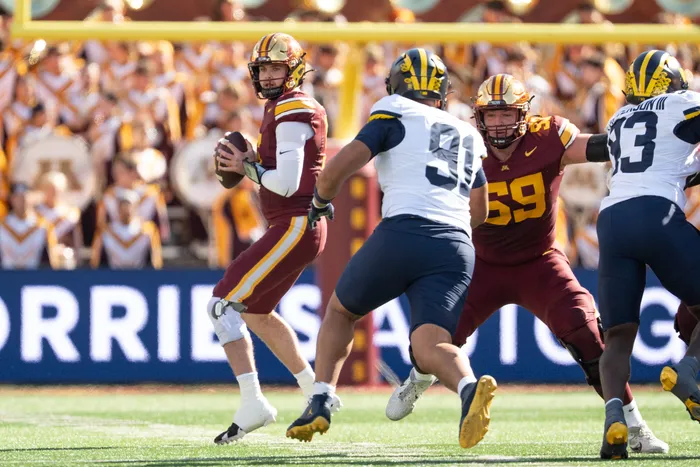
Minnesota averages 322.4 yards and 26.6 points per game, but those averages need context. The Gophers scored 100 of their 186 points against Eastern Illinois and Akron. In four Big Ten games, they have scored 73 points—18.3 per game. Indiana should respect their ability to finish a close game without mistaking the overall scoring average for a consistently explosive offense.
The rushing attack produces 100.1 yards per game and 3.4 yards per carry. Minnesota has 65 first downs through the air compared with 40 on the ground. The statistical picture is an offense that needs its quarterback and receivers to move the chains; the running game has not consistently carried the production.
The offensive players Indiana must account for
Drake Lindsey: The quarterback has completed 141 of 222 passes, a 63.5 percent completion rate, for 1,472 yards, nine touchdowns, and six interceptions. Minnesota has allowed only seven sacks. Protection has generally kept the offense out of sack losses, but Lindsey’s six interceptions show that pressure does not have to end in a sack to matter.
Javon Tracy: Minnesota’s leading receiver has 39 catches for 420 yards and a touchdown. He is the most productive receiving option by both catches and yards, and his 784 all-purpose yards make him a threat across multiple phases. Indiana cannot treat him as simply a return specialist.
Noah Jennings: With 30 receptions for 367 yards, Jennings gives Lindsey another substantial source of production. Together, Jennings and Tracy account for 69 of Minnesota’s 148 completions. Taking away one does not eliminate the other.
Jalen Smith: Smith has 16 catches for 249 yards and a team-leading three receiving touchdowns. His 15.6 yards per catch exceed the averages of Tracy and Jennings. He is the receiver whose smaller catch total can hide a significant gain.
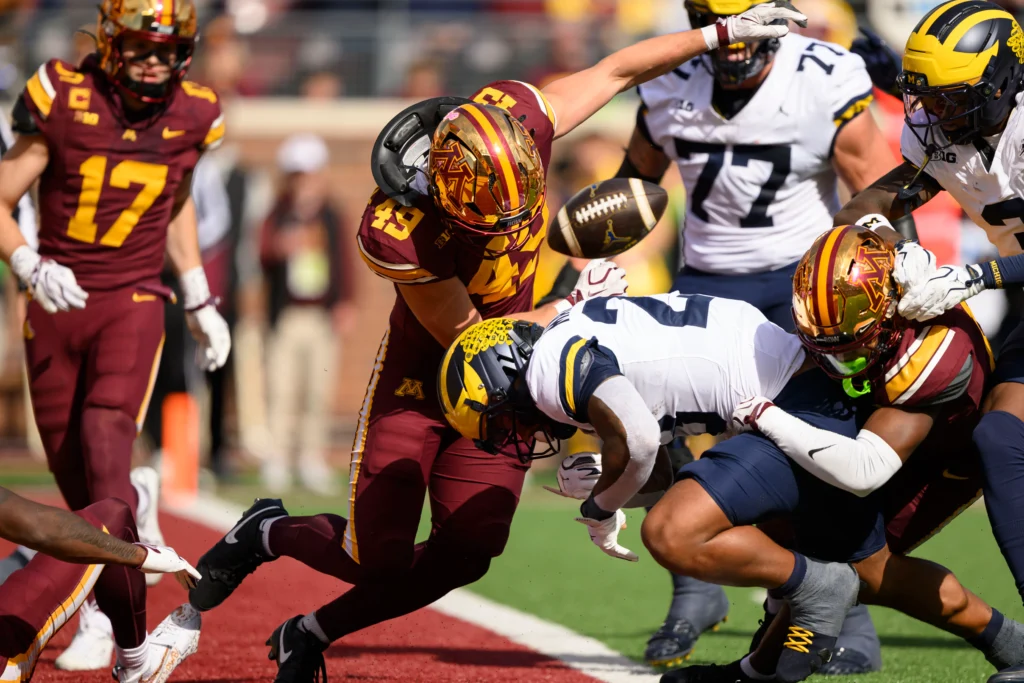
TJ Thomas and Darius Taylor: Thomas leads the rushing attack with 325 yards on 57 carries, averaging 5.7 yards per attempt, with a long run of 71 yards. Taylor has the greater workload—76 carries—but only 174 rushing yards at 2.3 per attempt. Taylor still leads the team with five rushing touchdowns and has added 19 catches for 166 yards and another score. Thomas has supplied the better rushing efficiency; Taylor remains a scoring threat and a factor in the passing game.
Coach Griff’s offensive read: win the early downs
The first job is to tackle well enough that Minnesota has to earn the next snap. Thomas’s numbers show why Indiana cannot allow the running game to escape for a long gain. Taylor’s receiving production means defenders must finish their coverage responsibilities when he releases out of the backfield.
Minnesota converts 34.0 percent of its third downs. That gives Indiana a clear objective: put the Gophers in longer third-down situations and make Lindsey complete a contested throw. The statistics do not tell us the exact route menu or blocking scheme, but they do identify the players who must be accounted for.
Once Minnesota gets inside the 20, it usually leaves with points: 24 scores in 25 red-zone possessions. Only 15 of those trips have ended in touchdowns. Indiana’s defense needs stops, but forcing a field goal instead of surrendering seven can still be a meaningful win.
Defense: get off the field and create extra possessions
Minnesota allows 288.7 yards and 20.1 points per game. Opponents average 123.6 rushing yards, 3.8 yards per carry, and 165.1 passing yards per game. They have completed 58.1 percent of their passes.
The most important number may be third-down defense: opponents are just 25 of 84, or 29.8 percent. That helps explain how the Gophers can survive stretches when their own offense struggles. A stop creates another possession and another opportunity for the return game to influence the field.
Minnesota has 46 tackles for loss, including 15 sacks. It has intercepted seven passes and recovered five opponent fumbles. Against eight giveaways, that is a plus-four turnover margin. The takeaways are spread around: seven different defenders have an interception.
The defensive players driving the results
Maverick Baranowski: The leading tackler has 52 stops, 3.5 tackles for loss, a sack, an interception, a fumble recovery, and a forced fumble. He contributes both steady tackling volume and possession-changing plays.
Zack Harden and Kerry Brown: Harden has 42 tackles, three tackles for loss, a sack, an interception, and three pass breakups. Brown has 40 tackles. They give Minnesota substantial tackling production behind its front.
Joey Gerlach: His 37 tackles come with three tackles for loss, an interception, a fumble recovery, and a team-leading three forced fumbles. Ball security matters around him through the finish of the play.
TJ Bush Jr., Karter Menz, and Riley Sunram: Bush leads the team with four sacks and six tackles for loss. Menz has three sacks and 4.5 tackles for loss; Sunram has 5.5 tackles for loss and 1.5 sacks. These are the names Indiana’s protection and blocking plans must locate.
Aydan West: West has a team-leading six pass breakups, an interception, and a fumble recovery. John Nestor is another productive defender, with 31 tackles, four tackles for loss, and an interception.
Coach Griff’s defensive read: make Minnesota defend the whole drive
Indiana needs to avoid giving this defense the negative play that puts a possession behind schedule. Minnesota’s combination of tackles for loss, third-down stops, and takeaways can turn one missed block or loose carry into a change of possession.
There are openings. Opponents have scored touchdowns on 14 of 20 red-zone trips, and Minnesota surrendered 41 points in its loss at Purdue. This defense can be stressed. The challenge is sustaining clean possessions long enough to reach those scoring opportunities.
Special teams: where Minnesota changes the math
The Gophers are 13-for-13 on field goals and 21-for-21 on extra points. Luke Drzewiecki is 12-for-12 on field goals, including five makes from 40–49 yards and a 51-yarder. Daniel Jackson supplied the other field goal.
That reliability changes the value of a stalled drive. Minnesota does not need every possession to end in a touchdown to stay in a tight game. Against Iowa, Drzewiecki’s 46-yard field goal as time expired delivered a 13–10 victory, after Lindsey and Smith connected for a 39-yard gain to help set it up. Minnesota’s official Iowa recap documents the finish.
The same game showed how special teams can manufacture a scoring opportunity. Mason Carrier blocked Iowa’s first punt, Mekhai Smith recovered at the Iowa 13, and Minnesota turned the short field into an early field goal. The official play-by-play traces the sequence. In a three-point game, both the opening field position and the final kick mattered.
The punt-return threat is Tracy: 19 returns, 342 yards, an 18.0-yard average, and two touchdowns. Minnesota averages 18.3 yards per punt return as a team, compared with 7.4 for opponents. His two touchdowns both came against Eastern Illinois, on returns of 87 and 69 yards, according to Minnesota’s report on his special-teams honor. Those scores establish his danger; they should not be presented as touchdowns that decided the close conference wins.
Minnesota also recovered a muffed Michigan punt return at the Michigan 17, setting up a field goal in the 20–14 victory, as described in the official Michigan recap. Special teams have contributed through recovery and field position as well as return yardage.
Tom Weston averages 41.6 yards on 34 punts, with 15 punts inside the 20 and no touchbacks. Minnesota’s team net punting average is 38.9 yards, compared with its opponents’ 33.0. Quayd Hendryx adds a 23.3-yard kickoff-return average, while Beckham Sunderland has produced 31 touchbacks on 39 kickoffs.
There is a vulnerability: Minnesota has had two punts blocked. Indiana should respect the Gophers’ special teams while recognizing that their protection has also allowed damaging plays.
Coach Griff’s keys for Indiana
Make the offense go the long way. Limit Thomas’s explosive runs, tackle the receivers after the catch, and force Minnesota to sustain possessions against longer third downs.
Protect the football and the pocket. Locate Bush and Menz, avoid tackles for loss, and finish every carry with the ball secure. A defense with 12 takeaways does not need free opportunities.
Coach the punt as a complete play. Protection, placement, coverage lanes, and the tackle all matter with Tracy waiting deep. Indiana’s return unit must secure the catch before trying to create a gain of its own.
Finish with touchdowns. Minnesota has a kicker who has converted every field-goal attempt. Indiana should make its best scoring possessions count for seven and avoid letting a long field turn into an easy three for the Gophers.
Minnesota has enough defense and special-teams production to win without a big offensive afternoon. Indiana’s task is to make the Gophers earn their field position, protect every possession, and prevent the kicking game from turning an otherwise manageable opponent into another close-game winner.
Statistical source: University of Minnesota Football, Overall Statistics as of October 27, 2026, covering seven games. Game-specific examples are linked to Minnesota Athletics’ official accounts. Coach Griff sections are scouting interpretation of those statistics and game accounts.